The way most guys buy an engagement ring hasn’t changed much in fifty years. You walk into a jewelry store on a Saturday, a salesperson sizes you up, and ten minutes later you’re staring at a tray of rings under very flattering lighting, trying to figure out which one looks like “her” while also doing mental math on your savings account.
There’s another path, and it’s more accessible than most people assume: having the ring designed and built from scratch. Not “customized” in the pick-a-setting, pick-a-stone sense that big retailers offer, but actually designed, by a person, around the specific ring you have in your head.
Here’s what you get when you go that route, what it costs, and when the traditional store is the smarter play.
What “off-the-shelf” really means
The rings in a retail case are produced in volume. A design gets created once, then cast hundreds or thousands of times in standard sizes, to a price point. That’s not an insult; it’s how you get a decent-looking ring on a Saturday and walk out with it the same day.
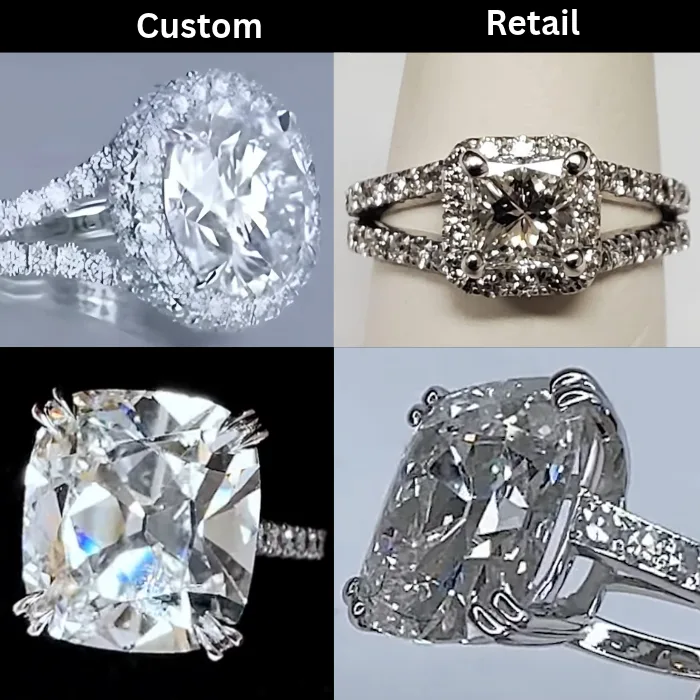
The tradeoffs are baked in, though. Settings are built to fit a range of stones rather than one specific diamond, which is why you’ll sometimes see visible gaps between the stone and the metal around it. Details that take bench time, like the tiny beadwork on a pavé band or the way prongs are shaped and polished, get simplified so the design survives mass production. And the “customization” most chains advertise is really configuration: same catalog of settings, same catalog of stones, assembled to order.
Again, none of that makes retail rings bad. It makes them standardized. Whether that matters depends on the person you’re proposing to.
What changes with a true custom build
When a designer builds a ring from scratch, you start with a conversation: her style, what she’s pinned or hinted at, how she uses her hands all day, what you want to spend. The design comes out of that, and the diamond gets sourced to fit the design and the budget rather than whatever’s in the case that month.
A few differences show up immediately:
The design is actually hers. If she wants a low-profile setting because she’s a nurse or a climber, or a band that echoes her grandmother’s ring, that’s built into the design rather than a compromise you settle for.
You see the ring before it exists. Nearly every legitimate designer now works in CAD, meaning you review a photorealistic 3D rendering of the exact ring, from every angle, and approve it before anything gets made. If the band looks too chunky or the stone sits too high, you say so, and the file changes. Nobody at the mall is re-casting a tray ring because you didn’t love the profile.
One person owns the outcome. This is the difference that surprises buyers most. In a chain store you’re dealing with a salesperson who didn’t design the ring.
Working directly with an independent ring designer means the person sketching your ring is often the same one setting the stones at the end, and you can ask them anything mid-process. Many work with clients remotely now, over video, so you’re not limited to whoever happens to rent space in your zip code.
The stone gets vetted for you. Independent designers typically source diamonds through dealer networks and walk you through the certification, ideally a report from the Gemological Institute of America, rather than steering you toward whatever needs to move this quarter.
The myth that custom is way more expensive
Here’s the part nobody tells you: custom isn’t automatically more expensive. What changes is where the money goes. In a mass-produced ring at a mall jeweler, a meaningful slice of your budget is covering retail overhead and markup. In a custom build, more of it goes into the stone and the labor.
That said, the range is wide. Some independent shops will do simple custom work for a few thousand dollars, while established designers known for detailed work generally don’t touch projects less than the five-figure range. Get the number on the first conversation. A good designer will tell you plainly what’s achievable at your budget and where they’d put the money; a great one will talk you out of spending on things she’ll never notice.
Timeline is the other real cost. A from-scratch ring typically takes four to eight weeks from approved design to finished piece, sometimes longer during engagement season. If you’re planning a proposal, work backward from the date and start earlier than feels necessary.
When off-the-shelf is the right call
Custom isn’t for everyone, and pretending otherwise would be bad advice. Buy from the case if any of these sound like you:
- You need the ring fast. If the proposal is in two weeks, a designer can’t help you. Buy retail, and consider upgrading or resetting the stone for an anniversary down the road. Though most custom jewelers have a plan for that. Many offer a temporary “proposal ring” that gets the job done, then you can design the real ring as a couple.
- She wants a specific branded ring. If she’s been dropping hints about one particular ring from one particular house, get that ring.
- Not sure if she’ll say yes. In this case, a big retailer’s return policy has real value.
The bottom line
The question isn’t which option is objectively better; it’s which failure you can’t live with. If the nightmare scenario is overpaying at a mall for a ring that looks like everyone else’s, custom fixes that for roughly the same money and a few weeks of patience. If the nightmare is complexity and waiting, retail fixes that too.
Just know that the choice exists. Most guys don’t find out the second path was an option until after they’ve already bought the ring, and by then she’s wearing the answer.