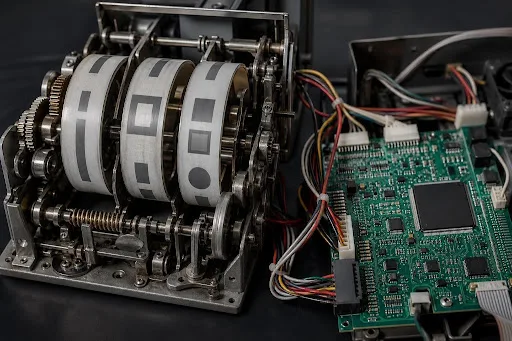
A reel, a spring and a shaft once helped determine what a slot machine displayed. As electronics entered the cabinet, those parts took instructions from circuits and, later, computer programs. The reels could keep turning while the decision about where they stopped moved into software.
That change gives the history of slots its engineering thread: outcome selection, machine control and display gradually became separate jobs. The transition unfolded through designs that mixed mechanical parts with electrical controls.
When the Mechanism Determined the Result
Charles Fey’s late-1890s Liberty Bell brought three reels and an automatic payment mechanism together in one cabinet. SFO Museum describes ten positions on each reel, allowing 1,000 possible position combinations.
Operating a mechanical machine required a coordinated sequence. It had to register a coin, release the mechanism, turn the reels, stop them at defined positions and respond to their final arrangement. Springs, shafts, stops and connecting parts carried out those tasks.
The moving reels helped determine the result and showed it through the cabinet window. Their operation depended on physical adjustments. Bearings needed lubrication, clearances needed checking, and interacting parts had to move in the intended order.
Electrical Signals Connected the Assemblies
By the 1960s, electromechanical machines combined reel mechanisms with switches, relays and motor-driven coin dispensers. Electrical signals passed between assemblies that still contained gears, timer shafts, levers and springs.
A relay, an electrically operated switch, let one part of the machine activate another. Period technical documentation describes reel contacts, relays, dispensing motors and electrical meters as parts of these linked assemblies. Lubrication and adjustment also remained part of routine maintenance.
The manual also lists numerous lubrication points. Electricity had taken on some of the coordination, but keeping the machine running remained a hands-on maintenance job.
A Processor Took Charge of the Reels
The next change introduced instructions stored in memory. In June 1975, James C. Saxton, Bruce H. Osterberg and Joseph C. Kawan filed a patent describing random-code generation, computer memory and electrically operated wheel stops.
Their computer-controlled design, granted a US patent in June 1978, placed a processor between the selection process and the mechanism. Working memory held information during operation. Read-only memory stored instructions and other data, while input and output connections carried signals between the computer and the equipment.
At the beginning of an operating cycle, the computer selected the final symbol arrangement. It then directed the mechanism to display that selection.
Spring-started wheels could remain inside the cabinet, with electrically operated stops receiving positioning signals. The computer made the selection; the wheels carried out its instructions. Engineers now had to ensure that the physical display accurately reproduced the computer’s decision.
Screens and Virtual Reels Changed Different Parts
Television screens offered another way to display an electronically selected result. A contemporary electronics-industry report records screen-based machines reaching the market in mid-1976, using integrated circuits and programmable read-only memory.
Software also changed how physical reel positions were represented. Inge S. Telnaes’s patent, filed in February 1982 and granted in May 1984, assigned numerical entries in memory to stopping positions. Several entries could point to the same physical stop.
In one example set out in Telnaes’s patent, a reel with 22 physical positions is paired with 44 numerical entries in memory.
Changing the numerical mapping changed how often a given physical stop could be selected without changing the reel’s dimensions. Screens replaced rotating display hardware; virtual reels changed the selection data behind the hardware. Both developments increased the importance of checking the connection between software and the displayed result.
Checking the Code and the Moving Parts
A software random number generator supplies a sequence of values using an algorithm. A starting input, called a seed, helps determine that sequence. Selection software then maps the generated values to outcomes.
Nevada’s technical standards cover initialisation, statistical testing and protection from outside interference. They specify a minimum average cycling rate of 100 times per second for software generators. They also address software authentication and records of program transfers and changes.
Physical reels need checks of their own. Position feedback lets software detect a jam or a reel that has stopped in the wrong place, adding an electronic check to a mechanical operation.
Understanding the equipment belongs alongside responsible gambling: participation carries financial risk. Anyone choosing to gamble should set spending and time limits and seek support if it causes harm.
Maintenance had expanded from checking bearings and clearances to verifying code, numerical selection and display accuracy. The cabinet still housed physical equipment, but its operation increasingly depended on instructions that engineers could inspect and test separately.

