For Australians, the backyard pool is the centre of summer at home. It sits beside the barbecue, faces the garden and becomes an informal meeting place when friends visit. But coastal winds, falling leaves and heavy use can make the upkeep less relaxing than the swimming. Smart pool technology is most useful when it takes responsibility for a repetitive physical task without demanding more attention than the job it replaces. Choosing equipment therefore starts with the location and layout of the pool, the debris it receives and the routines of the people who use it, not a fashionable feature label.
The coastal backyard has its own maintenance problems
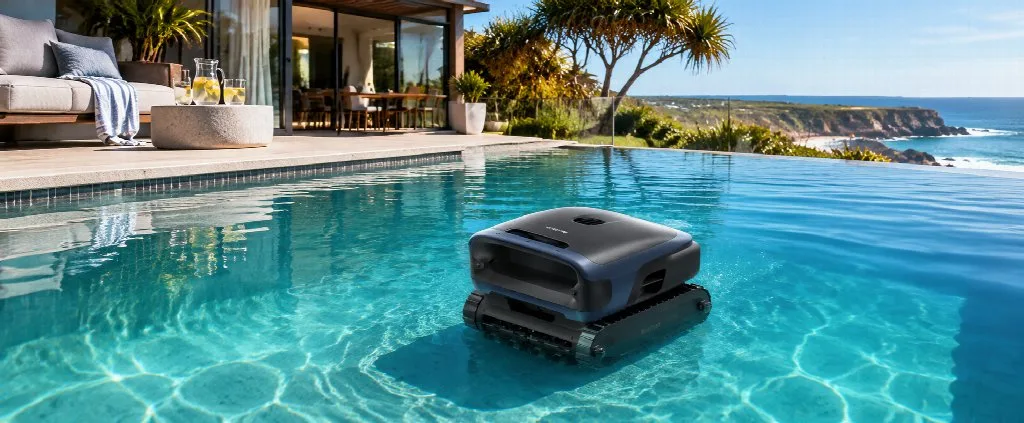
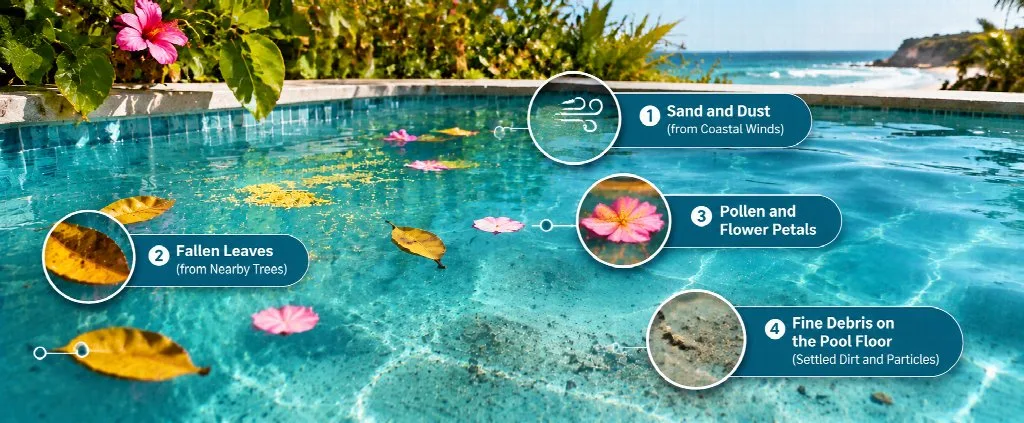
A pool close to the ocean may experience persistent wind, airborne grit and changing weather. A sheltered suburban pool might instead collect leaves from nearby trees or soil from garden beds. Neither situation is fully described by the dimensions of the pool. The direction of the prevailing wind, where the skimmer is positioned and whether the property has a shallow sun shelf can affect where debris accumulates.
Spend one ordinary week observing the pool. Note where leaves settle after the afternoon breeze, whether dust collects near the steps and whether a ring appears at the waterline. These observations are more useful than dropping artificial debris into the water for a demonstration. Keep a short record with the date, weather, pool condition and cleaning task required.
Landscape design matters as well. A lush planted boundary can make the space private but add regular organic debris. Stone and paved surfaces can introduce fine particles. Pruning appropriately, sweeping the deck and using containers for outdoor rubbish reduce the volume reaching the water, although none of these measures substitutes for water treatment.
What smart pool cleaning can actually automate
A robotic pool cleaner generally carries its own drive system and debris filter. It moves across supported surfaces, brushes or agitates dirt and collects it in a removable basket or cartridge. Unlike a suction-side cleaner, a robot normally does not rely on the pool’s skimmer suction to operate. Owners still need to empty filters, follow safe charging procedures and check for areas the machine cannot reach.
The most important distinction is between cleaning zones. Floor cleaning addresses dirt that has settled at the bottom. Wall cleaning concerns vertical surfaces and transitions. Waterline cleaning targets residue near the surface, while active surface collection deals with leaves and insects still floating. Shallow steps and platforms are another category because the machine may not fit or have sufficient water depth to operate.
When comparing cordless robotic pool cleaner Australia options, check the exact coverage stated for the individual model. An attractive general claim about total pool cleaning is less informative than a clear explanation of which zones it supports and where it cannot work.
Choose technology around the pool’s shape
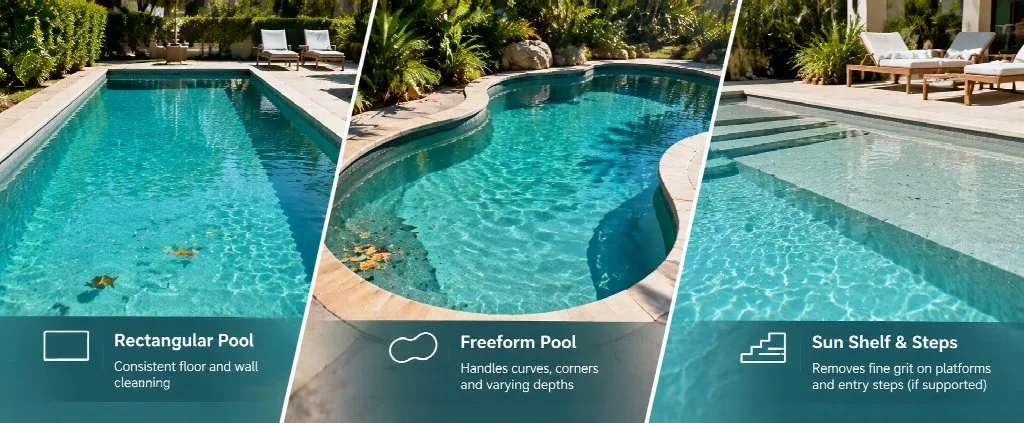
Rectangular pools with a clear floor
In an open rectangular pool, a reasonably consistent route may be enough to collect ordinary debris. Check the cleaner’s supported area, depth and filter specification. A longer battery life is not always valuable if the necessary cycle is short and the owner prioritises simple handling.
Freeform designs with curves and changes in level
Curved walls, sloping floors, narrow corners and unusual transitions challenge navigation. Sensors that detect orientation or obstacles may assist, but their presence does not guarantee every surface is reached. Look for test information from pools with a similar shape rather than relying on an animated path.
Pools with sun shelves and steps
Sun shelves are popular gathering spaces and often collect fine grit. A cleaner may require a minimum water depth and minimum usable platform area. Narrow steps should never be assumed compatible just because a product can clean a broad shallow ledge. Measure the ledge before purchasing.
A practical example from the Australian market
The Beatbot Sora 30 is marketed in Australia as a cordless robot with floor, wall, waterline and compatible shallow-platform cleaning modes. Those are manufacturer-described functions, not independent test results for this article. Before treating the shallow-platform claim as relevant, check the dimensions and depth of the particular pool feature against the published limitations.
For many homeowners, the value of a model such as this depends on whether its supported underwater cleaning zones correspond with the work they repeatedly perform. A pool surrounded by trees might also require regular surface skimming if the device does not collect floating leaves. A manual net and a robot can be complementary tools rather than competing purchases.
Where possible, request a demonstration of basket removal, the weight and drainage of the unit after a cycle, and its storage requirements. The everyday process of retrieving and cleaning a machine matters more than the appearance of the device in a product photograph.
A seasonal routine that leaves more time for swimming
Summer use creates a higher workload because people bring sunscreen, body oils and dirt into the water, while heat and sunlight affect the management of disinfectant. Follow local public-health guidance and the pool system’s instructions for testing frequency and appropriate treatment. Water that looks clear is not necessarily safe.
Before a busy weekend, remove major debris, check baskets and test water according to the applicable advice. Schedule a suitable cleaning cycle when nobody is swimming. Keep charging equipment and chemicals secure and away from children. Avoid running powered cleaners alongside swimmers unless the manufacturer’s safety guidance explicitly permits it.
After strong wind or storms, assess the pool before operating any equipment. Remove branches and sharp objects manually when conditions are safe. Empty blocked baskets and check water clarity. Rainfall can affect the water balance, so testing matters even when the visible debris has been removed.
In cooler months, an unused pool still requires attention. Falling leaves, equipment faults and water chemistry do not stop because people are not swimming. Review the maintenance plan rather than assuming that a robotic cleaner and timer will manage everything without inspection.
Seven details to check before buying
- Supported pool surface, shape, length and depth, including any exclusions.
- Cleaning modes for floor, wall, waterline, shallow platforms and the surface.
- Minimum dimensions and depth for ledges or wide steps.
- Basket size and included filter media for leaves and fine particles.
- Battery runtime by mode, charging arrangement and safe storage needs.
- End-of-cycle retrieval method and the effort required to empty the basket.
- Warranty, replacement filters and service support available in Australia.
Use the list as a practical comparison rather than a scorecard where every extra feature is automatically better. A simple pool with light debris may not need active surface collection. A large, tree-lined pool may benefit from it. The choice depends on what work can be reliably removed from the owner’s routine.
A better way to test a cleaner at home
Photograph three ordinary problem areas before running a cycle: the deepest corner, a waterline section and a step or ledge. Note the selected mode and whether the filter was clean. After the cycle, compare the same areas, inspect the basket and record what still needs manual attention.
Repeat on another typical day. A single run can be affected by wind, the starting position and the condition of the filter. The aim is not to claim a scientific percentage of cleaning coverage but to learn whether the machine addresses the specific areas that cause repeated work.
If the same location remains dirty, read the operating instructions before assuming a defect. The mode may exclude that area, or the water may be too shallow for the device. Where a problem continues, contact the manufacturer or service provider rather than attempting unsafe equipment modifications.
Keep the pool attractive without confusing appearance with safety
Physical cleaning is only one layer of pool care. The filtration system, circulation and disinfection process must be maintained. A robotic cleaner cannot correct inadequate chlorine levels, chemical imbalance or the underlying causes of green water.
Pool barriers and active child supervision remain essential in Australian homes. Keep furniture and equipment away from areas where they could become climbing aids near a safety fence. Decorative outdoor spaces still need accessible gates, clear paths and appropriate electrical installations.
Frequently Asked Questions
Are cordless pool cleaners suitable for coastal homes?
Some can be suitable, but check the individual model’s permitted operating conditions, pool surface compatibility and storage requirements. Coastal location alone does not determine compatibility; debris, pool shape and equipment care matter.
Can a robot clean leaves floating on a pool?
Only models with a suitable active water-surface function can do that. Ordinary floor and wall cleaning does not automatically capture floating leaves, so manual skimming may still be required.
Do robotic cleaners work on shallow sun shelves?
Some do, subject to minimum water depth and usable platform dimensions. Check the manufacturer’s stated limits rather than assuming that all steps are compatible.
Does cordless operation mean the machine never needs attention?
No. Filters must be emptied and rinsed, the battery needs appropriate charging and storage, and surfaces outside the supported zones may require manual care.
Can a pool robot make cloudy water safe?
No. Cloudiness requires appropriate water-quality testing, circulation and treatment. A robot can remove some physical debris but cannot disinfect unsafe pool water.
Make the technology fit the lifestyle
Smart outdoor equipment earns its place when it removes a familiar chore without creating a complicated new one. Assess the pool’s geometry and debris, choose cleaning modes that address actual problems and keep the essential water-quality and safety routines in place. The best result is not a perfectly automated backyard; it is a pool that is easier to care for and more enjoyable to use.

