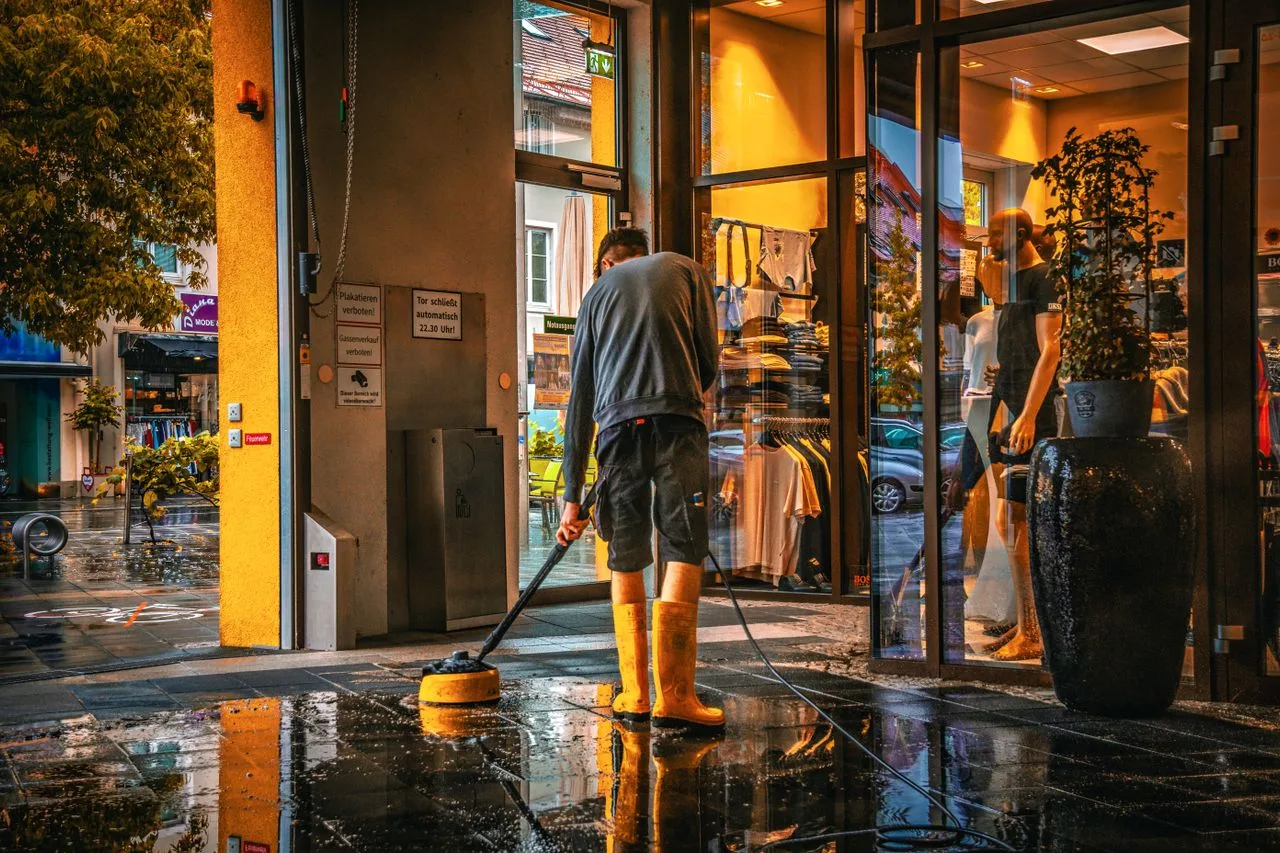
Hard floors in commercial facilities endure a lot of abuse. Foot traffic, spills, tyre marks from forklifts, and vehicle traffic wear out the flooring in a building. Maintenance crews struggle with using a mop and bucket when the area is over 3,000 square feet. In spaces such as hospital corridors or large warehouses these manual systems cannot cope.
The Association for Cleaning and Facility Solutions calculated that manual cleaning takes about 11.2 minutes for every 1000 square feet. This is why most large facilities end up hiring or purchasing powered equipment rather than scaling up manual labour. In this updated July 2026 guide, we discuss how four different equipment suppliers compare on hard floor equipment and support.
Imperial Dade
Product categories: A one-stop shop across manufacturers, Imperial Dade sells sweeping machines, burnishers, extractors and autoscrubbers. Instead of creating their own private label fleet they provide options across all equipment categories, from light-duty walk-behind floor machines to wide-sweep ride-ons.
Features: A varied range depending on manufacturer, providing water tanks, brushes and different widths. Imperial Dade provides expert advice in pairing an individual facility’s needs with a specific type of machine.
Pricing: Pricing isn’t readily available through a printed price list but is available through account representatives and volume orders. This suits large multi-site accounts but makes it harder for a single-location buyer.
Use Cases: Best suited for hospitality, healthcare and foodservice industries where it already provides chemicals and packaging in addition to its line of equipment.
Pros:
- Vast network of operations across North America with more than 130 distribution centers.
- Rapid procurement of parts, equipment and consumables.
Cons:
- Primarily built around chemicals and packaging.
- Less specialized floor care support.
Maintenance and servicing: Has technicians from manufacturers providing maintenance and equipment support, but does not maintain its own in-house servicing department.
Alternatives: Organizations looking for both a single point of contact and technicians can use local or regional equipment dealers.
Nassco
Product categories: Nassco floor equipment lineup includes auto scrubbers, stand-on and walk-behind units, buffers, sweepers and carpet extractors in new, used and remanufactured states. The lines accommodate both battery and corded setups, featuring cleaning paths as narrow as 13 inches or as wide as 28 inches.
Pricing: Nassco’s contract pricing for new equipment ranges from $2,646 for a battery-powered walk-behind micro scrubber to $17,318 for a wide rider scrubber. Nassco’s floor equipment lineup also lists long-term rentals for facilities that don’t want to buy outright.
Use Cases: Nassco serves retail, schools, office spaces and warehouse facilities throughout Wisconsin, Illinois, Iowa and Minnesota. They provide regular updates on new equipment and machines on their LinkedIn page.
Pros:
- Nassco has factory trained technicians.
- Quick parts turnaround with over 350,000 square feet of warehouse space.
Cons:
- Service outside Midwestern areas are limited.
- Rental availability is limited when compared to national companies.
Maintenance and servicing: The company dispatches an in-house service crew rather than using a manufacturer-authorized repair station, and rents its equipment on a short or seasonal basis.
Alternatives: The company may not be ideal for customers located outside the Midwest or those looking for a single point of national distribution.
4M Building Solutions
Product categories: Instead of selling scrubbers or sweepers, 4M Building Solutions’ teams install and operate equipment through contracted cleaning jobs, making them an outsourced labor solution rather than an equipment supplier.
Features: The equipment specifications are up to what 4M Building Solutions’ determines are applicable for the job at hand and is not determined by facility managers. A critical distinction from purchasing or renting a machine.
Pricing: Instead of per-machine pricing, 4M Building Solutions contracts the entire jobs, usually with per-square foot or per-visit labor rates, instead of a capital purchase.
Pros:
- Big cleaning scale with over 6,900 employees covering over 215 million square feet daily.
Cons:
- Facility managers cannot select specific machines or brands.
- If managers switch service providers they have to train new staff.
Alternatives: Facilities that want ownership of equipment would turn to distributors of those machines such as Nassco or Imperial Dade.
Guest Supply
Product categories: Guest Supply is first and foremost an amenities and hospitality supplies distributor. Hard floor equipment is a niche subset of what is mainly linens, toiletries, and guest room sundries.
Features: The floor care products tend to be small-scale machines suitable for hotel guest floors and back of house areas, not for large-scale industrial ride-ons.
Pricing: Its price is part of broader hospitality supply agreements; a hotel with an amenity order placed through Guest Supply can also simply add equipment to the same purchase order.
Pros:
- Guest Supply is responsible for serving over 25,000 customers in over 100 countries.
- Extensive experience serving top hotel-chains.
Cons:
- Is not a specialized equipment supplier for commercial buildings.
- Does not have specialized knowledge regarding floor cleaning.
Maintenance and servicing: There is often no floor care support from Guest Supply, instead servicing is referred to the manufacturer.
Alternatives: Larger floor spaces in the hospitality industry often supplement Guest Supply by finding separate specialists that focus on floor cleaning only such as Nassco and Imperial Dade.
Comparing Floor Cleaning Companies
| Supplier | Pricing Model | Key Strength | Limitation |
| Imperial Dade | Quote-based, volume pricing | 130 plus distribution centers | Equipment is secondary to packaging/chemicals |
| Nassco | Published contract pricing, $2,600 to $17,300 range | In-house factory trained service staff | Limited reach outside WI/IL/IA/MN |
| 4M Building Solutions | Per-square foot service contract | Over 6,900 cleaning staff and extensive experience | No equipment ownership or choice |
| Guest Supply | Bundled with hospitality orders | Experience in multiple countries | Not an equipment specialist |
Frequently Asked Questions
How often must commercial hard floors be machine cleaned?
Most facilities run their automatic scrubbers every day at entrances and cafeterias, while office settings at lower traffic locations should be cleaned two to three days per week depending on soil level and foot traffic.
Is it more cost effective to buy or rent a floor scrubber?
If facilities run a machine at least a couple of days per week, buying a unit often makes more sense, while rent may be better suited for seasonal increases, large jobs, or small locations under 10,000 square feet.
What size automatic scrubber should a warehouse purchase?
Warehouses with large, concrete areas are often best served by 26 inch to 34 inch ride-on machines due to speed over large surfaces whereas office and retail store applications often require 17 inch to 20 inch walk-behind units.
Conclusion
The problem: Manual machine cleaning of large commercial hard floors is highly inefficient, forcing large facilities to seek powered equipment or outsourced labor solutions.
Key takeaways: Floorcare solutions vary by need. Imperial Dade offers great distribution, Nassco provides Midwest servicing, 4M handles outsourced labor and Guest Supply bundles hospitality equipment.
Next Steps: Calculate your exact square footage, decide whether buying or renting equipment makes financial sense for your cleaning frequency, and request a quote from suitable providers.

