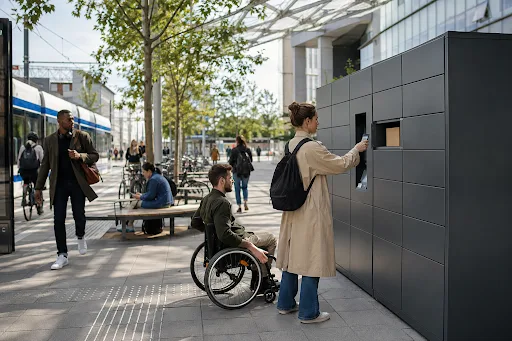
The parcel locker used to be an alternative for people who expected to miss a courier. It is now becoming a recognisable part of streets, railway stations, petrol forecourts and supermarket car parks. The change reflects a larger problem. Online shopping has made home delivery routine, but cities cannot indefinitely accommodate a separate van stop for every small order.
Networks operated by DHL, InPost and Amazon offer a practical answer. A driver can leave dozens of parcels at one secure point, while customers collect them at a convenient hour. Lockers also support returns. Their growing role raises questions about accessibility, pavement space and control of this increasingly important infrastructure.
One Stop Can Replace a Street of Doorbells
Home delivery becomes inefficient when recipients are absent or vans must search for legal parking. Instead of stopping outside many homes, a courier can unload a group of parcels at a single location.
DHL introduced its Packstation service in Germany in 2001, well before smartphone shopping became an everyday habit. The company says consolidated delivery through lockers can reduce last-mile carbon emissions by 30 per cent compared with conventional home delivery. The exact saving varies with local density, vehicle type and the distance travelled by customers, but fewer courier stops can reduce both mileage and repeated delivery attempts.
The strongest locations sit on journeys people already make:
- railway and underground stations used by commuters;
- supermarkets and retail parks with long opening hours;
- petrol stations serving drivers outside normal shop hours;
- residential developments where secure delivery space is limited.
This convenience helps explain the format’s rapid expansion across Europe. InPost developed its automated parcel-machine network in Poland before expanding into the UK, France, Italy and other markets. Amazon Hub lockers brought the idea to convenience stores and shopping centres, while postal groups continued building their own systems.
A Small Code Can Control a Valuable Transaction
The handover depends on more than a metal door and a keypad. Each parcel must be associated with the correct compartment, customer and collection window. The recipient normally receives a QR code, barcode or numerical PIN; after successful validation, the system releases only the assigned door and records the collection event.
A comparable control operates when a promotional code is submitted at a Mafia Casino: the cashier or bonus engine checks the campaign, eligible country, account status and expiry before adding bonus funds to the player’s balance. It may also confirm that the code has not already been redeemed and that any qualifying deposit meets the stated minimum stake conditions. Once accepted, the system records the claim against that account, preventing the same casino bonus token being credited twice.
The comparison shows why collection points need reliable software as much as strong locks. If a code expires or reaches the wrong account, the system must reject it without opening another customer’s compartment. Logs record when a door opened and whether it closed correctly.
Returns Are Changing the Calculation
Returns can be more expensive and inconvenient than outward delivery. Clothing may not fit, an item may arrive damaged, or a buyer may exercise a cancellation right. A locker capable of accepting a return therefore turns the network into two-way infrastructure.
The usual process requires only a few steps:
- the customer registers the return and receives a code;
- the parcel is placed in an available compartment;
- the locker records the deposit and issues confirmation;
- a courier collects several returns during one scheduled stop.
This consolidated model avoids a separate doorstep collection for every parcel. According to DHL’s overview of smart parcel lockers, deliveries made through lockers can reduce last-mile carbon emissions by 30 per cent while also supporting product returns.
The function changes where lockers provide the greatest value. A unit beside a supermarket, railway station or residential development can handle collections and returns throughout the day, making it a practical logistics point rather than a simple alternative to doorstep delivery.
Proprietary Networks Create a New Urban Question
Many current lockers belong to a single delivery company or retailer. That model gives the owner control over software, maintenance and customer service, but it can also produce clusters of competing machines. One carrier may have spare compartments while another installation nearby is full.
Carrier-neutral lockers offer another approach. Several delivery firms share the equipment, making better use of each site. The difficult part is governance: operators need common technical standards, responsibility for damaged parcels and an agreed way to divide access and costs.
Local authorities may also need rules covering advertising, noise, lighting and obstruction. A compact machine beside a supermarket is different from a long bank of lockers placed on a narrow residential pavement. Planning decisions will determine whether these networks remain convenient additions or become street clutter.
The Locker Is Becoming a Neighbourhood Utility
Parcel machines will not eliminate home delivery. Large appliances, medicines requiring controlled conditions and purchases needed by people with limited mobility still call for other arrangements. Rural areas also present a different calculation because a collection point may be several miles away.
Even so, the locker has moved beyond its original role as a backup for missed deliveries. It provides secure collection, supports label-free returns and concentrates courier activity at predictable points. As online retail becomes embedded in daily life, cities will need to decide where these machines belong, how accessible they must be and whether rival carriers should share them. Those are infrastructure questions, and the unassuming row of metal doors has become part of that debate.