


5 minute read
In this digital and print-driven world of today, images are everywhere, competing against each other to win the attention of a moment.
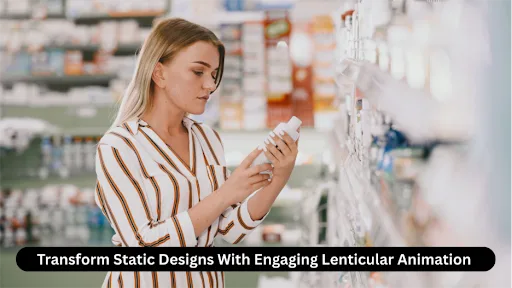
That is why we cannot always rely on flat, fixed-in-place designs to become unique. Here, the game is transformed by the lenticular animation.
It converts regular pictures into dynamic images that flip, shift, zoom, or even create the illusion of depth as the viewer moves, using a precision-engineered lens array. The outcome is not only a picture, but an experience that one can interact with, attracting people, causing curiosity, and having a tangible impact. It can be used for packaging, a display that requires a second look, or a business card that is remembered.
In short, lenticular animation makes your designs stand out in the market, a feature that simple graphics cannot match.
Wonder how to implement this magic into your projects?
Continue reading to learn how you can turn stationary designs into strong, interactive lenticular animations.
1. Make Simple Flips a Bold Storytelling
One of the most intriguing effects of lenticular animation is the flip effect, which can be incredibly basic and yet can entirely change a design.
In this context, interlacing two or more images behind the lenticular lens allows you to create a dynamic shift. It is created when the viewer alters their angle. Imagine it as a mini slideshow that becomes a print-based presentation.
That said, it is ideally suited to before-and-after comparisons, displaying product differences, or presenting two brand messages in a single small area.
Overall, in the lenticular animation, a simple flip is more than just a gimmick; it is a story in motion that is fascinating and engaging.
2. Add Depth with 3D Layering
Static graphics can struggle to project dimension, but lenticular animation can address this by utilizing 3D layer effects. It gives the appearance of three-dimensionality by grouping artistic pieces in the foreground, midground, and background. As a result, it creates a depth that makes the viewer curious about the piece.
The trick is that lenticular lenses help the eye to see the space between layers, just as everyone naturally sees the world. This method is particularly useful in posters, displays, and product packaging. That is because the dimensionality brings the design out of a flat surface to a three-dimensional, engaging form.
In other words, through appropriate planning, the 3D layering can emphasize the important aspects and give a sense of visual drama to your design. Thus, it makes your design not only interesting but also memorable.
3. Design Movement that Demands Attention
The human eye is a natural magnet to motion, and this instinct is taken advantage of in lenticular animation. You can make an image look animated without screens or digital display by sequencing frames of an object moving, rotating, or shifting. It is especially useful in marketing campaigns where it is necessary to capture attention in a short time.
That means a moving product is alive, which provokes interest and makes people interact more. So, whether it’s a shoe spinning 360 or a logo sliding into its place, motion designs shatter the barrier of the static.
The result? It makes sure your message does not go unnoticed, but rather stays in the customer’s mind.
4. Pop Your Products with Zoom Effects
Lenticular animation features a clever zoom effect that effectively captures attention.
With this, you can create the illusion that the product or message is approaching the viewer as they tilt the design. It attracts attention to the most important thing, which is your call-to-action or hero product.
Unlike motion effects, zooming does not need several frames, but it provides a dramatic visual impact. It is effective enough to be used as packaging or signage that requires an immediate outcome. This way, it transforms a stagnant marketing into an active focus, making essential details stand out for any viewer.
5. Morph One Image into Another
Morphing provides a smooth, enthralling transition between two or more designs. Rather than an abrupt switch, one image is slowly transformed into the other, producing an act of narrative development or change.
On that note, morphing is especially effective in campaigns that focus on growth, change, or innovation —such as product upgrades, seasonal promotions, or brand renewals. This constant transition is interesting as the audience automatically watches the movement till the transition is over.
In contrast to digital animations, morphing in a lenticular form is something that one can feel and experience, which makes the effect linger longer in memory. It is a rather subtle but effective method of adding creative variety to static images.
6. Reduce Ghosting with Contrast and Vibrant Colors
Ghosting is one of the largest problems in lenticular printing, where two images overlap and hinder the desired effect. The solution lies in the design decisions, specifically the use of contrast and saturated colors.
For example, dark colors and distinct lines between objects help keep effects sharp, as pale or low-contrast designs tend to blend.
Moreover, color can be strategically used not only to enhance readability but also to intensify visual appeal. It ensures that flips, zooms, and motion effects are not blurred and are easy to decipher. To designers, this mastery of contrast is not merely a style issue, but a matter of lenticular animation clarity and impact.
Conclusion
Lenticular animation is more than a design trick—it’s a bridge between static art and interactive storytelling. By flipping, zooming, morphing, or adding depth, it transforms ordinary visuals into unforgettable experiences that spark curiosity and hold attention.
Speaking of which, in a world where designs compete for every glance, this technique ensures your message stands out.
Consequently, embrace lenticular animation, and let your projects move, shift, and shine beyond the limits of flat graphics.