
Living with addiction often is an uphill battle, one that you may have to carry your entire life. If you’re lucky enough to have a strong support system, the journey to recovery and everything that follows will be a little easier.
Things aren’t easy for those who are part of an addict’s support system (family, friends, partners, etc.) either. Beside seeing a loved one going through the ups and downs of recovery, they also have to try and make sense of treatment options, especially when home-based support is no longer enough.
Inpatient rehab can be scary if you’re not familiar with the process, but it helps a lot of people. This is why, in today’s piece, we’ll focus on the different types of addiction treatment and what happens during residential treatment.
Different Types of Addiction Treatment
In addiction medicine, there are four levels of care designed around a patient’s needs, current situation, support structure, strengths, resources, and more. These levels range from recovery and treatment at home (for stable individuals with a strong support system) to outpatient and inpatient treatment.
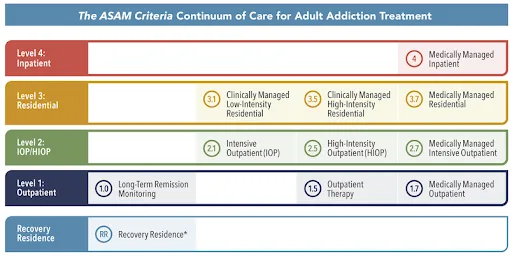
Source: https://www.asam.org/asam-criteria/about-the-asam-criteria
For the first two levels, patients can live at home if the environment is safe and they are doing well overall. But even so, they still need to be aware that addiction impacts every aspect of their life and should be in either a 12-step program (AA/NA) or recovery coaching.
Patients with mild-to-moderate addiction can still be in their own home environment, but have to go to a clinic or treatment center for scheduled therapy, group sessions, and medication-assisted treatment.
Residential Care in Addiction Treatment
If someone is struggling with a severe substance use disorder and is considered at high risk of relapse, they may need a higher level of support than can be provided through structured addiction treatment at home. In such cases, a qualified clinician may recommend residential care.
During treatment, the patient resides inside a clinical facility 24/7 for a period (typically 30 to 90 days). The purpose is to remove them from their daily environment and stressors, and cut off access to substances completely.
Days are fully structured with individual therapy, group counseling, psychoeducation, and medical management, which does feel like you’re handing over control of your daily routine, physical space, and coping mechanisms. Paired with the fear of being “locked away” (patients are free to leave, though strongly advised against), this can make inpatient care feel scary, but the benefits are tremendous.
Choosing the Best Path
Everyone’s path to recovery is different, but it always starts with acknowledging you need help and wanting to get better. To choose a path that’s suited for your needs, you’ll need a formal clinical evaluation from a licensed addiction specialist or physician.
Clinicians evaluate six core areas, known as the ASAM Criteria Dimensions, to identify the appropriate level of care for your specific case and make a recommendation. The patient decides whether to follow that recommendation.
But even if your doctor recommends residential addiction treatment, you shouldn’t be scared. It just means you need to break free from your current habits, and this is the most efficient way to do it.

