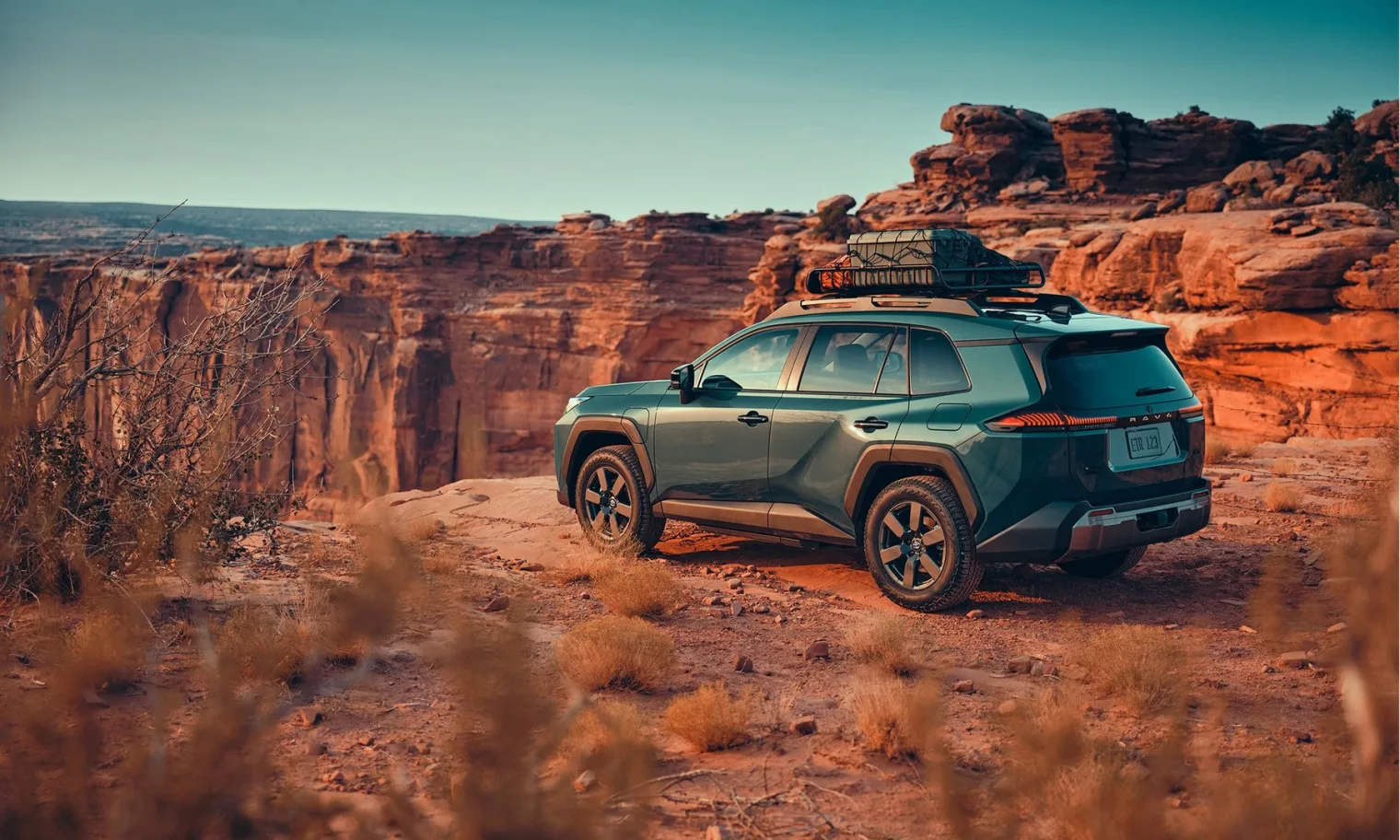
When Toyota brought back the Woodland badge on the redesigned RAV4 last year, I liked the look and questioned the substance. All-terrain tires, roof rails, and Rigid fog lights dressed up a crossover that sat barely higher than the regular RAV4. It read like a costume. For 2027, Toyota put hardware behind the badge, as the company’s November 5 release details. The Woodland gets new springs, shocks, and jounce bumpers that lift ground clearance to 9.1 inches, plus a real Multi-Terrain Select system with Rock and Dirt, Mud and Sand, and Snow modes. The hybrid starts at $40,655 and the plug-in at $46,055, before destination.
This is the RAV4 for the driver who leaves pavement for a trailhead, a campsite, or a cabin down a rutted dirt road, and wants a hybrid that still returns close to 40 mpg. It is not a rock crawler, and Toyota is not pretending otherwise. What changed is that the trim now has the hardware to back up the way it looks.
What Changed Underneath
The headline number is 9.1 inches of ground clearance. Every other RAV4 sits at 8.1 inches, and the sporty GR SPORT drops to 7.5, so the Woodland now stands a full inch taller than the rest of the lineup and 0.6 inches taller than last year’s Woodland. Toyota got there with new springs, shocks, and jounce bumpers, a proper suspension rework rather than a spacer lift. Toyota says the changes should also help ride quality on rough surfaces, which matters more than the clearance number. A taller SUV that crashes over washboard roads is no fun at any height.
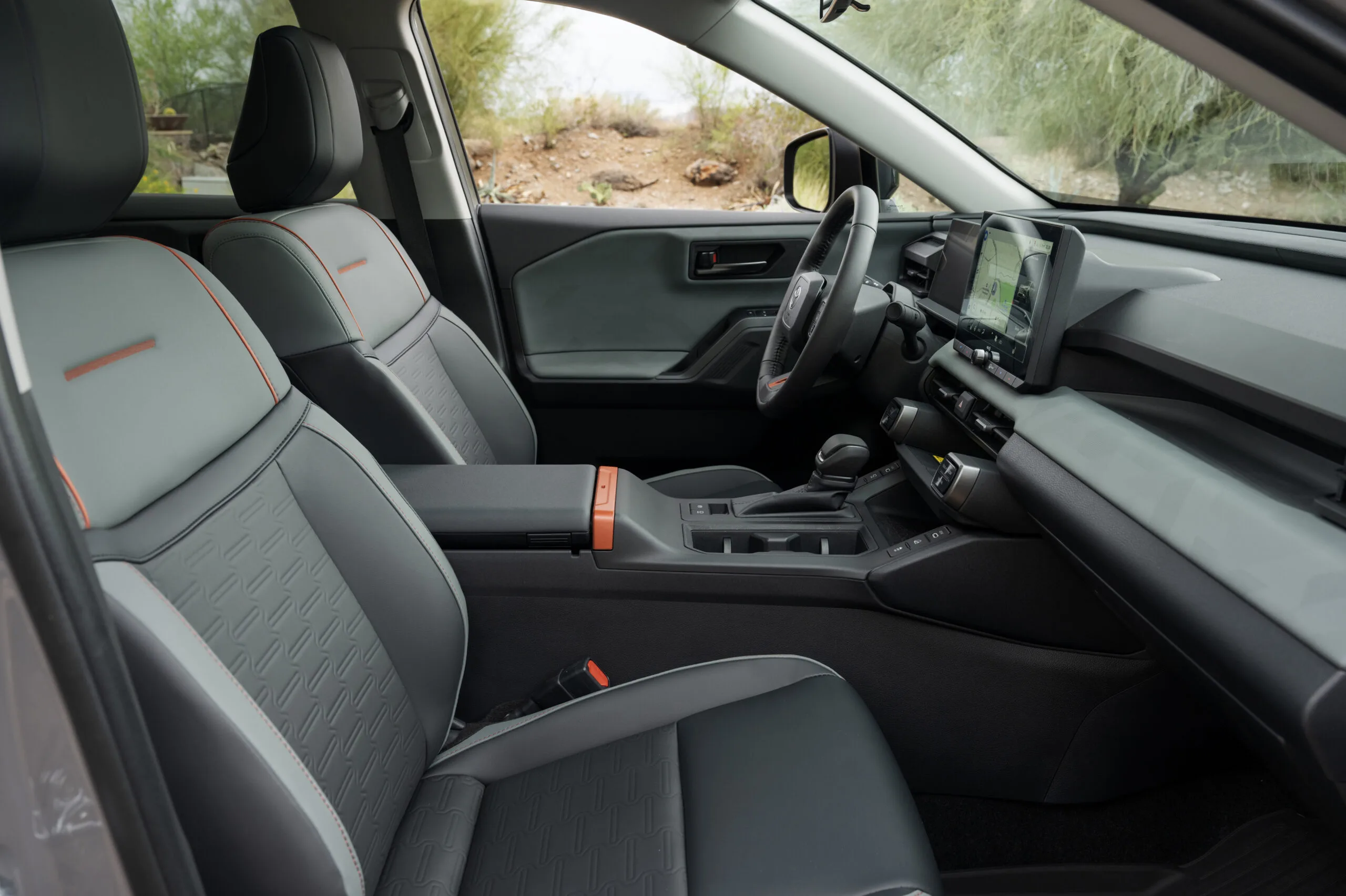
The rest of the Woodland kit carries over, and it reads like a real trailhead checklist now that the suspension matches. Standard all-terrain tires on 18-inch matte metallic gray wheels, raised roof rails with cross bars, a tow hitch receiver, and Rigid Industries LED fog lights. Inside, the Woodland gets its own gray SofTex seats with orange stitching, Woodland-branded all-weather floor and cargo mats, and a 120-volt, 1500-watt outlet in the cargo area. That outlet tells you who Toyota had in mind. It powers a campsite, not a parking lot photo shoot.
Multi-Terrain Select Takes Over
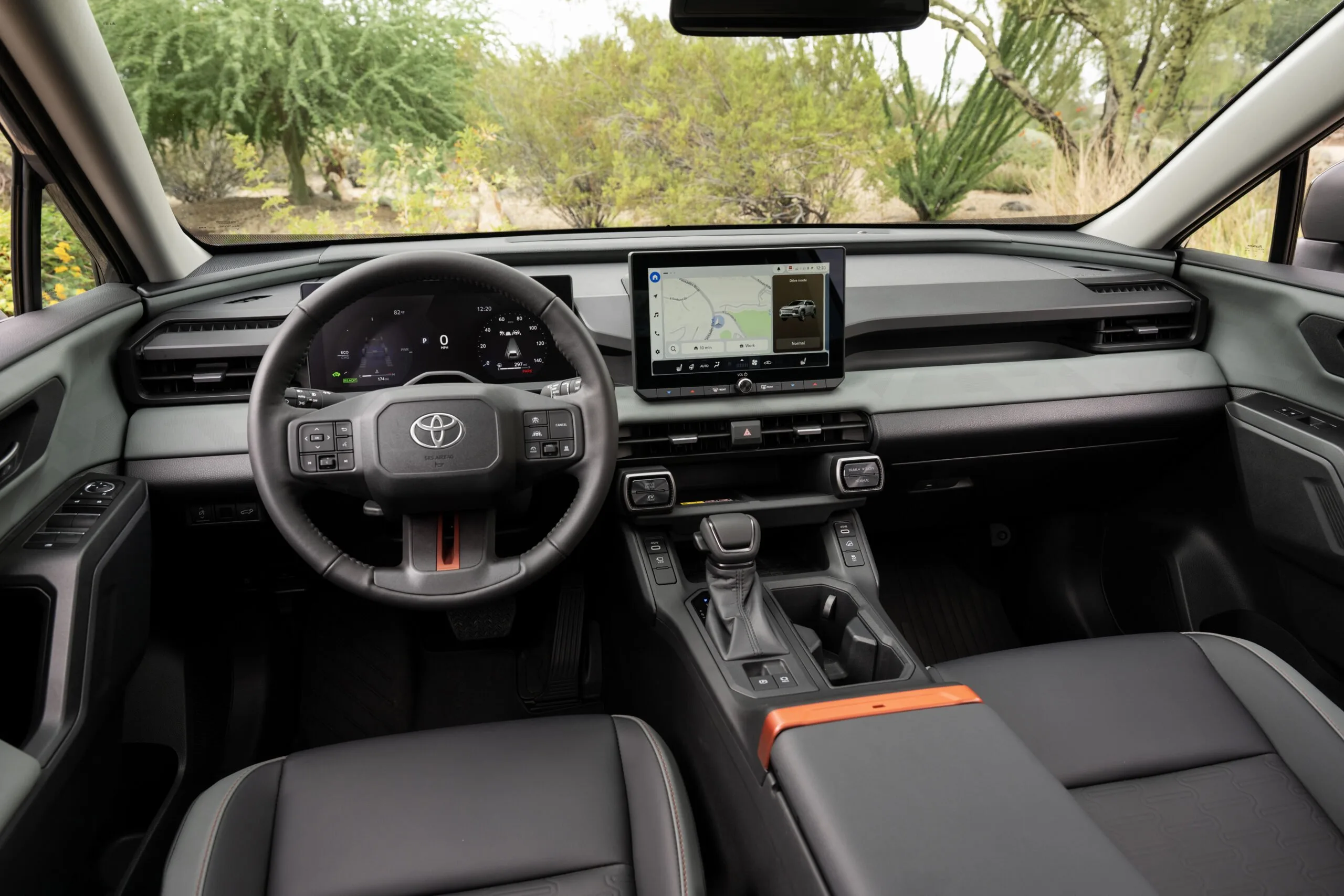
The suspension is only half the story. Toyota retired the old Trail mode across the all-wheel-drive RAV4 lineup and replaced it with Multi-Terrain Select, the same system thinking I got to know during my week in the 2025 Toyota Land Cruiser. The Woodland now offers Rock and Dirt and Mud and Sand modes, plus a dedicated Snow mode on the drive mode selector alongside Normal, Eco, Sport, and Custom. The system adjusts throttle response, brake pressure, and traction control to match the surface, which is the help a driver wants when the road turns to loose gravel or wet clay.
I came away from that Land Cruiser week impressed by how much of the off-road work the electronics quietly handled. The RAV4 Woodland is a different animal, a unibody crossover with no low range and no locking differentials, so nobody should confuse the two. But the shared thinking is real, and it beats a single Trail button that did a little of everything and not much of anything.
Hybrid or Plug-In: Pick Your Woodland
Every Woodland comes with standard all-wheel drive and a choice of two powertrains. The hybrid pairs a 2.5-liter four-cylinder with Toyota’s fifth-generation hybrid system for 229 horsepower and an EPA-estimated 40 mpg city, 35 highway, and 38 combined. The plug-in uses a sixth-generation plug-in system for 321 horsepower and 46 miles of electric-only range, and the same 38 mpg combined once the battery is spent.
The plug-in carries Toyota’s other big 2027 move. Every RAV4 plug-in now has a NACS charging port with DC fast-charging capability, and the onboard AC charger is now a standard 11 kW across all plug-in grades. The charge port moved to the driver’s side, too. With home charging and a short commute, the plug-in runs most of the week on electricity and still takes the long road trip without planning around chargers.
The tradeoffs are honest, and the numbers make them easy to see. The Woodland plug-in gives up 6 miles of electric range next to the plug-in SE, which manages 52, because the lift and the all-terrain tires cost efficiency. The Woodland hybrid returns 38 mpg combined against 43 for the base front-wheel-drive LE, so the rugged kit costs about 5 mpg. On price, the Woodland hybrid runs $8,355 more than the base LE, while the Woodland plug-in runs $3,955 more than the plug-in SE. You pay for the suspension, the tires, the rails, and the drive modes, not for a badge.
What the Woodland Still Isn’t
Here is the part worth saying plainly. The Woodland is a trailhead SUV, not a trail rig. There is no low-range transfer case, no locking differential, and no disconnecting sway bar. If your weekends involve rock gardens, buy the Land Cruiser. I spent a week hauling bar supplies in one and came away convinced it is the real thing. If your weekends involve a rutted Forest Service road or a creek crossing, the Woodland now has the clearance and the electronics to handle it.
The direct rival to keep in mind is the Subaru Forester Wilderness Hybrid, which clears 9.3 inches, two-tenths more than the Woodland. That gap is small enough to disappear the first time you load either SUV with gear. The real decision is the rest of the package: Toyota’s hybrid efficiency, the plug-in option Subaru does not offer, and a dealer network that reaches towns Subaru has never touched. On those points, the Woodland makes a strong case for itself.
Pricing and When It Arrives
The 2027 RAV4 Woodland hybrid starts at $40,655, and the Woodland plug-in starts at $46,055, both before the $1,595 destination fee. Add destination and the real numbers are $42,250 and $47,650. That is $755 more than last year’s Woodland hybrid, which is a fair price for a suspension rework and a better drive-mode system. The rest of the RAV4 lineup starts at $32,300 for the hybrid LE and $42,100 for the plug-in SE, before destination.
Toyota expects the hybrid models to reach dealers later this year, with the plug-ins following in early 2027. Smaller 2027 updates are still useful: a backup camera washer on every grade, a driver’s-side charge port for plug-ins, and a Remote Connect trial that grows from one year to five. The Grand Highlander remains the pick if you need three rows, but for two-row buyers who want the most capable RAV4 Toyota has built, the Woodland is now the obvious answer.
Toyota spent the 2027 budget where a photograph cannot fake it: under the car, and at the charge port. The Woodland spent a year as a styling package. It comes back as a trim with a reason to exist, and at $40,655 for the hybrid, it is priced like one. I have not driven it yet, and I will say so again when I do. On paper, though, this is the first Woodland that earns its name, and it arrives when the RAV4 needed exactly that. Ford showed what a wild one-off can look like with the 1,200-horsepower Bronco Frostwarden at SEMA. Toyota answered with something you can actually buy, and that is the more interesting car.
Questions People Ask About the 2027 RAV4 Woodland
Is the 2027 RAV4 Woodland worth the extra money over the base RAV4?
It depends on where you drive. The $8,355 gap over the base LE buys a taller suspension, all-terrain tires, roof rails, a tow hitch, and Multi-Terrain Select. If your regular routes include dirt roads, snow, or rough trailheads, that kit earns its keep. If your RAV4 never leaves pavement, keep the base model and the 43 mpg.
Should I get the hybrid or the plug-in Woodland?
Buy the plug-in if you have home charging and a commute under 46 miles, since most daily driving then runs on electricity and the 321 horsepower is a bonus. Buy the hybrid if you road-trip often, lack home charging, or want the lower $40,655 starting price. Both have standard all-wheel drive and the same suspension.
Is the Woodland a real off-roader?
It is a capable soft-roader, not a rock crawler. The 9.1 inches of clearance and the Rock and Dirt, Mud and Sand, and Snow modes handle rutted dirt roads, mud, and snow with confidence. It has no low range and no locking differentials, so serious rock work still belongs to the Land Cruiser or 4Runner.