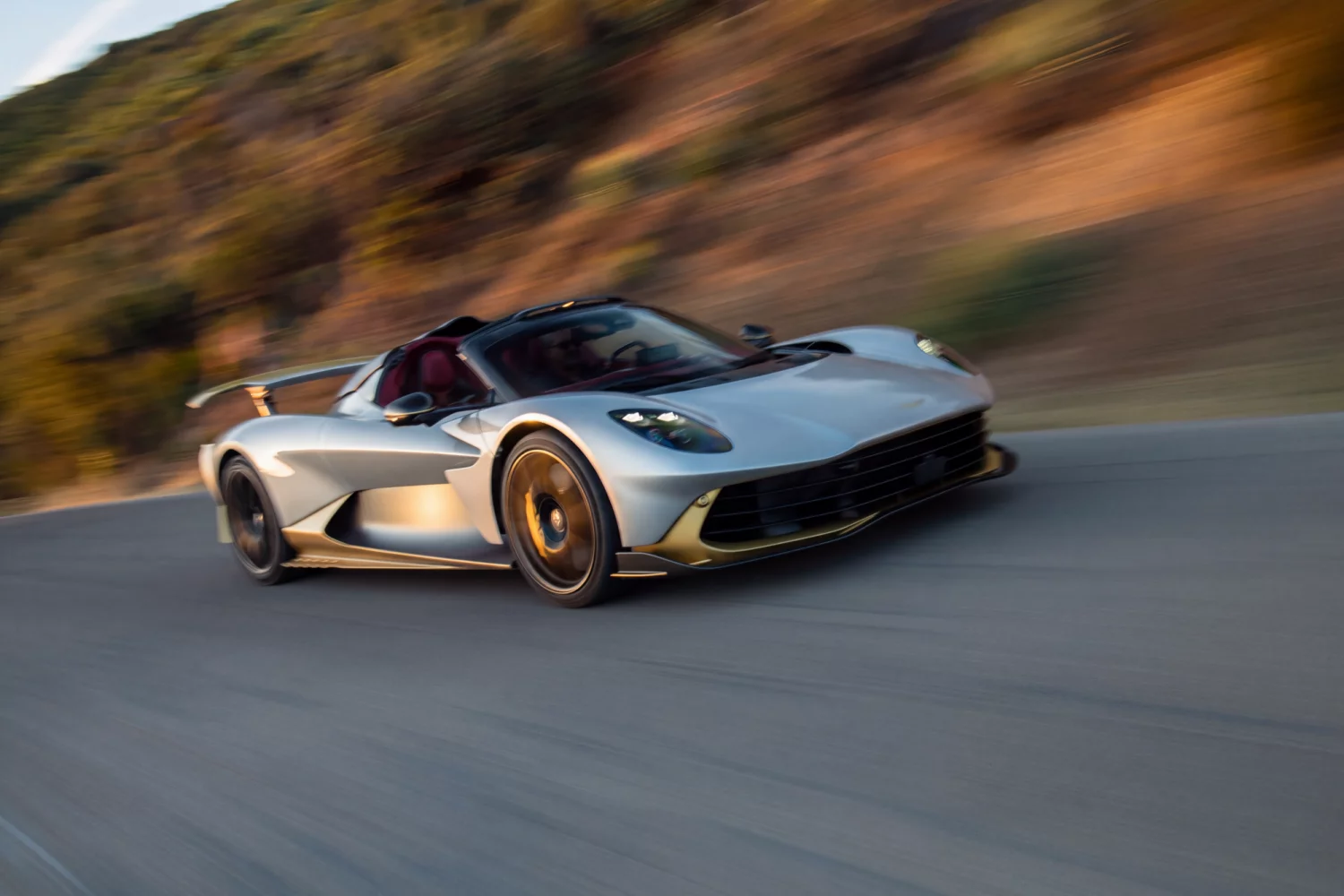
Aston Martin has revealed the Valhalla Spider, an open-top version of its first production mid-engined supercar and its first plug-in hybrid. Nothing was lost in the conversion. The Spider keeps the coupe’s full 1,064-horsepower hybrid powertrain, and it can still reach its electronically limited 217 mph top speed with the roof removed. That makes it the fastest open-cockpit Aston Martin ever built, faster topless than the $3 million-plus Valkyrie Spider, which tops out at just over 205 mph with its roof panel off. The order book is open now, the car makes its public debut October 30, 2026 at the Concours at Wynn Las Vegas, and deliveries start in the third quarter of 2027. Aston Martin has not announced a price yet, but expect a premium over the coupe’s roughly £850,000 tag (about $1.05 million).
The same 1,064 horsepower, minus the roof
Behind the seats sits a bespoke 4.0-liter flat-plane-crank twin-turbo V8, the most potent combustion engine Aston Martin has ever built at 207 horsepower per liter. It sends 817 horsepower to the rear wheels through an eight-speed dual-clutch transmission with an integrated electric motor. Two more electric motors drive the front axle, providing all-wheel drive and torque vectoring with no mechanical link between the axles. Combined output is 1,064 horsepower and 811 lb-ft of torque, fed by a 6.1 kWh battery, and Aston Martin predicts a 0-62 mph run of 2.5 seconds. It joins a small club of hybrid supercars, a group that includes Lamborghini’s Revuelto. For context, 1,064 hp is nearly double the 591 hp of Audi’s flagship SQ9 SUV.
Underpinning it all is the coupe’s carbon-fibre monocoque, developed with Aston Martin Performance Technologies, the consulting arm of the Aston Martin Aramco Formula 1 team. The tub was so stiff to begin with that it needed only minimal changes for open-top duty, with no heavy bracing added to the sills or transmission tunnel and only the upper structure redesigned for the new roofline. The Spider’s 1,680 kg dry weight is just 25 kg more than the coupe’s, and Aston Martin puts the real-world increase at less than 20 kg.
The hard part was feeding the snorkel
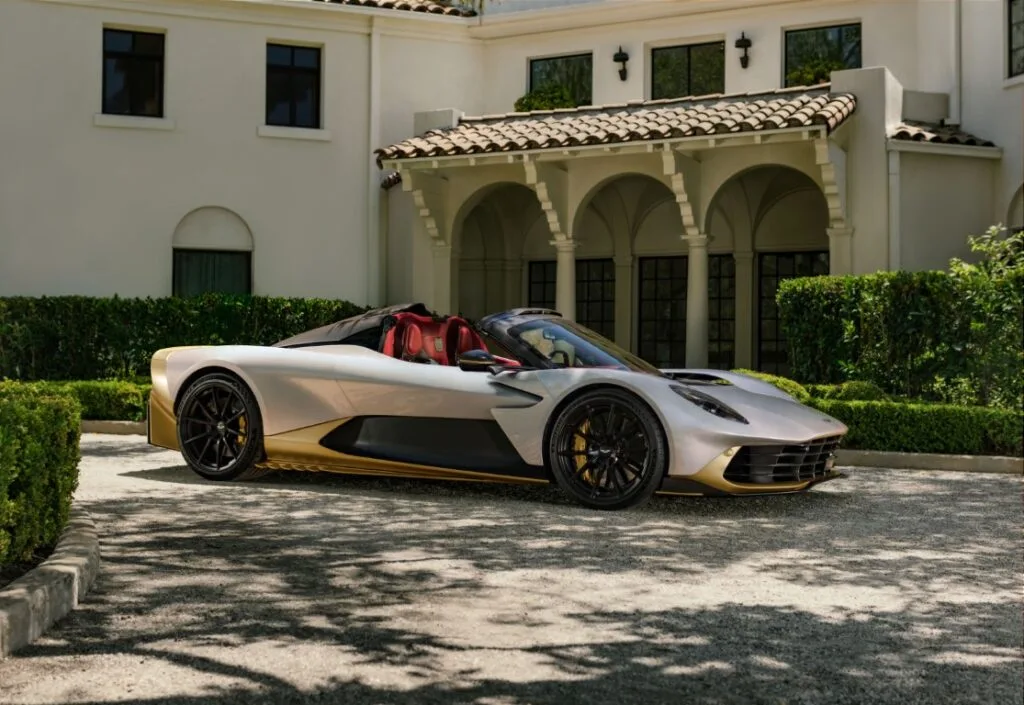
Turning the coupe into a Spider created one problem above all others: the roof-mounted snorkel. It supplies fresh air to the turbochargers and charge-air coolers sitting above the V8, and without a roof, the air coming off the windscreen tends to lift up and over the car instead of funneling into the intake. “The car doesn’t work unless you feed that snorkel,” Andrew Kay from the Valhalla programme team told Magneto at a private preview ahead of the reveal. “That was probably the biggest challenge we’ve faced.”
Aston Martin’s answer is a clip-on wind deflector that lifts air over the occupants’ heads while channeling cooling air down into a reprofiled snorkel raised 35mm for the Spider, which now draws slightly more air than the coupe’s. The deflector folds into three sections and stows in new 15-litre sill compartments, which also hold the first-aid kit and warning triangle. The active aerodynamics and stability control were recalibrated for roof-on and roof-off running, with the front aero dialed back when the roof is off to hold a 40:60 aero balance front to rear, the same as the car’s weight distribution. The full 600 kg-plus of downforce is only available with a roof fitted.
Three ways to drive it, and one speed limit to know
The standard roof is a removable black fabric panel that stows in the car, but it caps the top speed at 124 mph when fitted. The optional carbon-fibre hardtop, which is standard in the US, carries no such penalty, and neither does driving with no roof at all: both reach the full 217 mph. Aston Martin also supplies a rain cover to protect the interior when the car is parked.
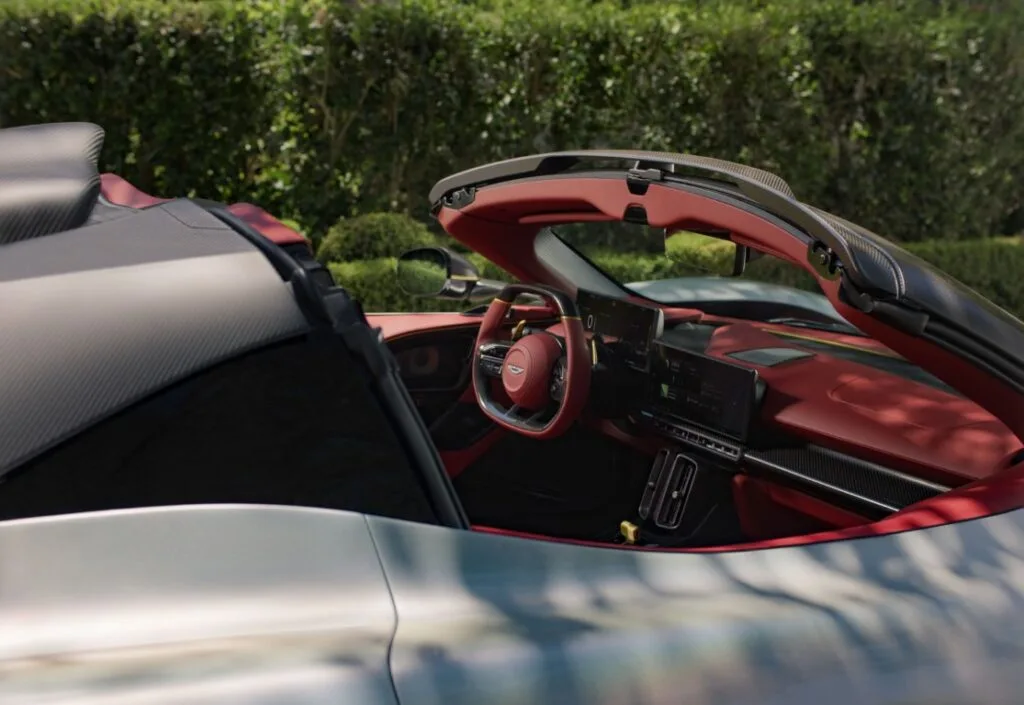
The carbon-fibre dihedral doors are now frameless, with revised kinematics and a door-glass top edge raised about 20mm to make getting in and out easier with the roof fitted. Inside, a new carbon-fibre Touring Seat comes standard, with its bolsters cut lower after coupe owners found the original seat awkward to climb over. The coupe’s more focused carbon bucket remains available at no extra cost.
Price, production, and when you can get one
Aston Martin committed to building 999 Valhallas in total, and that has not changed: the Spider will account for around one in four of them. The order book is already open and private viewings with clients are underway ahead of the October 30 public debut in Las Vegas. Deliveries begin in the third quarter of 2027. Pricing is still unannounced, but with the coupe starting around £850,000, expect a healthy premium: evo estimates roughly £935,000, about a 40 percent uplift.
The Valhalla coupe was a long time coming, first teased as a concept back in 2019 and only reaching customers recently. That Aston Martin has already followed it with an open-top version that gives up nothing on speed says plenty about how confident Gaydon is in the car. A 1,064-horsepower hybrid that does 217 mph with the sky above you is not a compromise. It is the point.
Frequently asked questions
How fast is the Aston Martin Valhalla Spider with the roof off?
217 mph, electronically limited, the same as with the optional carbon-fibre hardtop fitted. The standard fabric roof caps the top speed at 124 mph.
How much will the Valhalla Spider cost?
Aston Martin has not announced pricing. Expect a premium over the coupe’s roughly £850,000 (about $1.05 million); evo estimates around £935,000.
When can you buy a Valhalla Spider?
The order book is open now. The car debuts publicly October 30, 2026 at the Concours at Wynn Las Vegas, and customer deliveries start in the third quarter of 2027.


