
There is a gap in the RV market that Thor just drove a 19-foot-8 motorhome into. On one side sit Class B vans, easy to park and short on storage. On the other sit full Class C coaches, roomy and a chore in town. The 2027 Thor Rize+ 18R plants itself between them: a cutaway-chassis camper with a real wet bath, a real kitchen, and a starting price of $130,340, ordered through Thor’s dealer network. I have not driven one, and Thor’s own positioning gives the game away in a good way: the company calls it the pick for spontaneous adventures, weekend road trips, and couples’ retreats. That is exactly who this is for. If you need to sleep a family, keep looking. If you want a rig that sleeps two properly and still drives like something you can take into town, this one deserves a closer look.
Small outside, serious underneath
The Rize+ 18R measures 19 feet 8 inches, shorter than some of Thor’s ProMaster and Sprinter rigs, and it rides on a Ford E-350 Super Duty cutaway with a custom box at the rear. The engine is Ford’s 7.3 liter Godzilla V8, about 325 horsepower and 450 lb-ft of torque, with an 8,000 pound towing capacity. Ceiling height runs over six feet, so most adults can stand up straight inside. Thor describes the Rize+ as a Class C, while RV-Pro files it as a Class B+ rig, and both labels are telling the truth from different angles: the footprint and maneuverability lean van, while the box body and storage lean coach. That split is the whole pitch. A Class B gives you agility and asks you to live small. A Class C gives you room and asks you to plan every turn. The Rize+ tries to keep the agility and give back some of the room.
A layout built for two
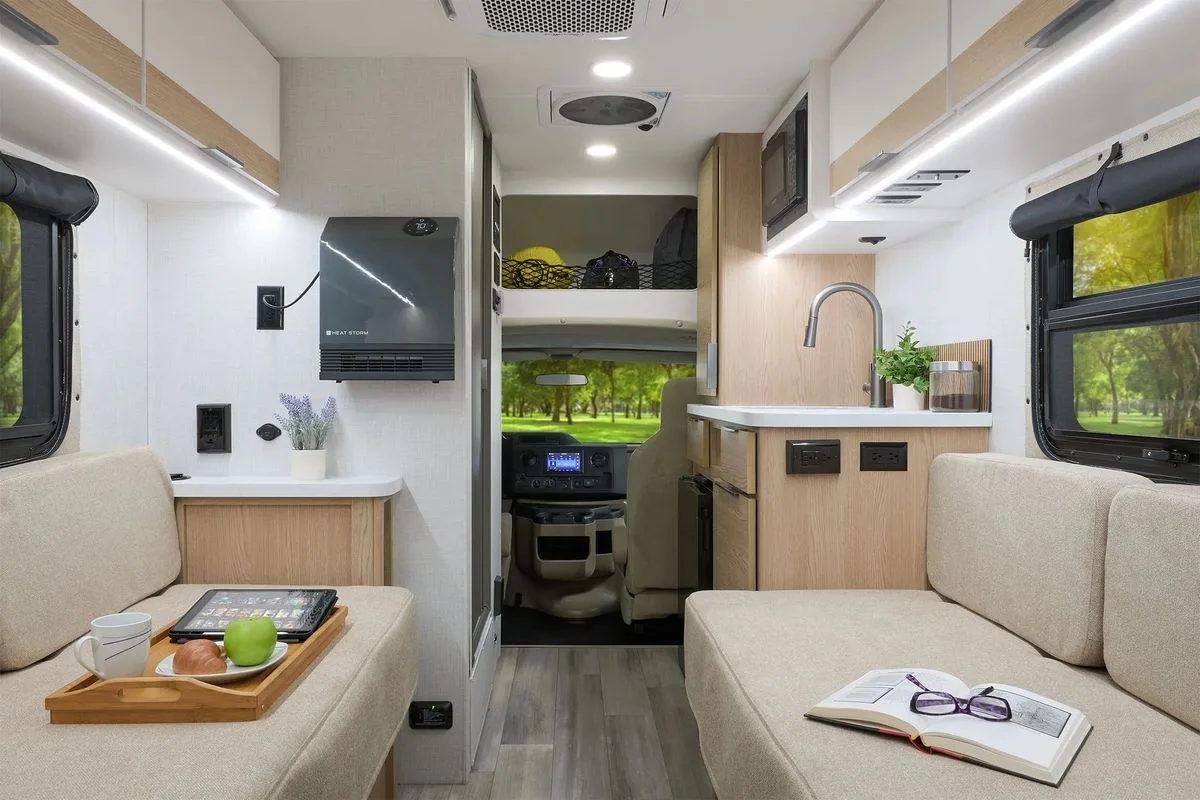
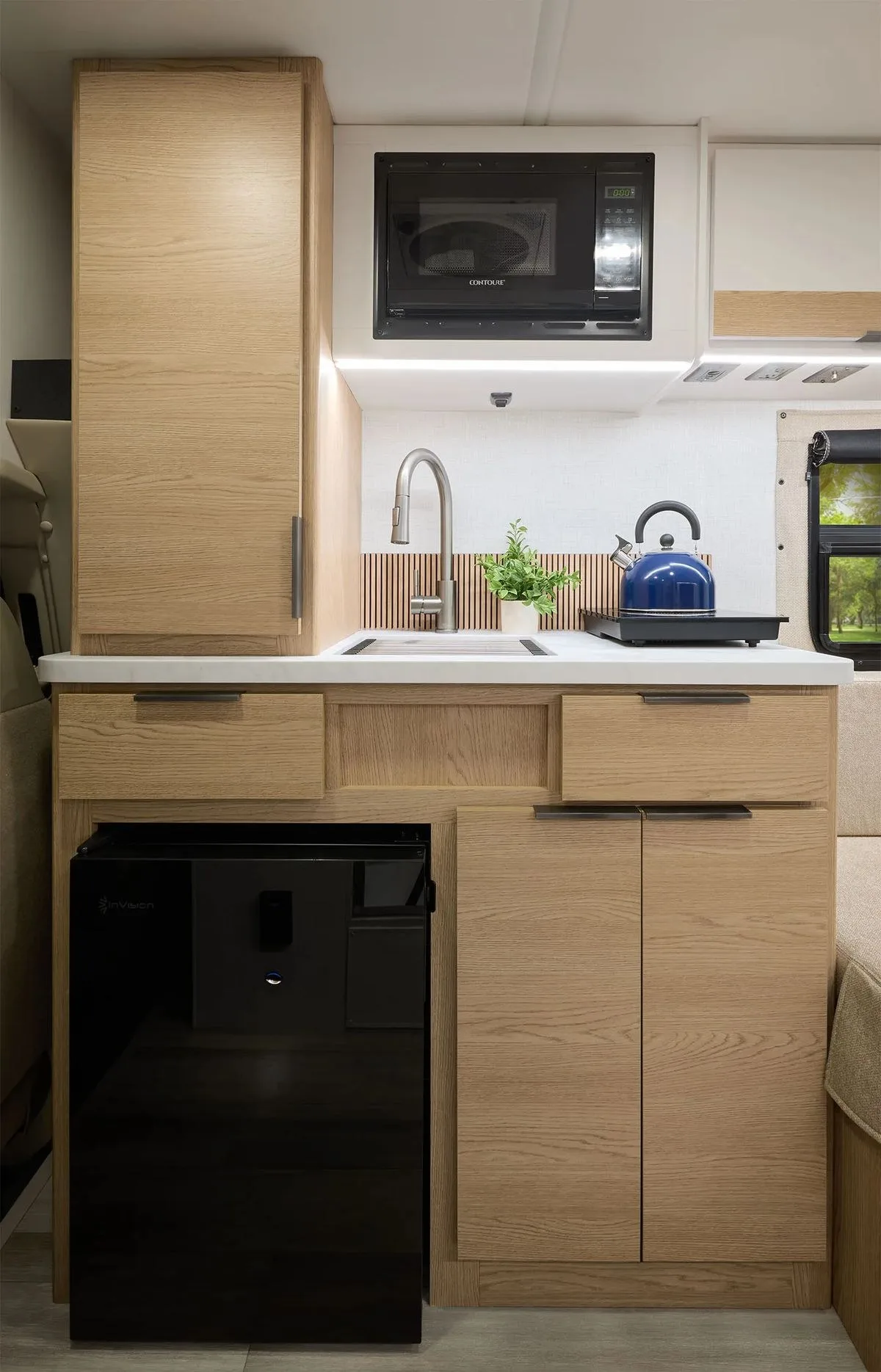
There is a single 18R floor plan, and it makes its priorities clear at the rear door. Entry sits at the back, where two vis-a-vis sofas face each other across a removable table, forming a dining lounge that converts to twin beds or one 52 by 82 inch double bed. The center aisle stays open enough to load a bicycle or two through that same rear door, which is a detail weekend riders will appreciate more than any spec line. The kitchen block and wet bathroom sit forward, behind the cab seats. Cooking runs through a portable single-burner induction cooktop plus a microwave, with a 12 volt refrigerator and a stainless steel sink with a pull-down sprayer and roll-up grated cover. The wet bath is fully enclosed, with a foot-activated flush toilet, a sink with its own faucet, and a shower with an independent wand and a skylight. Two people can genuinely live in this layout for a long weekend. Four can ride, thanks to seatbelts in the cab and on the sofas, but sleeping stays at two.
Power and water for staying out longer
The numbers that matter for time off grid are solid without being showy. Fresh water holds 20.5 gallons, grey water 24 gallons, and wastewater 11 gallons. Power comes from a 100 amp-hour battery system with a 100 watt solar panel, a 1,000 watt inverter, and a 4.0 kW gas generator as backup, with shore power and solar compatibility built in. Climate runs through a 3,400 BTU furnace and a 13,500 BTU air conditioner, plus power vents and ambient LED lighting. An AGS12 panel handles lights, climate, tank levels, and monitoring from one place, and the details keep coming: soft-close drawers, TV prep and cable-ready wiring, a Girard power patio awning, a shore power plug, and a city water connection. Nothing here reinvents the camper. It just covers the bases a first-time buyer forgets to ask about, which is arguably the more useful trick.
Who the Rize+ is for, and who should skip it
The price is where the Rize+ makes its sharpest argument. At $130,340 to start, it sits in line with some Class B conversions and well below many Class C coaches. New Atlas puts it more than $20,000 under the Winnebago Elora and Resa, which is the comparison most shoppers will actually make. It is the opposite approach from the full-size Escalade IQL, which stretches past 228 inches, and that contrast is the point: Thor built this for people who want the coach experience without the coach footprint. The same buy-the-size-you-use logic shows up in the LIVAQ EQUAD electric ATV, which trades bulk for trail access. Couples who take long weekends, first-timers who do not want to learn to drive a bus, and van lifers ready for a bathroom with a door will all find something here. Families should skip it. Two berths is two berths, and no clever sofa mechanism changes that. So should anyone who needs a dedicated workspace or a garage for more than a bike or two. For everyone else, the Rize+ is a serious answer to a question the RV market usually answers with a compromise.
Questions People Ask About the Thor Rize+ 18R
Is the Rize+ a Class B or a Class C?
The honest answer is both, depending on who is doing the classifying. Thor markets the Rize+ as a Class C, while RV-Pro lists it as a Class B+ rig. The cutaway chassis and box body read as Class C, while the 19-foot-8 length and van-like maneuverability read as Class B. Shop it against both categories and you will see why the distinction matters less than the floor plan.
Can you daily drive a 19-foot-8 camper?
That is the Rize+’s best argument. At under 20 feet with a Ford E-Series cutaway underneath, it handles town driving and parking far better than a full-size coach, which is exactly why Gear Patrol calls it more manageable in urban environments. It still drives like a truck-based camper, not a car, so expect truck mirrors, truck brakes, and truck fuel stops.
What is the Thor Scope+?
The Scope+ is the Rize+‘s twin: same layout, same equipment, different interior and exterior appearance options, following the pattern of Thor’s earlier Rize and Scope camper vans. New Atlas reckons the Scope+ interior looks whiter and brighter in photos. If you like the 18R plan but not its finishes, the Scope+ is the first place to look.


