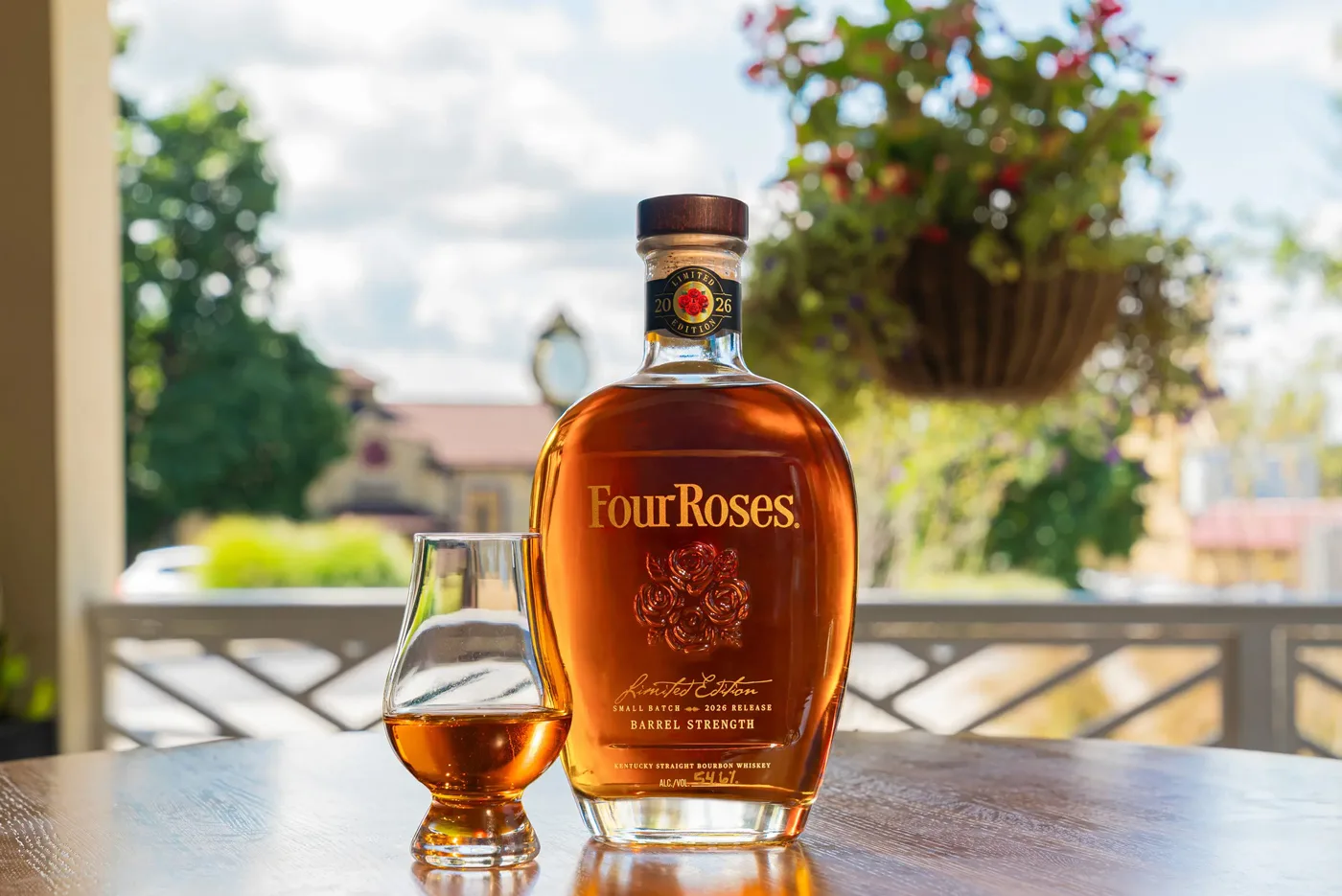
The most interesting number in Four Roses’ 2026 Limited Edition Small Batch isn’t the $249 price or the 109.2 proof. It’s 23: the age of the oldest bourbon in the blend, an OESK-recipe whiskey that has been sitting in a Kentucky rickhouse since roughly 2003. When the 19th edition of this annual release lands on October 10, that 23-year-old joins three younger batches, two at 14 years and one at 15, in a barrel-strength, non-chill-filtered blend of about 16,800 bottles.
I haven’t tasted it yet. Nobody outside Lawrenceburg has. But I’ve been drinking Four Roses long enough to read a blend sheet, and this one tells a story worth your attention: the same OESK recipe appears twice, at 14 years and at 23 years old. Nine years apart, same mash bill, same yeast. That’s a vertical study in what time does to whiskey, hiding inside a $249 bottle.
What’s Actually in the Bottle
Four Roses distills 10 distinct bourbon recipes, and this year’s Limited Edition pulls three of them across four hand-selected batches: a 14-year-old OBSK, a 14-year-old OESK, a 15-year-old OESV, and the 23-year-old OESK. Everything goes into the bottle at barrel strength and non-chill filtered, which is exactly how whiskey this old should be handled. Chill filtering strips out the fatty acids and texture that two decades in oak build up. Skipping it keeps the mouthfeel intact.
For the code-curious, the letters are Four Roses’ recipe system. O means distilled at Lawrenceburg. The second letter is the mash bill: B is the high-rye recipe, E is the lower-rye one. The final two letters are the yeast strain: K brings slight spice, S brings rich fruit, V brings delicate fruit. This year’s blend leans on spice-yeast whiskeys, with two of the four batches built on K strains and a delicate-fruit V rounding out the middle.
Why the 23-Year-Old Matters More Than the Price
Here is the part the announcement doesn’t spell out. A 23-year-old bourbon doesn’t just add age to a blend, it sets the ceiling for oak influence across the whole bottle. At 23 years in new charred oak, you’re getting deep extraction: tannin, wood sugars, the full architecture. The 14- and 15-year-old components keep it from tipping into over-oaked territory and pull the fruit and spice forward. Blending across a nine-year age gap is a balancing act, and it’s the kind of work Brent Elliott’s blending team has built its reputation on. Elliott framed this year’s release as a return to tradition after a year of experimental releases, which reads to me like a distillery reminding everyone what it does best.
Four Roses describes the pour as opening with apricot and light, elegant oak, moving into baking spice, honey, and delicate wood, with a long finish of fruit, vanilla, and caramel. Take distillery tasting notes for what they are, but “beautifully integrated oak” is the phrase I’d underline. At 23 years, if the oak weren’t integrated, they’d be describing furniture.
The Release Details, and Who Should Chase It
Suggested retail is $249, with roughly 16,800 bottles hitting select retailers nationwide and the Four Roses visitor centers in Lawrenceburg on October 10. Past editions have sold through quickly, and a 23-year-old component gives this one a story that won’t hurt demand.
This is for Four Roses completists and anyone who already buys barrel-proof bourbon in the $200-plus tier. At $249 you’re paying for the blending as much as the age. There are cheaper 15-year bourbons on the shelf, but none of them contain a 23-year-old OESK. Skip it if you drink your bourbon at 90 proof over ice, because 109.2 proof will not meet you there. And if the price makes you wince, the standard Four Roses Small Batch remains one of the best values in bourbon.
If you’re hunting a bottle, call your store now. Allocations on this release go to regulars first, and 16,800 bottles spread across the country disappears fast.
I’ll taste it as soon as I can get my hands on a bottle, and I’ll update this with real notes. Until then, the blend sheet alone has me more interested in this edition than I’ve been in a few years. A 23-year-old OESK doesn’t come around often.
Questions People Ask About the Four Roses 2026 Limited Edition Small Batch
What do the OBSK, OESK, and OESV codes mean?
They’re Four Roses’ recipe codes. O means distilled at Lawrenceburg, Kentucky. The second letter is the mash bill: B is the high-rye recipe at 60 percent corn and 35 percent rye, E is the lower-rye recipe at 75 percent corn and 20 percent rye. The last two letters are the yeast strain: K gives slight spice, S gives rich fruit, V gives delicate fruit. Four Roses makes 10 combinations, and this year’s release uses three of them.
Is the 2026 Limited Edition Small Batch worth $249?
It depends on what you value. The $249 buys a barrel-strength, non-chill-filtered blend containing a 23-year-old bourbon, which is genuinely rare at this price. If you collect Four Roses or already buy in the premium barrel-proof tier, the math works. If you just want a great daily drinker, the regular Four Roses Small Batch costs a fraction of the price and remains excellent.
Why doesn’t the bottle carry an age statement?
Because it’s a blend of whiskeys aged 14, 14, 15, and 23 years, and Four Roses has never put age statements on this release. They could technically state the youngest age, but the Limited Edition Small Batch has always been sold on the blend story rather than a number. The announcement gives you the full breakdown anyway, which is more transparent than most age-stated bottles.