



9 minute read
According to the National Highway Traffic Safety Administration’s 2022 data, large trucks were involved in 5,936 fatal crashes in the United States — a 26% increase from five years prior. Behind each of those numbers is a collision that likely involved more than one vehicle, more than one responsible party, and injuries far more severe than what a typical car crash produces. That’s what makes truck accidents uniquely complicated: not just the physical devastation, but the layered legal questions that follow.
Multi-vehicle truck accidents have become an increasingly pressing concern as commercial freight volume grows and highway congestion intensifies. When an 80,000-pound semi collides with passenger vehicles traveling at highway speeds, the resulting crash rarely involves a clean, two-party chain of events. Instead, victims often find themselves caught between competing insurance carriers, corporate legal teams, and a complex web of potential defendants — all while managing serious physical injuries.
Understanding what causes these injuries, how they manifest, and who bears legal responsibility isn’t just useful for attorneys. It’s essential knowledge for anyone who has been involved in one of these crashes or who wants to understand why the legal landscape around truck accidents looks so different from a standard fender-bender claim. This article examines each of those dimensions — from crash mechanics to courtroom considerations — and the regulatory frameworks that shape them all.
How Multi-Vehicle Truck Accidents Cause Specific Injuries
The injuries that emerge from truck accidents aren’t simply “worse” versions of car accident injuries — they often involve entirely different mechanisms. A commercial truck’s mass advantage over a passenger vehicle is dramatic: the average fully loaded semi weighs roughly 20 to 30 times more than a typical car. That physics gap doesn’t just increase severity; it changes what breaks and how.
In a rear-end collision where a truck strikes a stopped or slower-moving vehicle, the energy transfer is so extreme that the struck vehicle can be pushed beneath the truck’s trailer — a phenomenon called underride. In these crashes, the passenger compartment suffers structural collapse rather than the engineered crumple zone deformation that modern cars rely on for occupant protection. The result is catastrophic head and neck trauma in scenarios where a lower-speed car-on-car crash might produce only soft tissue injuries.
Multi-vehicle pileups introduce additional complexity. When a truck jackknifes — where the trailer swings outward relative to the cab — it can sweep across multiple lanes simultaneously, striking several vehicles in a single motion. Occupants in those vehicles may sustain primary impact injuries from the initial collision and secondary injuries as their vehicle is then struck by other traffic reacting to the chain reaction. That layered trauma makes it difficult to attribute specific injuries to specific impact events, which has real consequences when determining which party caused what harm.
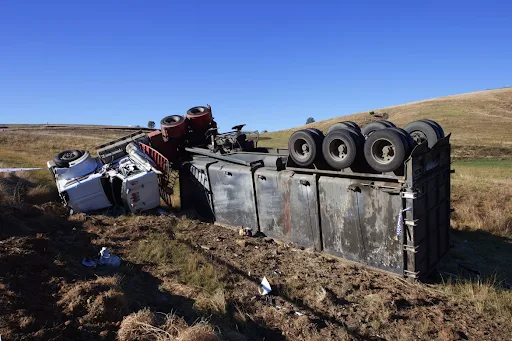
Rollover incidents create their own injury dynamic. When a top-heavy truck rolls, it may crush adjacent vehicles or eject cargo onto roadways, creating hazards for drivers who had no direct involvement in the initiating event. Understanding these crash mechanics matters because injury causation is central to liability — and in multi-vehicle cases, how an injury happened is often just as contested as who is responsible for it happening.
Common Types and Symptoms of Truck Accident Injuries
The physical injuries that follow from the crash dynamics described above tend to cluster in predictable patterns, though the severity can vary significantly based on vehicle position, speed, and point of impact.
Traumatic brain injuries (TBIs) are among the most serious and frequently misunderstood outcomes. A victim may walk away from a crash feeling disoriented but otherwise functional, only to develop worsening headaches, cognitive difficulties, and mood disturbances over the following days. Many TBIs go undiagnosed at the scene precisely because victims don’t lose consciousness and emergency responders prioritize visible trauma.
Spinal cord injuries occupy the other end of the spectrum in terms of immediate recognition — the paralysis or severe neurological deficits they cause typically present acutely. But the more common spinal outcome is disc herniation or vertebral fractures that produce chronic pain and limited mobility without dramatic immediate symptoms. Someone who declines an ambulance at the scene may not realize the extent of their spinal injury until weeks later, after inflammation has progressed.
Blunt chest trauma from steering wheel or seatbelt impact frequently causes rib fractures, pneumothorax, and internal organ injuries — all of which can be life-threatening if not identified quickly. Soft tissue injuries, particularly whiplash and deep muscle tears, are nearly ubiquitous in truck crash survivors and tend to dominate the long-term recovery conversation even when more dramatic injuries initially take precedence.
What connects all of these injury types is the importance of prompt medical evaluation, even when symptoms seem minor at first. The gap between initial presentation and full injury expression can be days or weeks, and that delay carries real implications for both medical outcomes and legal documentation.
Legal Liability and the Lawsuit Process in Multi-Vehicle Truck Accidents
Identifying who is legally responsible for a truck accident injury is rarely straightforward — and in multi-vehicle crashes, it becomes genuinely complex. The driver is an obvious starting point, but the legal chain of potential defendants extends considerably further.
Trucking companies bear liability in multiple ways. If a driver was employed by the carrier at the time of the crash, the company is generally liable under the legal doctrine of respondeat superior. But trucking companies can also face independent negligence claims — for inadequate driver screening, failing to enforce federal hours-of-service regulations, improper cargo loading, or deferred vehicle maintenance. In some crashes, the truck’s manufacturer may share responsibility if a mechanical defect contributed to the accident.
In multi-vehicle collisions, other passenger vehicle drivers may also carry partial fault, which triggers comparative negligence analysis. Many states apportion liability percentages across multiple parties, meaning a victim’s recovery could be reduced if they’re found to share some degree of responsibility. This is one reason why the lawsuit process in truck accident cases typically involves extensive discovery — obtaining the truck’s electronic logging data, black box records, maintenance logs, and driver employment history before any liability determination is made.
Individuals pursuing claims in states with complex trucking corridors often benefit from working with attorneys who understand the interplay between federal motor carrier regulations and state tort law. For instance, truck accident legal representation in Wisconsin involves navigating both state contributory fault rules and FMCSA compliance requirements simultaneously — a combination that shapes how evidence is gathered and how defendants are identified.
The lawsuit process itself generally moves through demand and negotiation, then formal litigation if a settlement isn’t reached. Expert witnesses — accident reconstructionists, trucking industry consultants, and medical professionals — play an unusually prominent role in these cases because the technical complexity requires outside expertise to make comprehensible to a jury.
Psychological and Long-Term Impacts of Truck Accident Injuries
The physical injuries discussed above are often what dominate early medical conversations, but the psychological aftermath of a serious truck accident can prove equally disabling — and is far more frequently overlooked in both treatment and legal claims.
Post-traumatic stress disorder is a documented outcome among a meaningful portion of serious accident survivors. Victims may experience flashbacks triggered by driving situations that resemble the original crash, hypervigilance on highways, or an inability to return to driving altogether. For people whose livelihood depends on commuting or who live in areas without public transportation, this isn’t just a quality-of-life issue — it’s an economic one.
Depression frequently accompanies the physical recovery process, particularly when injuries produce chronic pain or permanent functional limitations. The psychological burden of watching a career be interrupted, relationships strain under caregiving demands, and financial pressure accumulate creates conditions where mental health deteriorates in parallel with physical healing. Research published in the Journal of Trauma and Acute Care Surgery has documented the relationship between injury severity and long-term psychological outcomes, noting that patients with polytrauma — multiple simultaneous injuries — face substantially elevated risk for persistent mental health challenges.
This matters legally because comprehensive liability claims should account for non-economic damages: pain and suffering, loss of enjoyment of life, and the emotional cost of reduced capacity. When attorneys and medical experts fail to document psychological harm alongside physical injury, settlements may undervalue the true scope of a victim’s losses. The long-term picture — what a person’s life looks like two, five, or ten years after the crash — is what a damages calculation should reflect, not just the immediate medical bills.
The Role of Safety Regulations and Investigations in Reducing Injuries
Federal motor carrier safety regulations exist precisely because the consequences of truck accidents are so severe. The Federal Motor Carrier Safety Administration sets standards for driver rest periods, vehicle inspection intervals, cargo securement, and electronic logging requirements — all designed to address the conditions most frequently associated with catastrophic crashes.
When accidents occur despite those regulations, thorough investigation becomes the mechanism through which violations are identified and accountability is established. The NTSB and state agencies routinely analyze crash data, driver records, and vehicle condition reports to determine contributing factors. Those findings don’t just inform future policy — they become critical evidence in civil litigation, often revealing whether a carrier was operating in compliance with federal requirements at the time of the crash.
From a prevention standpoint, the data gathered through these investigations has driven meaningful safety improvements. Electronic logging devices, which became mandatory for most carriers in 2017, created a verifiable record of driver hours that’s far more reliable than paper logs. Collision mitigation systems and automatic emergency braking are increasingly present in newer commercial fleets, and early evidence suggests these technologies reduce rear-end crash frequency.
For anyone involved in a truck accident, understanding that regulatory compliance — or non-compliance — is part of the evidentiary record changes how the case should be approached from the outset. The question worth asking isn’t just “what happened?” but “what should have been done differently, and by whom?” That investigative orientation is what separates a thorough liability analysis from a superficial one — and ultimately, it’s what determines whether all responsible parties are actually held accountable.