


5 minute read
Wool rugs have rarely been short of visual appeal. Their problem has been practical. Dense natural fibers and rigid backings can be hard to live with. They can shed and need specialist cleaning. This makes them hard to justify in homes with kids, pets, guests, and constant foot traffic. In 2026, that tension is becoming more relevant. COVER magazine reports on new rug launches. It highlights varied pile heights, natural materials, and sculptural texture. It also notes responsible material choices. Designers interviewed by Homes & Gardens describe key trends for the year. They point to richly textured wool, thick weaves, and earthy fibers.
Byron Bay rug company Double sits inside that shift. The brand began with washable, recycled-polyester rugs before expanding into New Zealand wool, organic cotton, and natural jute. Its wool collection addresses a category that has forced buyers to choose between material quality and manageable care.
A Design Business Built Around Real Homes
Double launched in 2022. Its founders saw a common gap in homewares. Practical products often looked purely functional. Design-led pieces could feel too delicate for everyday life. The founding team used a fashion-based approach to color, pattern, and product design. They then tested small production runs in the Australian market before expanding the range.
That process shaped a collection with a stronger design identity than the generic patterns found in some rug trade. Double says it creates its designs in-house. Internal teams develop motifs, color options, and surface treatments. They don’t choose finished designs from supplier catalogs. The current wool range includes simple cream and taupe options. It also includes terracotta, burgundy, puce pink, eucalyptus, dark olive, and blue ash.
Wool Without a Single Care Formula
Double’s wool range isn’t one uniform product. It includes fine-cut pile, heavy loop pile, Berber, sheepskin, abrash-dyed, handwoven, and knotted constructions. That variety matters because washability depends on more than fiber content. Rug size, weight, backing, pile density, and washing-machine capacity all affect how a piece should be cleaned.
The collection page for a wool rug in Australia shows flexible backing as a central practical feature. It allows many rugs to be moved and cleaned more easily than traditional wool rugs with stiff backing. Smaller suitable styles may fit commercial washing machines, while larger rugs can be washed using the at-home methods outlined in Double’s care guides. Heavy loop pile and hand-woven wool rugs are exceptions to machine washing because of their weight and construction. They can be spot cleaned or washed carefully in a bath or shower, according to the product-specific instructions.
This distinction is important. “Washable” shouldn’t be treated as a universal promise that every size can be placed in a residential machine. Double’s clearer care guidance gives the term a more useful meaning: the rugs are constructed to tolerate water and practical cleaning methods that many conventional wool rugs aren’t designed to handle.
The company also advises buyers to expect natural shedding, especially during the first three to four months. That is a normal characteristic of wool rather than a product defect. For households that want no shedding, Double positions its recycled-polyester alternatives as the more suitable option.
Texture Is the Main Design Argument
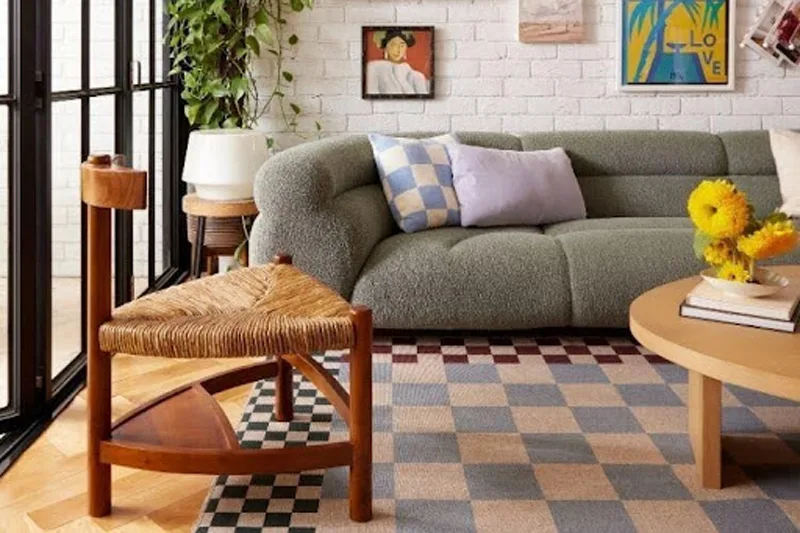
Washable rugs have often been associated with short pile, printed surfaces, and limited depth. Double’s wool collection takes the opposite approach. Its current range includes substantial loops, dense cut piles, Berber textures, sheepskin surfaces, and abrash-dyed yarns that create subtle tonal movement.
This direction aligns with wider 2026 interiors coverage. COVER magazine’s recent launch reports show wool, jute, raffia, and recycled PET appearing across hand-knotted, tufted, and flatwoven constructions, often with tonal variation or changing pile heights. Homes & Gardens likewise identifies plush surfaces, natural materials, grounded colors, and expressive texture as defining current rug themes.
Double’s response isn’t to pursue one trend across the entire collection. The Marlborough heavy loop rugs offer a pronounced, uneven surface. Banksia uses a low, loom-knotted construction with New Zealand wool on recycled PET warp. Waikato relies on abrash dyeing for variations in tone, while Otago draws on a thicker Berber profile. These differences give buyers more control over how a rug behaves visually and physically in a room.
Wool itself contributes resilience, elasticity, and a naturally complex surface. The International Wool Textile Organisation also identifies wool as renewable and biodegradable under suitable conditions. Those material qualities don’t remove the environmental impact of production, dyeing, transport, or backing components, but they explain why traceability and construction details matter when sustainability claims are made.
Testing and Styling Reduce Purchase Uncertainty
A washable claim is only useful when buyers can see how it has been tested. Double reports that Eurofins independently tests each texture through 40 intensive wash cycles before release. The company also identifies ethical factory certifications and product-level material credentials, including OEKO-TEX Standard 100 certification on selected wool styles. Specifications disclose when recycled PET warp, organic cotton backing, or separate non-slip pads form part of a rug’s construction.
The buying tools address a different risk: choosing the wrong rug online. Double offers an augmented-reality room preview, a style quiz, complimentary consultations, and samples for selected natural-fiber rugs. The service gives customers a chance to compare pile, weave, color, and tonal variation against their own flooring and lighting.
Free shipping and returns apply across much of the Australian range, although final-sale items, regional delivery charges, and certain heavy products may have separate conditions. That level of detail matters in a category where size and texture can be difficult to judge on a screen.
Double’s wool collection is timely because it treats practicality as a construction problem rather than a reason to flatten the design. The result isn’t maintenance-free wool. It is a broader set of cleaning options, backed by testing, clearer specifications, and enough material variety to make washable rugs part of the design conversation rather than a compromise outside it.