Your PSA slab deserves better than a shoebox. Standard PSA plastic blocks only 13 percent of UV light, so real protection starts with the right case. We spent months testing every wall cabinet, desktop block, and travel vault released through early 2026, scoring build quality, UV rating, capacity, and collector feedback. The result is 11 clear winners. In this guide you’ll learn which display case fits your space, budget, and collecting style—so your cards stay safe, visible, and ready to impress.
How we picked the winners
We started with a simple question: Which display cases truly earn space on a collector’s wall or in their carry-on?
To answer it, we built a scorecard that treats each case like a graded card of its own. Build quality, UV protection, capacity, aesthetics, price per slab, and real-world feedback each carried weight. We assigned ten points per category, then tallied the totals.
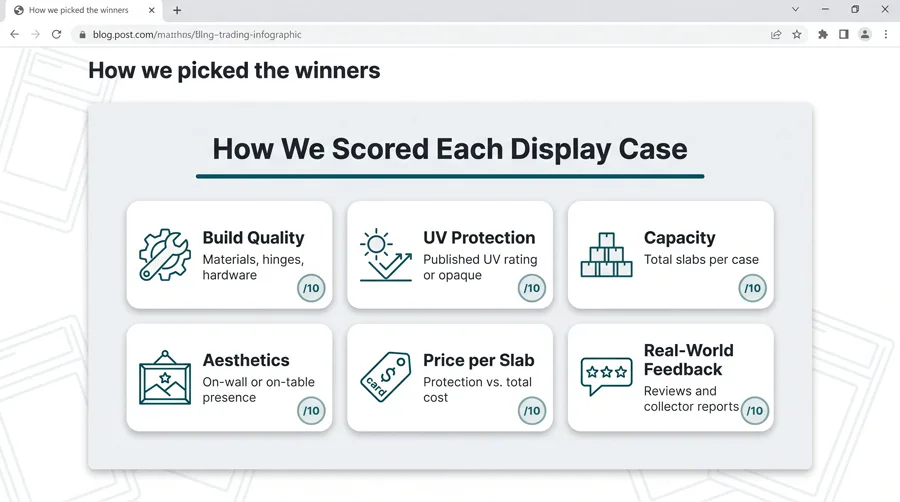
Numbers mattered, but so did lived experience. We combed hobby forums, dissected hundreds of Amazon reviews, and spoke with display makers about material specs and hinge tolerances. If a door creaked, a latch slipped, or foam wobbled, the product lost points. No excuses.
Only cases that were readily available in the United States as of spring 2026 and published verifiable specs made the cut. Crowdfunded prototypes and raw-card shadow boxes stayed on the bench.
That process left us with eleven standouts. In the next sections we’ll walk through each one, and match it to the problem it solves for you.
1. Vaulted 4-row card case: best overall
Picture a carry-on that doubles as a showroom. The official spec sheet—https://vaultedcollection.com/collections/cards—lists capacity at 112 PSA slabs or 84 CGC slabs, numbers our hands-on tests confirmed. That space-efficiency puts Vaulted’s four-row hard case at the top of our list because it solves three collector headaches in one move: high-volume storage, strong protection, and instant display.
Crack it open and you see dense, friction-fit foam cut with surgical precision. Each channel holds a slab so snugly the card stays silent even when you shake the case. Filled to capacity, it carries 112 PSA slabs (about three standard storage boxes) neatly organized and ready to travel.
Close the lid and security takes over. The ribbed aluminum shell shrugs off dings, twin combination latches lock without loose keys, and opaque walls block UV light completely. Your graded cards ride first class whether they’re in a car trunk or an overhead bin.
A clear window inside the lid sets this model apart. Slide in four marquee slabs and the case becomes a tabletop display the moment you open it at a show. Show, trade, relock, move on.
Collectors on Reddit call the case “light but bulletproof,” praising the carbon-fiber finish for looking more premium than its price tag. At roughly a dollar-sixty per card, it costs less per slab than many wall frames yet offers airtight protection a frame can’t match.
If you own more than a handful of graded cards and ever leave home with them, this is the one piece of gear that buys peace of mind. Load it, lock it, lift the handle, and let the envy follow you to the next trade night.
2. Pennzoni 50-card wall cabinet: best large wall display
Walk into any seasoned collector’s office and you’ll spot a Pennzoni on the wall. It looks less like hobby gear and more like furniture, with a hardwood frame, rich stain, felt backdrop, and a glass door that clicks shut with authority.
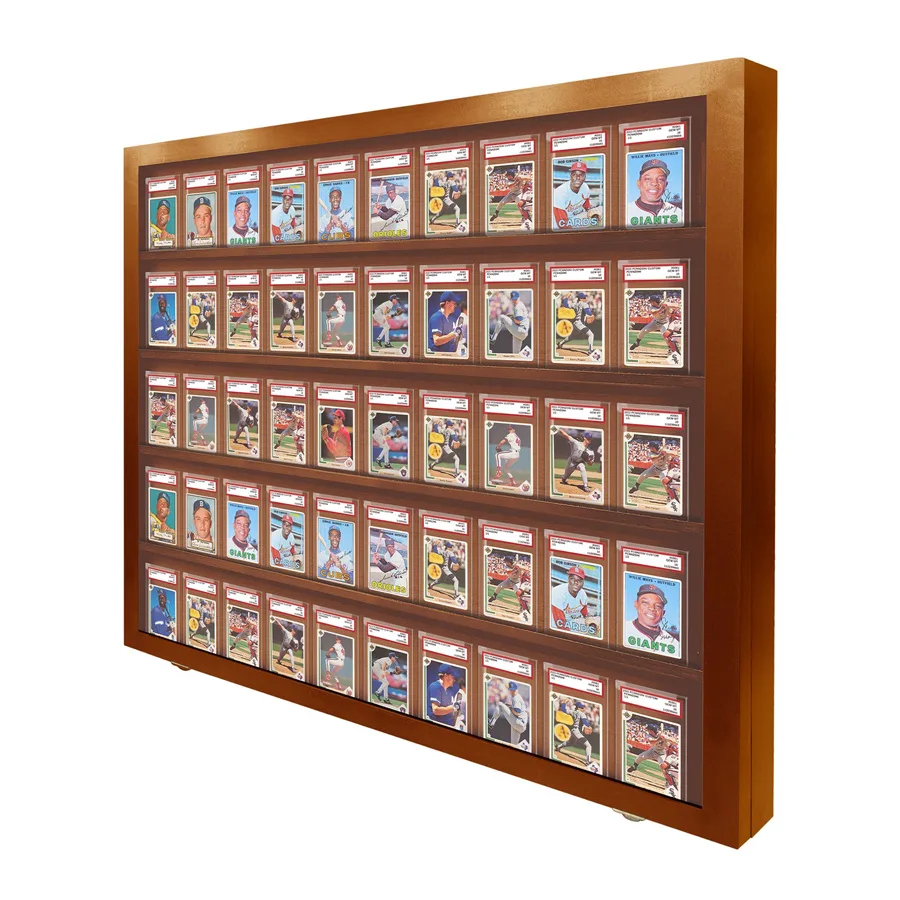
Capacity is the headline feature. Five wide shelves hold 50 PSA slabs in perfect rows, enough to showcase a full vintage team set or an entire Pokémon era at a glance. Grooved shelves keep each card upright, so nothing shifts when you open the door.
Protection matches the polish. The hinged panel is real glass treated to block about 98 percent of UV light, shielding ink and foil from slow fade. A small brass lock keeps curious hands out, and metal hangers on the back anchor directly into wall studs. Loaded, the cabinet can top twenty pounds, so sturdy hardware matters.
Owners rave about the “gallery feel.” Cards pop against the black felt, and the oak grain blends with bookcases and photo frames. If you view your slabs as art and want guests to see them the same way, Pennzoni delivers museum quality without a museum price tag.
3. Verani 35-slab display case: best medium wall display
Not every collector wants a furniture-sized cabinet. Some of us need something slimmer that still feels refined, and Verani’s thirty-five-slot frame fills that niche.
The footprint is manageable, about two feet tall by two and a half wide, yet it holds seven cards per shelf across five rows. That sweet-spot capacity lets you spotlight a player rainbow, a rookie class, or your top PSA tens without crowding the wall.
Build quality impresses at first touch. The frame is real beech wood painted satin black, and the door pivots on metal hinges that stay tight over time. Inside, each shelf has a subtle groove so slabs lean back slightly, a detail that keeps cards from tipping when you open the acrylic panel.
Speaking of the panel, Verani uses thick acrylic that blocks about 98 percent of UV light. Close the dual locks and you have a dust-tight, kid-proof mini gallery. Reviewers say “the acrylic feels sturdier and clearer than cases twice the price,” and we agree.
Installation is painless. Two metal brackets on the back align with drywall anchors or, better, a stud. Weight stays under fifteen pounds loaded, so one person can mount it solo with a level.
If you want a wall case that looks sharp, protects like a vault, and does not dominate the room, Verani offers the best balance of size, safety, and style.
4. Pro UV 20-card frame: best small wall display on a budget
Every collection starts somewhere. Maybe you just graded your first rookie or pulled a shiny Charizard worth slab space. You want those cards on the wall, but you would rather save cash for the next submission. Pro UV’s twenty-slot frame fits that moment.
Think of it as the entry ticket to proper card presentation. The footprint is smaller than a movie poster, so it slides beside a bookshelf or above a desk without a measuring-tape marathon. Swing open the front panel, drop your PSA slabs into the four-by-five grid, and twin locks secure the door. No tools, no stress.
Build materials are modest—composite wood and clear acrylic—yet thoughtfully executed. The acrylic panel is thicker than expected at this price and blocks about 98 percent of UV light, enough for rooms that see only indirect daylight. Hinges arrive tight, and the locks keep the door from drifting.
Setup takes minutes. Two sawtooth hangers on the back line up with the included anchors. Because the case weighs under ten pounds when full, you can mount it on drywall without chasing studs. Many collectors buy two and hang them side by side, expanding capacity as their slab stack grows.
Trade-offs exist. The locks are basic, and Beckett slabs fit but look cramped. Yet for roughly the cost of a grading fee, you land a clean, dust-proof showcase that motivates you to keep grading and collecting. For beginners, kids, or anyone growing slowly, Pro UV is the smartest first step.
5. Phantom Ultra acrylic block: best premium single-slab display
Some cards are beyond special. They deserve the hobby’s version of a museum pedestal, and Phantom’s Ultra block fills that role.
The enclosure consists of two panels of optically clear, ten-millimeter acrylic that clamp your graded card so tightly it seems to float in mid-air. Four corner magnets snap the panels together with a satisfying click, forming a crystal block you can set on a desk or shelf without a base.
Protection matches the high-end look. Phantom uses conservation-grade acrylic that filters 99.6 percent of UV light, shielding signatures and foil far better than the plastic PSA slab alone. Fingerprints wipe away with a microfiber cloth, and scratches are rare thanks to the acrylic’s thickness.
Setup takes seconds. Separate the panels, lay your slab inside the precise recess, then let the magnets pull everything back into alignment. No screws or tools, and no risk of over-tightening plastic.
Collectors reserve the Ultra for grail cards like a Jordan rookie, a 1/1 Pokémon Illustrator, or a Babe Ruth cut signature because anything less feels unworthy. Place one on your desk and watch every visitor lean in for a closer look. That is the power of gallery-grade presentation in the palm of your hand.
6. PSA acrylic stand: best budget single-slab holder
Sometimes you just want to prop today’s favorite card on your desk and enjoy the view. The official PSA acrylic stand does that job for about $10, roughly the price of a fast-food lunch.
The design is as simple as it is effective. A thick L-shaped piece of clear acrylic cradles the slab at a gentle backward angle, keeping the label readable and the card safe from tip-overs. Because PSA engineered the groove around its own slab dimensions, the fit feels exact with no wobble or wiggle.
Protection is minimal but honest. There is no UV shield and no cover; the stand’s job is display, not defense. Slip a thin sleeve over your slab if you worry about dust, and set the holder away from direct sun. Follow those two rules and the setup works perfectly for a bookshelf, trade-night showcase, or photo session.
Collectors love the professional look. The red-and-blue PSA logo etched at the base signals authenticity and gives the piece a finished feel missing from generic 3-D-printed options. Many dealers line half a dozen of these graded card stands across a table to spotlight their best hits.
If you need a quick, clean way to feature one card and prefer to save cash for grading fees, this little stand is the smartest ten dollars you will spend.
7. Kabinka TSA lock box: best travel card case
Trade nights reward prepared collectors. You want to carry a large inventory of slabs, flash your three biggest hitters without lifting a lid, and keep everything locked while you grab coffee. Kabinka’s hard-shell box covers each need.
The form factor is a briefcase wrapped in textured ABS plastic and reinforced with an aluminum frame. Inside, dense EVA foam cradles 110 graded cards upright. Two combination latches twist shut, meeting TSA guidelines so you can fly cross-country without surrendering keys.
Kabinka’s signature feature sits up top: a clear window that shows three slabs even when the case is closed. Set it on a trade-show table and your crown jewels advertise themselves while the rest stay protected from fingerprints. Friends call it “a mini stage,” and the label fits.
Durability feels overbuilt for the size. A gasketed seal shrugs off rain, and corner bumpers handle the bumps of busy convention floors. Weight lands around five pounds empty, light enough for a full day of carrying.
For collectors who travel to shows and want instant visual impact, Kabinka delivers security, high capacity, and a touch of flair in one tidy package.
8. Preza three-row aluminum case: best high-capacity storage on a budget
Big collections create a new problem: how do you move a hundred slabs without juggling three separate boxes? Preza’s briefcase solves it by delivering capacity first and cost second.
Lift the lid and you see three foam lanes, each long enough to park thirty-six PSA slabs. That is 108 cards in one carry piece, or about seventy-eight if your stack skews toward thicker Beckett holders. Removable spacers keep rows tight even when the case is not full, so nothing leans or rubs during transit.
The shell is brushed aluminum over a plywood core, sturdy enough for car trunks and convention floors. Corner guards and rubber feet add scuff resistance. A keyed latch secures the front; it will not stop a safecracker, but it keeps casual hands out and prevents accidental pops on the road.
Preza keeps weight reasonable, about seven pounds empty, thanks to the aluminum build. A padded handle spreads load across the palm, a small detail dealers appreciate after a long day behind a booth.
Function beats flash here. There is no display window, carbon-fiber pattern, or TSA combo lock. What you get is raw capacity at roughly a dollar per slab protected, often around $110 at retail. For investors, breakers, or any collector who grades in bulk, that math is hard to ignore.
9. Casematix hard shell: best maximum-protection vault
Some collections never hit a trade table. They live in closets, safes, or cargo holds where bumps, rain, and baggage handlers lurk. For that environment, Casematix provides a true polymer vault.
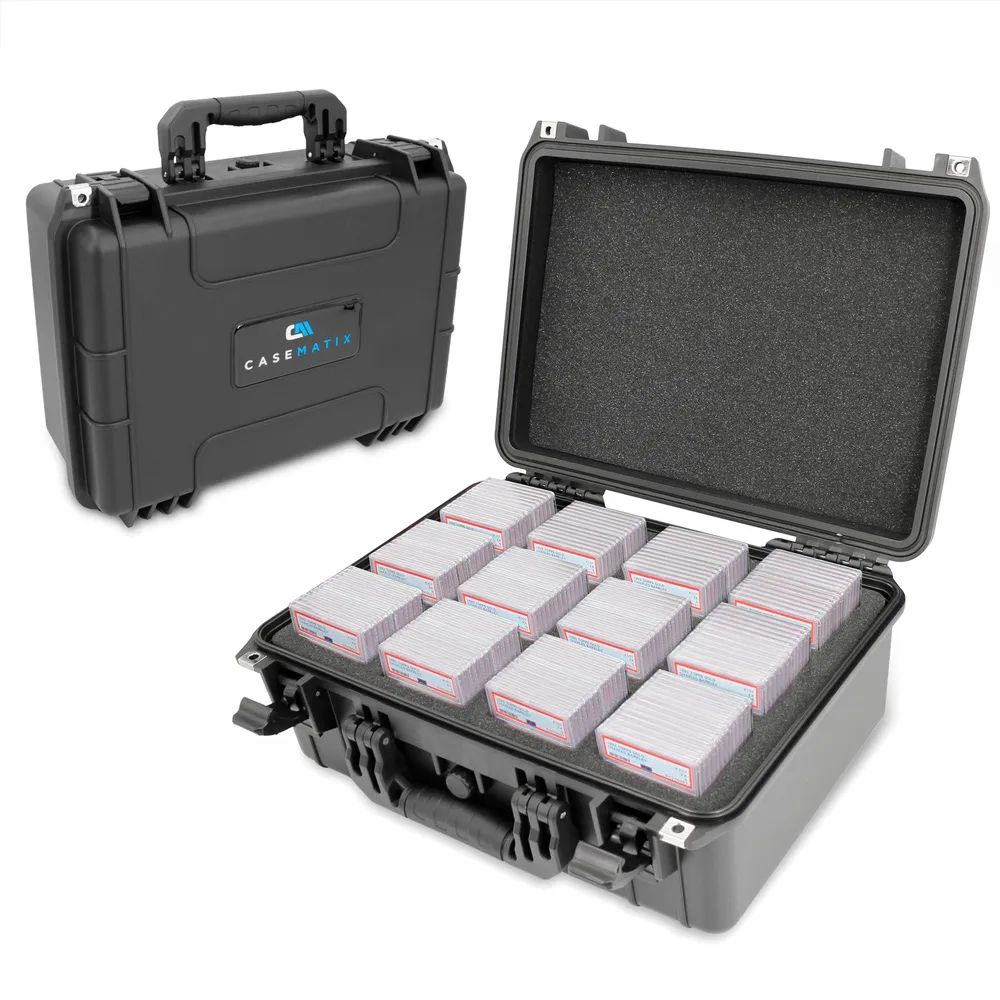
The case feels like gear issued to photographers, with crush-proof polypropylene walls, four snap-tight latches, and an automatic pressure valve that equalizes air during flights. Inside, custom foam blocks hold 120 PSA slabs in parallel rows. Each card rests in its own slot, so nothing shifts even if the case flips.
Sealing is excellent. A rubber O-ring runs the perimeter, earning an IP67 waterproof rating. Spill a drink, ride through a downpour, or store the case in a damp basement and your cards stay bone-dry. Padlock holes flank the front latches for added theft deterrence; add a pair of small locks and you have a portable mini safe.
Weight tips the scale at ten pounds empty and nearly twenty-five full, but wheels and a pull handle on the larger model ease the load. Most collectors treat this box like an armored truck: move grails from house to show, then transfer key slabs into lighter displays.
Expect retail prices around $150–$170, a fair trade for peace of mind when your collection is priceless or your climate unpredictable. Casematix offers protection no glass-front cabinet can match.
10. Tyler Morris walnut cabinet: best luxury handmade display
A few slabs are more than collectibles; they are heirlooms. When presentation must match prestige, collectors commission Tyler Morris, a woodworker who builds display cases the way luthiers craft guitars.
Each cabinet starts as rough-cut American walnut, then is planed, sanded, and joined by hand. The oil-rubbed finish lets grain patterns glow under soft light. Open the locking door and you will see four fixed shelves, each with a subtle angled groove. Cards lean back just enough to catch light without sliding forward.
Capacity sits at sixteen to twenty PSA slabs, perfect for a curated hall of fame. The standard museum-grade acrylic filters about 98 percent of UV light, rivaling professional gallery glass. Brass hinges and a tiny skeleton key provide period charm and gentle security.
Owners praise the tactile feel: doors close with a hush, the wood warms the room, and the quality turns sports cards into wall art. Cabinets start around $600 with a four- to six-week lead time because every unit is built to order, but the wait yields a piece you can pass to the next generation along with the cards inside.
For collectors who view their slabs as legacy, not inventory, Tyler Morris offers the most beautiful home money can buy.
11. DisplayGifts 36-card cabinet: best horizontal wall layout
Sometimes a tall cabinet will not fit your room’s layout. Wide wall spaces above desks or monitors need a different approach, and DisplayGifts solves that challenge with a four-by-nine grid that shows 36 upright slabs in a gallery-style mosaic.
The frame is solid wood, finished in matte black. A clear, lockable acrylic door swings a full 180 degrees, making it easy to shuffle rows without wrestling a half-open panel. Each shelf has a routed lip, so cards stay seated even when the door is wide open.
UV protection equals other mid-tier displays at roughly 98 percent, enough for rooms lit by LEDs or indirect daylight. Reviewers praise how “thick and crystal clear” the acrylic feels for the price and commend customer service for quick replacements when shipping issues arise.
Size falls between Verani’s medium case and Pennzoni’s giant. At about twenty-two inches tall and twenty-six wide, the cabinet fills wall space without overpowering it. Mounting hardware arrives pre-installed; two screws into studs or heavy anchors secure the twenty-pound loaded case.
If your prized slabs lean sideways, or you simply want visual variety on the wall, DisplayGifts delivers a clean, affordable horizontal graded card display, usually around $140 at retail.
How to pick the right case for your slabs
UV protection tops the list. PSA slabs block only 13 percent of ultraviolet light, so a sunny shelf can fade ink in months. Look for displays that publish a number; 97–99 percent is ideal, or choose an opaque travel vault that blocks light completely.
Fit and capacity come next. Measure your biggest slab first. BGS holders are wider and thicker than PSA, and some cases molded for PSA will not close on Beckett. If you mix grading companies, confirm shelf height (at least 6 inches) and slot width (about 0.5 inch) before you buy. Collections always grow, so choose extra capacity.
Build quality protects the investment. Hardwood or metal frames last longer than thin MDF. Hinges should be metal, not plastic, and acrylic panels need to be at least 3 millimetres thick to resist warping. For travel cases, pick dense closed-cell foam that grips a slab without compressing the label.
Security depends on your lifestyle. Wall cabinets usually rely on simple cam locks that keep kids out but not burglars. Travel cases with combo latches or padlock holes deter theft on the road. If you store high-value slabs at home, place the display inside a safe or buy a fully lockable vault.
Aesthetics seal the deal. Clear acrylic blocks make a single card look like it is floating. Wood cabinets blend into home offices, while aluminum briefcases give a pro-dealer vibe. Match the style to your room and you will handle the cards less, preserving condition.
Dial in these five factors and judging any graded card display becomes simple.
Keep your display and cards looking mint
Dust and sunlight are sneaky enemies, but a quick wipe today prevents bigger headaches later.
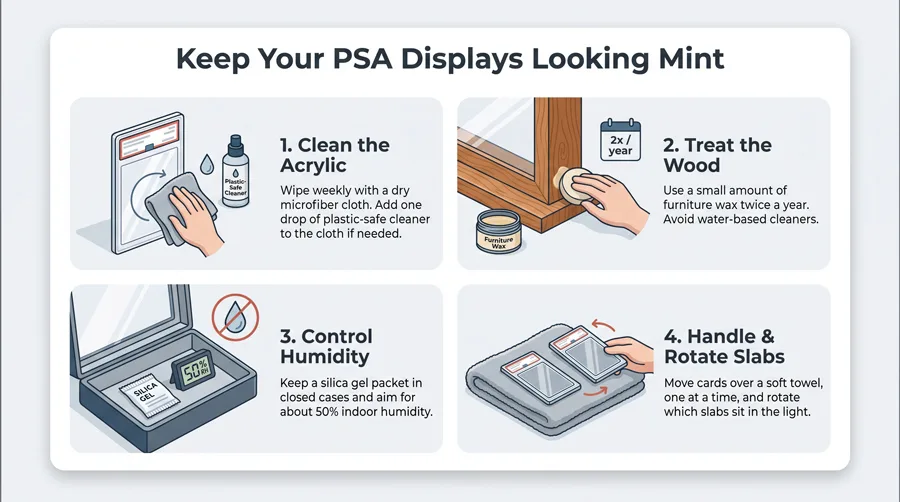
Start with the clear panel. Wipe it with a dry microfiber cloth each week. If fingerprints remain, place a single drop of plastic-safe cleaner on the cloth (never directly on the acrylic) and polish in gentle circles until the surface shines.
Treat wood frames the way you treat a coffee table. A dab of furniture wax twice a year keeps walnut or oak from drying out. Skip water-based cleaners; moisture can swell wood fibres and loosen joints.
Control humidity. Slip a silica-gel packet inside closed cases and replace it every six months. Aim for indoor humidity near 50 percent to stop slab gaskets from fogging.
When you rearrange cards, lay a soft towel on the table and move one slab at a time. Rushing risks dropped corners and hairline scratches. Mount heavy wall cabinets first, then load the cards; your drywall anchors will stay secure.
Finally, rotate displayed cards every few months. Even with UV-filtered acrylic, steady light exposure ages ink. Swapping slabs lets you enjoy the rest of your collection and keeps every card vibrant for years.