The best European road trips share one quality that no flight-and-transfer itinerary can replicate: the road itself is the destination. European highways and back lanes were built over centuries to connect villages, cross mountain passes, and trace coastlines, which means a two-hour drive can move through three distinct landscapes before lunch.
Self-drive Europe travel is not about covering distance efficiently; it is about what surfaces between the headline stops, the empty headland, the unmarked lane down to a harbor, the castle visible from the road for exactly forty seconds before the forest closes back in.
Why Europe Rewards the Driver
This road trip Europe guide covers seven routes chosen for variety of terrain, quality of the driving experience, and the strength of what waits between the named attractions. Coordinating the logistics across foreign mountain passes and remote coastlines demands specialized regional knowledge.
Utilizing resources like custom-curated European tours with Tenon Tours provides the structural support needed to secure the right vehicle and map out achievable daily distances. These seven paths span from brief coastal stretches to full island circumnavigations, representing the diverse driving holidays worth building a trip around.
1. The Wild Atlantic Way, Ireland
At 2,600 kilometers, the Wild Atlantic Way runs from Donegal in the north to Cork in the south along Ireland’s Atlantic-facing edge. The tarmac hugs cliff sections, dips through stone-walled fishing villages, and opens onto headlands where nothing sits between the vehicle and the ocean.
High winds and sudden rain squalls frequently dictate driving speeds on the exposed coastal sections.
Named stops worth building a schedule around include the Cliffs of Moher, Connemara’s bog roads, the Dingle Peninsula, and Slieve League in Donegal. These northern sea cliffs stand taller than the Cliffs of Moher while drawing a fraction of the daily visitor traffic.
May through September delivers the most daylight for driving, and late spring offers vivid green landscapes alongside lighter congestion on the narrow approach paths.
2. The Scottish Highlands Loop from Inverness
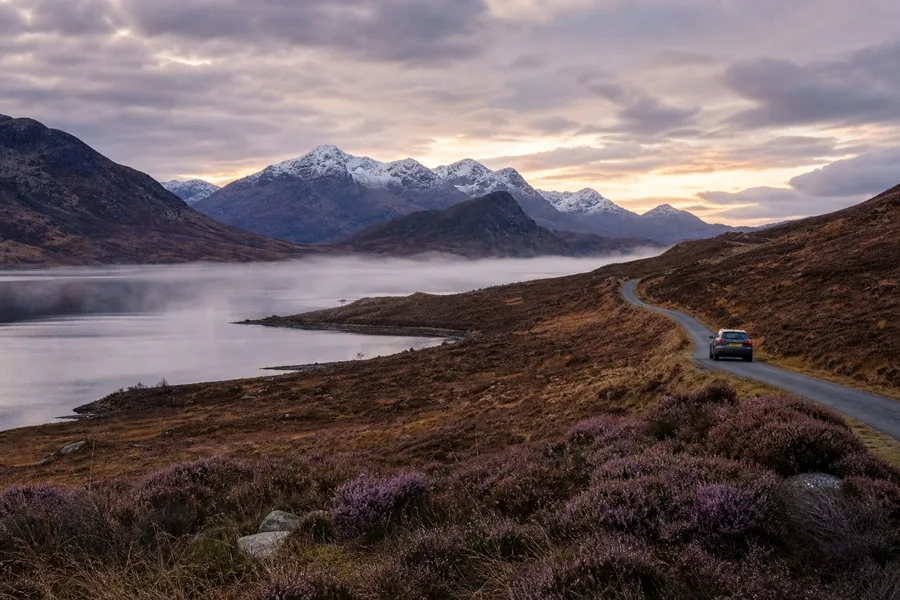
Single-track roads in the Scottish Highlands require absolute focus since these one-lane routes carry traffic in both directions. The regular passing places marked by white diamond signs dictate the operational rhythm of the journey rather than acting as optional courtesies. The reward for that attention is deep solitude across an environment that remains largely unchanged by modern development.
Loch Ness, Eilean Donan Castle at the junction of three lochs, Glencoe’s glacially carved valley, and Cairngorms National Park deliver different geographic profiles within a single highland loop. Late spring brings wildflowers and northern evenings with usable light past 10 p.m.
Early autumn trades that brightness for golden heather and low mist settling over the lochs, creating the specific visual contrast that draws photographers to the region.
| Pro Tip: White diamond signs aren’t suggestions. Pull into passing places to your left and let oncoming cars pass; this is the road’s operational rhythm, not a courtesy. |
3. The Ring Road, Iceland
Route 1 circumnavigates Iceland at roughly 1,332 kilometers, exposing drivers to shifting topography hourly. Glaciers, black sand beaches, geothermal fields, remote eastern fjords, and volcanic lava plains surround the tarmac in rapid succession. Jökulsárlón glacier lagoon, where icebergs drift onto a black sand beach, and Lake Mývatn’s geothermal craters serve as distinct geological anchor points for the drive.
June through August keeps all highway sections open and provides near-24-hour daylight for extended travel periods.
September brings the possibility of aurora borealis without committing to heavy winter conditions, which routinely close sections of Route 1 between November and April. Travelers mapping out ten days or more frequently add the Snæfellsnes Peninsula as a western extension.
4. The Amalfi Coast, Italy
The Amalfi Coast road demands technical skill due to switchbacks carved into cliff faces and a single lane handling two directions of traffic alongside commercial buses.
A 7 a.m. departure from Sorrento before tour circuits begin determines whether the morning remains a continuous coastal drive or devolves into a traffic queue above the Tyrrhenian Sea. As the road curves left, Positano appears stacked vertically below in one of the most recognized images of Italian driving.
Ravello rewards a short inland detour with elevated coastal views and a slower pace than the densely packed waterside towns. April through early June offers the most manageable surface conditions before summer heat peaks. July and August bring heavy congestion on a route built with narrow margins and minimal guardrails.
| Important: Depart Sorrento by 7 a.m. A post-bus start trades a cinematic coastal drive for a dangerous, standstill traffic queue on a cliff edge. |
5. The Douro Valley, Portugal
The Douro Valley routes trace river bends through terraced vineyards climbing steep schist walls in tight geometric rows. These agricultural formations are the result of two thousand years of manual cultivation on near-vertical slopes. The winding road layout slows down vehicle momentum naturally as the path weaves through active wine estates.
Pinhão serves as the region’s logistical center, with Quinta do Crasto offering a working estate visit. Late September through October brings harvest season, when the terraces buzz with activity and afternoon light turns the valley golden.
April and May offer cooler temperatures without the heavy competition for local accommodation that the autumn harvest period creates.
6. The Croatian Coast, Istria to Dubrovnik
The Croatian coastal drive places the Adriatic Sea on one side and limestone karst hills on the other for a 600-kilometer southward run. This environment ranks among the best road trips in Europe for men seeking layered historical architecture adjacent to the highway.
Roman amphitheaters stand intact in Pula, Venetian building styles mark Rovinj, and Diocletian’s Palace in Split operates as a functioning modern neighborhood.
Plitvice Lakes National Park justifies an inland detour of roughly 140 kilometers from the primary coastal route. East of Split, the island of Hvar is easily accessible by a short vehicle ferry crossing.
Traveling in May, June, or September keeps sea temperatures prime for swimming while avoiding the dense summer crowds that fill Dubrovnik’s walled city.
| Key Insight: Diocletian’s Palace in Split isn’t a roped-off museum; it’s a functioning neighborhood, making 1,700-year-old history a lived experience. |
7. The Black Forest to the Bavarian Alps, Germany
This sequence moves through distinct geographical zones over a single continuous push. The Black Forest entry through Baden-Baden gives way to the Triberg waterfalls and the historic university streets of Freiburg. The route then connects to the Romantic Road, passing early medieval towns like Rothenburg ob der Tauber before arriving at the foothills below Neuschwanstein Castle.
The final leg south to Berchtesgaden introduces Alpine scale near the Austrian border, where steep gradients replace the flat timbered sections driven earlier. Early autumn keeps all mountain passes safely crossable while offering a cooler climate for long days in the car. Late October brings early snow to higher elevations, shifting traction requirements for those entering the Alpine zones.
Your Next Steps
Executing any of these seven routes requires specific timing, vehicle parameters, and regional knowledge to function smoothly. The empty road through the Glencoe valley and the unobstructed morning switchbacks in Italy rely exclusively on calculated scheduling rather than luck.
Navigating foreign road networks effectively demands understanding which car handles cliffside passes and when seasonal closures block coastal approaches.
| Author Profile: Tenon Tours is the leading boutique tour operator of customized European journeys for curious travelers seeking authentic, meaningful connections. |