Engineers often select instruments based solely on peak sampling rates, only to watch their signal integrity crumble in the face of real-world industrial noise. Data acquisition requires more than speed; it demands hardware that actively shields measurements from ground loops, high-voltage spikes, and high-frequency interference. Selecting the wrong interface topology can render an expensive sensor array entirely useless.
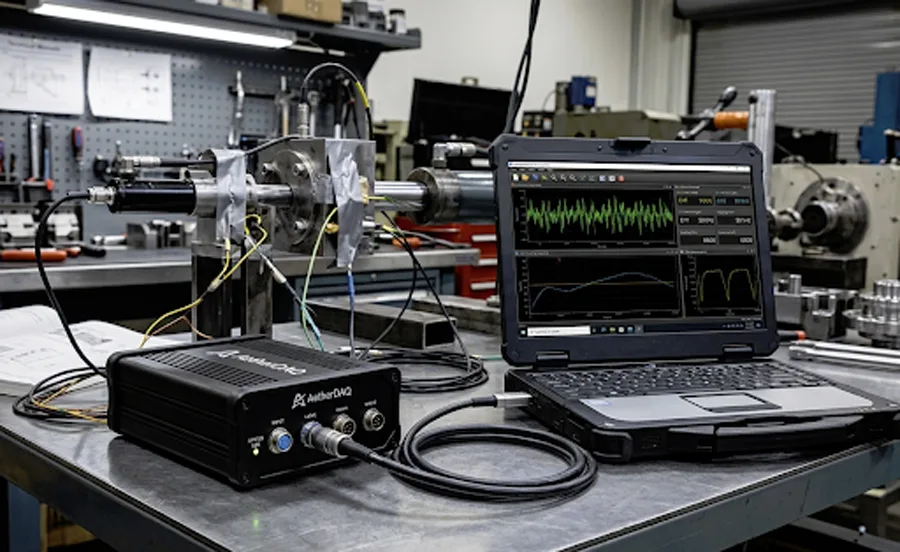
Assess the Integrity of Your Signal Chain
Field technicians measure many thousands of physical phenomena as part of their role, yet these data points can suffer from signal degradation before reaching the processing software. The foundation of any dependable system rests on structural protection.
Selecting hardware with robust channel-to-channel isolation prevents cross-talk and ensures that a massive voltage spike on one sensor does not cascade through the system to fry your host computer. When accuracy is non-negotiable, processing architectures must match your specific environmental conditions.
Modern external systems solve these challenges through localized architectures:
- High-end architectures leverage 24-bit analog-to-digital converters to deliver up to 256 times greater vertical axis resolution than baseline 16-bit units
- Built-in anti-aliasing filters serve as steep, automated low-pass shields that prevent high-frequency noise from masking your core wave data
- Rugged external modules distribute processing loads safely outside the main chassis to eliminate internal electrical noise interference
Engineers who need to explore USB DAQ options look closely at how a unit handles analog signal conditioning. If your hardware lacks hardware-driven isolation, software calibration cannot save your dataset.
Balance Bandwidth Requirements Against Portability
Field testing introduces unique environmental obstacles that static laboratory setups never encounter. A desktop PCIe system delivers incredible raw processing power, but balancing an industrial PC enclosure on a vibrating test vehicle is an operational nightmare. Compact USB modules deliver laboratory-grade fidelity straight to mobile workstations without sacrificing signal quality.
This plug-and-play convenience must be weighed carefully against the specific throughput constraints of the interface bus. While modern USB interfaces easily manage multi-channel setups for temperature or strain gauges, pushing dozens of high-frequency acoustic emissions sensors simultaneously will stress the bus bandwidth limit.
For distributed layouts spanning massive testing structures, splitting your deployment into synchronized network nodes or utilizing hybrid logging architectures often yields cleaner results than daisy-chaining unpowered hubs. This is a far cry from adjacent technologies, such as audio hardware designed for streamers. While there’s a lot to balance and consider, putting time into weighing your options will pay off in the field.
Evaluate Environmental Constraints and Form Factors
Deploying sensitive test equipment into extreme territory requires a deep understanding of structural ingress protection. A standard plastic enclosure might perform flawlessly on a laboratory bench, but it will quickly fail when subjected to the thermal cycles, moisture, and high vibration of an automotive engine bay or an open-air launchpad. You must look for chassis milled from solid aluminum blocks and rated with high IP compliance to ensure long-term survivability.
Connectors represent another common point of failure that rookie test engineers overlook. Consumer-grade USB connectors lack locking mechanisms and can shake loose during high-G acceleration testing.
Industrial-grade systems solve this problem by incorporating threaded LEMO or circular Amphenol connectors that lock the signal line securely to the chassis. These heavy-duty physical interfaces keep your critical data stream intact when a test vehicle encounters unexpected turbulence or heavy impact.
Power distribution is another hidden variable that separates industrial setups from basic laboratory gear. While bus-powered modules offer incredible portability for quick troubleshooting field trips, they draw directly from the host laptop battery.
This arrangement can lead to voltage drops that compromise the stability of sensor excitation. Opting for externally powered modules or systems with wide-range DC inputs guarantees that your strain gauges and pressure transducers receive a perfectly stable excitation voltage regardless of the host computer’s power state.
Optimize Sensor Synchronicity
Matching your hardware layout to your sensor profile is the ultimate step in eliminating timing drift across multiple physical channels. High-frequency dynamic applications like shock testing demand simultaneous sampling topologies so every single sensor captures data at the exact same fraction of a microsecond. Check our blog for more insights into the latest and greatest tech across a range of industrial and consumer contexts, as well as posts on topics as diverse as finance and entertainment.