Most man caves get the big stuff right. TV goes up. Couch goes in. Maybe a mini fridge lands in the corner if you’re feeling ambitious. Then someone flips on the ceiling light, and the whole room looks like a dentist’s office.
Lighting is the one thing that separates a room you hang out in from a room you actually want to hang out in. We’ll spend two weeks comparing soundbars and arguing about screen sizes, then leave the lights to whatever builder-grade flush mount was already screwed into the ceiling. That’s backward. It should be one of the first decisions, not the last.
Good lighting sets the mood before anyone even sits down. And when it’s done right, it becomes part of the man cave’s whole identity, like you just feel it.
A custom neon sign is one of the best ways to pull that vibe together because it does two things at once. It lights up the room, and it makes it personal, which is pretty cool. Like, no other single piece really does both.
Why Overhead Lighting Kills the Vibe
Ceiling lights flood a room from above. Fine for a kitchen. Fine for a bathroom. But in a man cave, that flat brightness strips out all the atmosphere. You end up with a box containing stuff, and that’s about it. No depth. Just uniform light doing nothing for the room.
The fix is straightforward: layer your light sources. You want some glow from the sides, something near or below eye level, and one piece on the wall that pulls attention. Floor lamps and table lamps can help, but they eat up surface space and floor real estate you probably don’t have.
A wall-mounted neon sign skips that tradeoff entirely. It sits flush against the wall, throws a wide ambient glow, and only needs a standard plug with a thin cord you can tuck behind furniture.
Color matters here more than people realize. Warm white and soft orange tones pull a room toward a bar or lounge feel. Blues and purples push it toward a gaming vibe. Color temperature (measured in Kelvins) is the technical term behind this, but honestly, you don’t need the jargon.
Ask yourself one question: Do I want this room to feel like a cocktail bar or an arcade? That’s your color, right there.
What Makes Neon Work in a Man Cave
Old-school glass neon tubes were fragile, ran hot, and hummed loudly enough to be heard across a quiet room. If you’ve ever stood under a vintage neon bar sign, you know the sound. Modern LED neon flex is a completely different product wearing the same name.
The tubing is silicone or PVC, stays cool to the touch, and the power draw is low enough that your electric bill won’t flinch. Most custom signs in the 20-to-30-inch range draw between 15 and 30 watts, roughly the same as charging a phone.
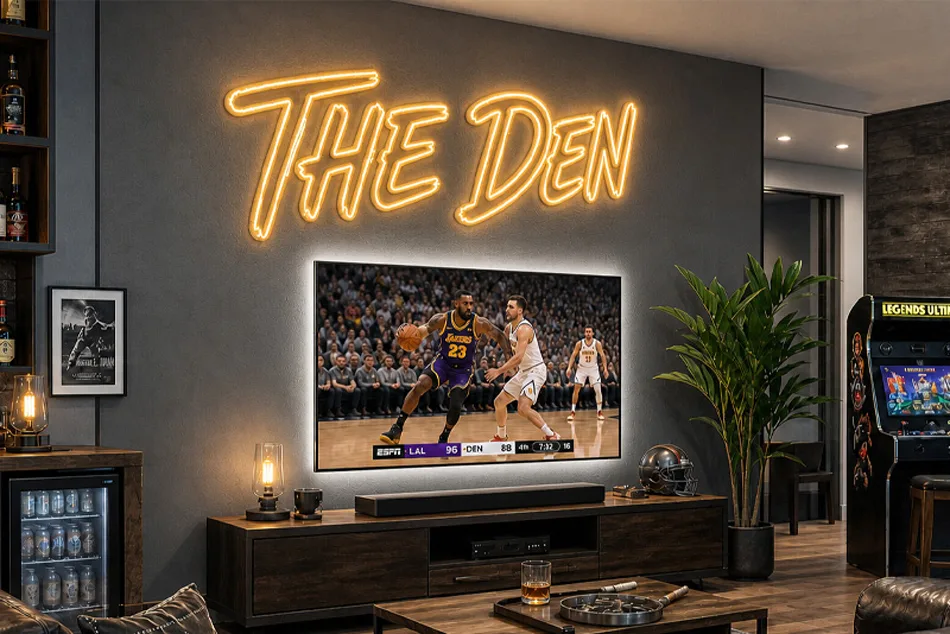
What’s actually interesting is how placement alone changes the room’s character. Mount a neon sign behind a bar, and it signals “this corner is for drinks.” Put it above a gaming setup, and it frames the whole station. Hang it on a focal wall by itself, and suddenly, that wall is the anchor of the room. Same sign. Completely different effect.
Because these are custom, you can pick the text, font, size, and color. Your last name. A line that only makes sense to your group of friends. That kind of personalization is what separates a custom neon sign from a generic poster you grabbed off a shelf. Nobody else owns the same piece, and that’s the whole point.
Getting the Size and Placement Right
This is where most people trip up. They ordered a sign that’s too small. A 12-inch neon on a big empty wall looks like a postage stamp on an envelope. It doesn’t anchor anything, and you’re left wondering why the room still feels off.
Make sure to measure the wall you’re working with and aim for a sign that covers about 50-75% of the width. A typical accent wall runs around 8 feet wide, so something in the 30-to-40-inch range hits the sweet spot. Bigger rooms with higher ceilings can handle 48 inches and up without looking overdone.
Height matters just as much as size. Eye level works for most setups. But if the sign sits above a couch or behind a bar counter, raise it about 6 to 8 inches above head height. You want people to see it when they walk in, not after they crane their necks.
One more thing: think about the wall behind it. Neon shows up best against darker surfaces (charcoal gray, exposed brick, dark wood paneling). White walls work, but the glow fades because there’s less contrast. Even a single accent wall in a dark matte finish behind the sign makes a visible difference, and you don’t have to repaint the whole room to get it.
The Dimmer Question
Most quality LED neon signs ship with an inline dimmer or a remote control. Use it. Full brightness is great for photos, but for everyday use, dial it back to about 60 or 70 percent. That’s where you get the warm background glow without overpowering the rest of the room. You’ll notice the shift immediately.
This is why neon works as a primary mood light, not just wall decoration. Bright for game night. Low for a late-night movie. Off when nobody’s around, a framed print or a metal sign will never give you that kind of range, no matter how good it looks up there.
Pairing Neon With Your Existing Setup
A neon sign doesn’t have to carry the room alone. It works best as the centerpiece in a layered lighting scheme. Here’s what pairs well with it:
LED light strips behind the TV or along shelving. These reduce eye strain during gaming or movies and complement the neon’s color palette. If your sign is warm white, run warm-toned strips behind the screen. Matching the tones keeps the room feeling cohesive instead of chaotic.
A single accent lamp near the seating area. Something low and warm. Not a floor lamp that looks like it wandered in from the living room. A small Edison-bulb table lamp or a vintage desk light adds a second layer without competing with the sign.
Smart bulbs in any overhead fixtures. If you can’t ditch the ceiling light entirely, at least control it. A smart bulb set to 2700K (warm white) at 30 percent brightness fills in the gaps without washing out your neon. You can always shut it off when the sign is handling the atmosphere on its own.
What This Actually Costs
Custom neon signs aren’t pocket change, and I’m not going to pretend they are. A quality piece in the 20-to-30-inch range runs between $200 and $350, depending on the design’s complexity, the number of colors, and the maker. Larger signs, 40 inches and above, can push past $500.
Is that cheap? No. But compare it to what most guys drop on a single piece of tech for the cave. A decent soundbar runs $250 to $400. A good gaming headset is at least $150. A nice bottle of bourbon? That’s gone in a month.
A custom neon sign is a one-time purchase that shifts the room’s feel every time you turn it on. Cost-per-use, it’s one of the smarter purchases you can make in a personal space.
If the budget is tight, start smaller. A 15-inch sign with a single word or short phrase still makes an impact, especially tucked into a corner bar area or mounted above a shelf. You can always size up once you see how much the lighting changes the room.
Man cave lighting rarely gets the attention it deserves. We treat it as an afterthought when it should be one of the first things on the list after the furniture lands. A good custom neon sign gives you mood lighting, wall art, and personal expression in one piece.
Mount it right, dim it down, and the whole room shifts from “finished basement” to something that actually feels like yours.