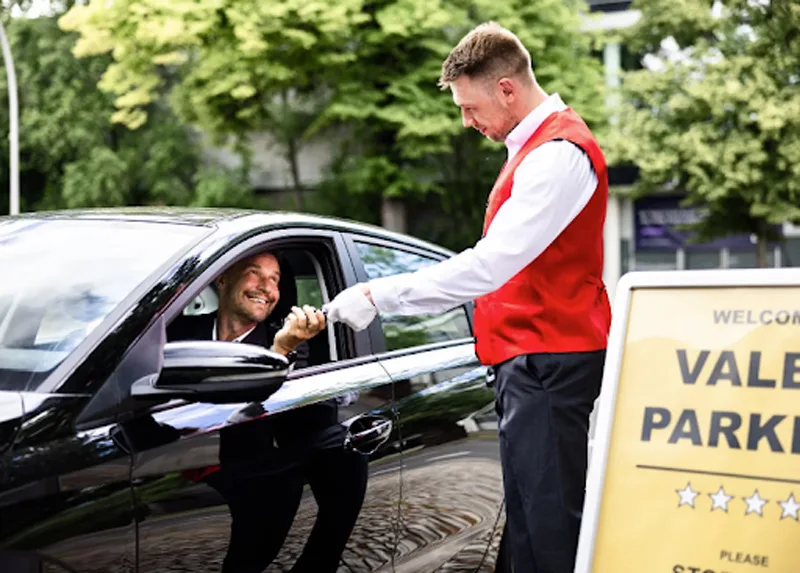
You have about three seconds. That’s roughly the amount of time it takes for someone who just entered the hotel to form their first impression. Before the lobby, before the room, before the minibar. Those first few seconds belong to the valet. And the uniform they wear carries most of the weight. But modern uniforms are not designed only to impress. They are tailored to the needs of the people who wear them for hours a day, in sun, wind, and rain, all while staying comfortable and looking polished.
The First Impression Is an Attire
As the first point of contact, the valet’s appearance plays a crucial role in setting the tone of the entire experience for clients. A professional, on-brand hotel valet uniform reflects the hotel’s identity, instilling trust and confidence from the very first interaction.
This is more than just a symbolic outfit. It has a direct effect on how guests perceive the experience before them. An impeccably styled uniform says: “We care about the details.” A poorly styled and ill-fitting uniform gives guests the complete opposite message, regardless of how luxurious the rest of the hotel might be.
So, what is a modern uniform expected to do? All of it. Look great, survive a full outdoor shift, reflect a brand, and make the employee feel good wearing them.
Purpose Comes First: Attire for Performance, Not Just Style
Behind every uniform is a person who will be wearing it while doing quite a demanding job. They are on their feet for hours at a time, often outdoors in all sorts of weather conditions, running from cars to guests to luggage. A uniform that looks great on a hanger in the wardrobe but is uncomfortable and impractical on the employee’s body is a failure by design.
Modern valet uniform design has moved to garments that support rather than hinder. The diversity of the job requires pieces that balance comfort and movement without compromising on style. Stretch-woven fabrics, articulated seams, and breathable linings are now basic features. Moisture-wicking fabrics and breathable mesh panels are invisible to the guest but invaluable to the wearer. Pockets may seem like insignificant details, but deep, well-positioned pockets can keep key fobs, phones, printed tickets and more, are more than valuable for the valet staff.
Durable and functional workwear is taking the lead over ‘brochure, costume-like’ pieces. Garments are engineered for endurance, designed with intention, and styled to honour both the brand and the people wearing them.
Seasonal Versatility: Uniform Systems, Not Just Outfits
One of the key changes in contemporary hotel valet uniforms was switching from outfits to uniform systems. Rather than prescribing a single appearance for a whole season, hotels now choose to create a system of compatible items that can be layered and adapted across different seasons.
Long and short-sleeved shirts that match fabric-wise give the valet staff a base from which they can style through different seasons without losing cohesion. The same Oxford shirt for hot weather can be paired with a service vest for autumn or a jacket for cold winter days – all within the same colour scheme and branding.
Modern bomber jackets keep hotel valets warm on cold, brisk days while making the team look stylish. Designed to be both functional and fashionable, these jackets can be customised with a logo embroidery so the team remains easily identifiable to guests.
Inclusive Design: Every Body, Every Position
The hospitality workforce is diverse, and uniforms that accommodate different body types are essential. The idea of a ‘single silhouette’ uniform that would suit only one body type is long gone, and leading uniform brands offer a variety of options in terms of fit, cuts, and sizes to ensure comfort and confidence.
Shirt dresses, for example, make an excellent choice for women. They can be easily layered up and accessorised to the venue’s unique style. Slim-fit trousers, chinos, blazers, and dresses in a unified colour scheme allow for a cohesive look without enforcing a one-size-fits-all approach.
Branding on the Move
While desk clerks work at the hotel, valets work in the open air, far removed from the setting of the hotel building. Thus, strong branding is especially important.
Logo embroidery and branding are key for valets as they are often outside the hotel and should be easily recognised for a smooth first touchpoint with the guest. A well-placed embroidered logo on the chest or a branded name badge tells the approaching guest: I’m with the hotel, I’m here to help. It removes ambiguity, creates trust, and reinforces brand identity in the car park, the street, or the drop-off zone, where signage cannot do that work alone.
Colour palettes are more interesting too. Moving away from the dominant black and navy, modern options include earthy tones, forest greens, deep burgundies, and charcoal greys. Paired with the right uniform accessories, the final look is polished and professional.
Durability and Sustainability: The Uniform of the Future
In addition to the design, hospitality uniforms need to be durable. They are worn daily, laundered frequently, and exposed to the elements most of the time. Quality-constructed garments will stand the test of time and lower replacement costs.
Sustainability is no longer a niche idea, but a philosophy aligned with the brand’s values. The most progressive hotels today are looking for sustainable workwear, and more suppliers are answering this by producing eco-friendly uniforms. Consider suppliers that offer fast turnaround times and no minimum order quantity requirements.
The Broader Context
For any valet at a hotel, the uniform is beyond just clothes. It marks the beginning of the customer’s journey into your hotel. The message conveyed by an impressive design is one of professionalism, style, and identity from the very start. When done well, balancing form, comfort, inclusiveness, seasonality, and visual appeal, the effect is not only a nice image but a promise for great service.
In the end, what a valet wears is what a hotel says about itself. Make it count.