We all see that promise—“strict no-logs policy”—splashed across every VPN homepage. It sounds comforting until a subpoena arrives and a provider quietly hands over user data. So we put 24 major VPNs to the test, combing through audits, court filings, and police-seizure reports. Our goal: find the services that truly have zero data to surrender when pressure mounts. Whether you’re a security lead, a journalist, or a privacy-first streamer, this guide will show which VPNs deserve your trust—and which rely on borrowed reputation. Ready to separate proof from puff?
What counts as proof, and why audits are only half the story
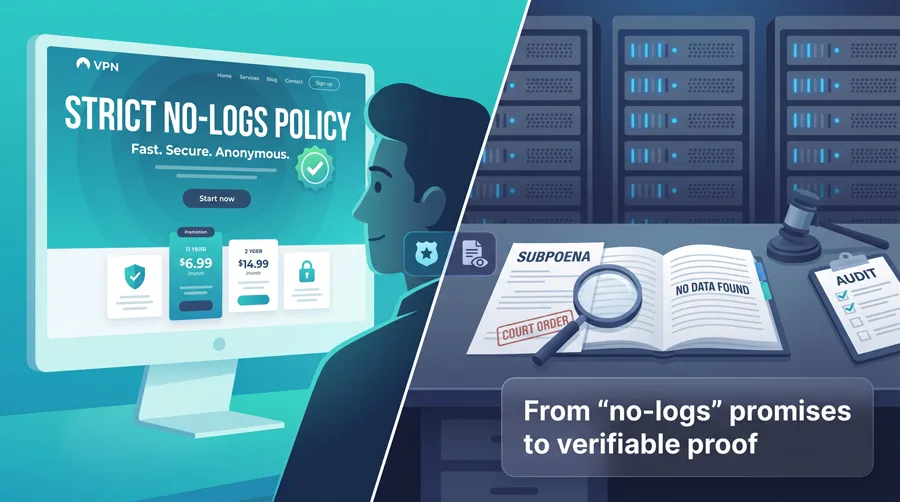
Before we rank a single VPN, we need a shared definition of proof.
An independent audit is the most visible badge. Firms such as Deloitte, KPMG, and Cure53 inspect server images and log pipelines; ExpressVPN alone had 23 published audits by 2025. Audits matter, but they capture a single moment.
Hardware evolves, code changes daily, and a clean report ages quickly. That’s why we value real-world pressure tests just as highly. When Turkish investigators removed an ExpressVPN server in 2017 and found zero data, or when U.S. courts subpoenaed Private Internet Access in 2016 and 2018 and received the same answer—nothing—privacy shifted from claim to fact.
We also track quieter transparency signals: open-source clients, warrant canaries that refresh monthly, and RAM-only fleets that erase data on reboot. Each element shortens the trust chain between you and the provider.
So, as you read the rankings, remember the formula:
audit ✚ real-world test ✚ daily transparency = proven privacy.
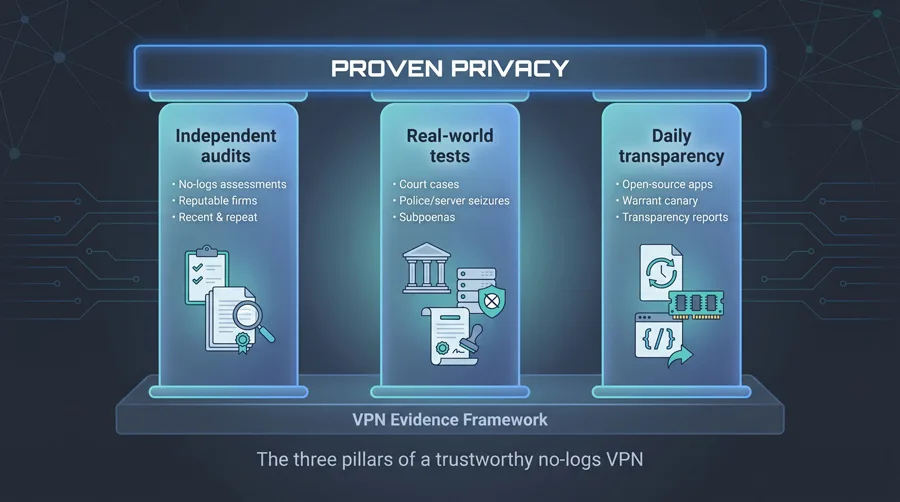
Services that score in all three arenas rise to the top; polished PDFs alone cannot save a VPN if its server spills secrets the moment someone pulls the plug.
How we built the rankings
We treated each VPN like a zero-trust job applicant; marketing claims were ignored, and only verifiable proof earned points.
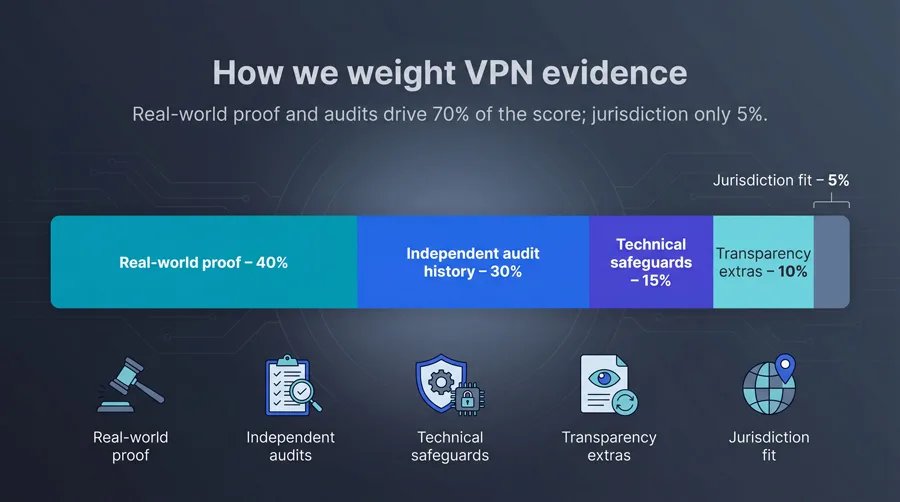
Our baseline was the 2025 Top10VPN study by Simon Migliano, which weighted real-world evidence three times higher than audits. We expanded that idea into five weighted buckets:
- Real-world proof – 40 percent
Police raids, court subpoenas, or server seizures must end with zero data surrendered. - Independent audit history – 30 percent
Recent, repeat audits from reputable firms. One-off checks from years ago score lower. - Technical safeguards – 15 percent
RAM-only fleets, full-disk encryption, and self-hosted DNS show the policy is built into hardware. - Transparency extras – 10 percent
Open-source apps, live warrant canaries, and monthly transparency reports signal a willingness to be scrutinized. - Jurisdiction fit – 5 percent
A privacy-friendly home base helps, but a flawless no-logs design can still succeed inside the Five Eyes.
Every provider started at zero and climbed as evidence stacked up. A fresh Deloitte audit added points, and a court record confirming “nothing was found” added more. Ties were rare; when scores matched, diversity of audits (reports from multiple firms rather than one loyal partner) broke the deadlock.
This rubric keeps the list honest: every score traces back to something that happened in the real world, not a promise buried in the footer.
The field at a glance
Before we dive into individual contenders, here’s the scorecard we used while grading. One glance shows who has been audited, who has passed a real-world test, and whether each network forgets data when it reboots.
| VPN | Latest no-logs audit | Real-world proof | RAM-only servers | Home base |
| TorGuard | — | Breach 2019, no logs exposed | Partial | United States |
| ExpressVPN | KPMG 2025 | Turkey server seized 2017, no data | Yes | British Virgin Islands |
| Mullvad | Cure53 2022 | Swedish police raid 2023, nothing handed over | Full-disk encryption | Sweden |
| Private Internet Access | Deloitte 2024 | US subpoenas 2016 and 2018, zero logs | Rolling out | United States |
| ProtonVPN | Securitum 2025 | No incidents to date | Full-disk encryption | Switzerland |
| NordVPN | Deloitte 2024 | Breached server 2018, no user info leaked | Yes | Panama |
| Surfshark | Deloitte 2025 | No incidents to date | Yes | Netherlands |
| Windscribe | Packetlabs 2024 | Dutch server seized 2026, no logs | Yes | Canada |
| CyberGhost | Deloitte 2022 | No incidents to date | Yes | Romania |
| IVPN | Cure53 2019 | No incidents to date | Core nodes in RAM | Gibraltar |
| OVPN | — | Swedish court case 2020, no logs | Yes | Sweden |
| TunnelBear* | Cure53 2024 | Transparency reports only | No | Canada |
*TunnelBear publishes a full security audit every year; 2024 is the most recent at press time.
Key takeaways:
- Audits are now table stakes. A mainstream VPN without a third-party check stands out for the wrong reasons.
- Audit, plus real-world validation, is the gold standard. ExpressVPN, Mullvad, PIA, and Windscribe combine both forms of evidence, so they enter the detailed rankings with a head start.
Keep this grid handy as you read on; it underpins every score that follows.
1. TorGuard: zero-log veteran still waiting for a public audit
www.torguard.net has operated since 2012, when “no logs” was still a niche promise, and its homepage now lists 3,000+ servers in 50+ countries along with built-in port-forwarding that appeals to torrent power users. In October 2019 a security researcher disclosed that a single TorGuard server had been breached months earlier. The company confirmed the incident and said no IP addresses, timestamps, or browsing data were present. That remains the only known test of its policy, and it passed.
Yet TorGuard is now the only VPN in this ranking without an independent audit. Management argues that a 14-year clean record and a strict privacy policy are enough, but transparency advocates disagree.
Power users are TorGuard’s niche. Obfuscation modes such as Stunnel and OpenConnect help bypass firewalls, and you can pay with crypto or even retail gift cards for extra anonymity. Recent WireGuard upgrades provide solid torrent performance, although Cloudwards tests in 2026 recorded U.S. download speeds averaging about 18 Mbps. The trade-off is closed-source apps and an interface that has not seen a major redesign since 2020.
Headquartered in the United States, TorGuard relies on a classic defense: store nothing, surrender nothing. Until a public audit or a court case confirms that stance, it remains our lowest-ranked “proven” option.
Why you’d choose it
- Advanced stealth features, anonymous payment options, and a long operational history
- Solid torrent speeds after WireGuard rollout
Keep in mind
- No third-party audit, and closed-source clients
- U.S. jurisdiction introduces NSL or gag-order risk
- Interface feels dated compared with rivals
2. ExpressVPN: privacy proved in court and under the microscope
ExpressVPN tops our list because it pairs the industry’s deepest audit trail with a real-world test few rivals can match.
In 2017 Turkish investigators seized an ExpressVPN server during the probe into the assassination of Russia’s ambassador. They found no connection logs and no metadata, a public confirmation that ExpressVPN had nothing to surrender.
Since then ExpressVPN has commissioned 23 independent audits across its apps, infrastructure, and Lightway protocol, more than any consumer VPN to date. Recent no-logs assessments by KPMG (2025) and PwC echo earlier Cure53 code reviews, all reaching the same verdict: no user-identifying data is stored.
The technical bedrock is TrustedServer, a fleet of RAM-only machines that boot from a read-only image and erase everything on restart. Even if a government takes control of a live node, data disappears when power drops. To encourage scrutiny, ExpressVPN offers up to 100,000 US dollars for critical server vulnerabilities through its public bug-bounty program.
Headquartered in the British Virgin Islands, outside the Five Eyes alliance and free of data-retention laws, ExpressVPN also publishes a warrant canary and a quarterly transparency report.
Why you’d choose it
- Proven in court and lab: 2017 hardware seizure plus 23 audits
- Consistently fast for streaming, gaming, and large downloads
- Bug-bounty and transparency culture invite outside testing
Keep in mind
- Clients are not fully open source (only Lightway and select tools)
- Pricing sits at the high end; the audit cadence is part of the premium
3. Mullvad: privacy by design, proven under a police raid
Mullvad’s mantra is simple: collect nothing, so nothing exists to give away. That claim met its toughest test on 18 April 2023, when six Swedish police officers arrived at the Gothenburg office with a search warrant. They left empty-handed; no user logs existed and no hardware was seized.
The service removes personal data from the start. Instead of an email address, you receive a random 16-digit account number. Payments can be made with cash in an envelope or various cryptocurrencies, erasing the usual billing breadcrumbs.
Technically, Mullvad encrypts every disk in its fleet and keeps configurations minimal. The company argues that a boot-locked, fully encrypted drive gives the same pull-the-plug, lose-the-data protection as RAM-only designs, a claim the 2023 raid appears to support. To prove the point, Mullvad has commissioned 18 independent audits of its apps, backend, and GotaTun WireGuard implementation since 2017; all public reports confirm no identifiable data is stored.
One trade-off is convenience. Mullvad does not optimize servers for streaming libraries, and live chat support is absent. What you get instead is a VPN built by privacy purists who prefer solid security to glossy upsells.
Why you’d choose it
- Anonymous sign-up (no email), cash payments accepted
- Police-tested no-logs claim, plus multiple open audit reports
- Open-source clients and frequent security research
Keep in mind
- Fewer entertainment perks (stream unblocking, loyalty rewards)
- No live chat; support is ticket-based and documentation-heavy
4. Private Internet Access: court-tested, code-transparent, and budget-friendly
Private Internet Access (PIA) is one of the few VPNs that can point to U.S. court records instead of a marketing slide. In 2016 and 2018, federal subpoenas demanded user logs related to criminal investigations; PIA replied that it had none, and the courts proceeded without user data.
PIA then added independent verification. Deloitte audited its no-logs policy in October 2022 and again in February 2024, with the latter confirming that the new RAM-only servers still retain zero identifiable data.
PIA open-sourced all desktop and mobile clients in 2020, and its GitHub remains active with community pull requests. A live warrant canary and quarterly transparency reports list every legal request (over 90 in 2025, zero fulfilled), giving users a clear paper trail.
Critics note the company’s U.S. headquarters, but PIA’s defense is simple: store nothing, surrender nothing, a stance already upheld in court.
Why you’d choose it
- Court-proven no-logs policy, verified twice by Deloitte
- Fully open-source apps and lively developer community
- Low prices, plus a vast server list for streaming, gaming, or P2P
Keep in mind
- U.S. jurisdiction may still deter the most cautious users
- Feature-rich interface can overwhelm first-timers
5. ProtonVPN: annual audits, open-source apps, and Swiss legal muscle
ProtonVPN was born at CERN and keeps that peer-review mindset. Every client app is open source, and the service has cleared four consecutive no-logs audits, most recently by Polish firm Securitum in September 2025. Each report confirmed that ProtonVPN stores no activity or connection metadata.
The VPN has not faced a hardware seizure, but its sibling ProtonMail was ordered in 2021 to log one activist’s IP address under Swiss law. Proton complied for email yet noted, correctly, that Swiss courts cannot compel VPN logging because the systems are separate and no hooks exist. The episode underscored ProtonVPN’s design: there is nothing useful to track.
Swiss jurisdiction adds another shield. Data requests must clear multiple court layers, and Proton’s transparency report shows zero VPN user data disclosed to date. A public warrant canary confirms no sealed orders are pending.
Technically, ProtonVPN secures full-disk-encrypted servers that boot from locked images; if hardware is seized, decrypting it is infeasible without keys stored off-box. Features such as Secure Core (double-hop through hardened sites in Iceland or Sweden) and Tor over VPN add optional layers for high-risk users.
Why you’d choose it
- Open-source apps and reproducible builds
- Four verified no-logs audits in four years
- Free tier to test before paying, plus Swiss legal protections
Keep in mind
- Long-distance speeds trail ExpressVPN and NordVPN
- Free plan blocks P2P and offers limited locations
6. NordVPN: Big Four–audited and battle-hardened after a breach
NordVPN’s privacy claims were stress-tested in 2018, when a rogue data-center contractor exploited a remote-management tool on a single Finnish server. No traffic logs or user identities were exposed, and Nord disclosed the issue publicly with a full post-mortem.
The incident pushed a network-wide shift to 100 percent RAM-only servers and a tighter audit schedule. Deloitte completed NordVPN’s fourth no-logs review in January 2024, following PwC audits in 2018 and 2020. Deloitte concluded that the service “does not retain information that could tie activity to users,” matching earlier findings.
Based in Panama, outside the 5, 9, and 14-Eyes alliances, NordVPN publishes quarterly transparency reports; each notes no user data shared. A warrant canary confirms no sealed orders are in force.
Feature-wise, NordVPN offers Double VPN, Tor over VPN, and its WireGuard-based NordLynx protocol. Independent speed tests by Tom’s Guide in 2026 recorded average speeds above 900 Mbps.
Why you’d choose it
- Fast worldwide speeds, plus privacy tools such as Double VPN
- Verified no-logs policy, backed by a Big Four audit
- Panama jurisdiction and a full RAM-only infrastructure
Keep in mind
- Full Deloitte report is not public, only a summary
- The 2018 breach remains a talking point despite no data loss
7. Surfshark: Deloitte-verified no logs and unlimited devices for less
Surfshark is the newest name in our top six, yet it already carries two Deloitte no-logs audits. The first, published in January 2023, confirmed that “no identifying data survives a session” across Surfshark’s infrastructure. A follow-up audit in June 2025 reached the same conclusion, showing the policy has stayed intact.
From day one Surfshark has run a 100 percent RAM-only network with no phased migration and no residual disks. If authorities seize a server, power-cycling wipes it clean, just as ExpressVPN proved in Turkey.
Value is Surfshark’s hook: one subscription covers unlimited devices. In independent WireGuard speed tests by TechRadar (2025), Surfshark reached more than 950 Mbps, matching NordVPN at the top of the charts. The optional Nexus feature can rotate your exit IP mid-session to foil long-term tracking.
The company merged with Nord Security in 2022 but maintains separate infrastructure and audit cycles, arguably gaining budget for additional transparency.
Why you’d choose it
- Two Deloitte-verified no-logs audits, plus RAM-only servers
- Unlimited device connections on a single low-cost plan
- Competitive WireGuard speeds, plus extras like Nexus IP rotation
Keep in mind
- Deloitte releases only summary reports, not full PDFs
- Support reps may upsell add-on bundles; stick to the core VPN plan for the best value
8. Windscribe: open source and unfazed by a 2026 server seizure
Windscribe’s privacy story includes hard lessons and clear fixes. In June 2021 two legacy servers in Ukraine were seized with disks still readable; encryption had been misconfigured. Windscribe published a root-cause post-mortem and, within six months, rebuilt its entire fleet as RAM-only. A Packetlabs audit in June 2024 verified the new setup and found no evidence of logging.
The redesign paid off on 5 February 2026, when Dutch investigators grabbed a Windscribe node during a cyber-crime sweep. Windscribe shared a photo of the empty rack on X, noting that authorities would “find a stock Ubuntu install.” Subsequent statements confirmed zero logs were recovered.
Transparency is integral. All desktop and mobile apps live on GitHub, with open issue trackers and merge requests. A monthly “Law-Enforcement Log” blog series lists each request (12 in 2025; 0 bytes of user data disclosed) and links to ticket IDs.
Windscribe also offers a generous 10 GB per month free tier that follows the same no-logs policy as paid plans. Power users get split tunneling, self-generated WireGuard keys, and the ROBERT DNS firewall for ads and trackers.
Why you’d choose it
- Police-tested no-logs claim, plus open-source clients
- Free plan with 10 GB data and the same privacy protections
- Advanced tweaks like custom WireGuard keys and ROBERT filtering
Keep in mind
- Speeds are respectable but trail NordVPN and ExpressVPN in independent tests
- Support is ticket-based; no 24-hour live chat
9. CyberGhost: Romanian jurisdiction and Deloitte-certified transparency
CyberGhost has spent a decade proving that privacy can be easy. A September 22, 2022 Deloitte audit confirmed that “no logs stick around once a session ends,” after inspectors reviewed server images, configuration management, and the token-based Dedicated IP system. Since then CyberGhost says it has moved its entire 9,000-server fleet to RAM-only hardware, erasing data on every reboot.
Romania helps. The country repealed its data-retention law after the Constitutional Court struck it down in 2014, following the CJEU decision that invalidated the EU Data Retention Directive. That legal backdrop lets CyberGhost publish quarterly transparency reports. In 2025, for example, it recorded multiple police requests and 0 bytes of user data disclosed.
Ease of use is the ace card. Apps label servers for streaming, torrenting, or gaming; one tap and you are connected. A “NoSpy” cluster sits in a privately operated Romanian data center accessible only to CyberGhost staff, adding an extra moat for cautious users.
Why you’d choose it
- One-click interface backed by a Big Four no-logs audit
- RAM-only servers across 90 countries, and a NoSpy enclave in Romania
- Quarterly transparency reports with zero user-data disclosures
Keep in mind
- Last audit was 2022, so privacy advocates may want a fresher report
- The service shares a parent company with ExpressVPN and PIA, which some purists avoid
10. IVPN: small team, open code, and a Cure53 no-logs verdict
IVPN is a privacy purist’s VPN. In March 2019, Berlin security firm Cure53 audited its logging architecture and issued a “very positive” report, finding no evidence of retained user data. The full PDF is public.
Every IVPN app, and even its website code, is open source. You can compile the clients yourself, inspect pull requests, or run diffs after every update. Multi-hop routes are fully configurable, a built-in firewall blocks traffic outside the tunnel, and AntiTracker DNS stops ads and trackers without third-party resolvers.
The company rejects affiliate deals, keeping reviews unpaid and revenue lean. The network spans 40 countries and 56 locations as of early 2025, all on owned or directly leased hardware; speeds remain solid thanks to premium metal rather than cheap virtual nodes.
Legal pressure is minimal, but the team maintains a warrant canary and publishes an annual transparency report that recorded zero law-enforcement requests in 2025. Founders say they will shut down before logging, and the minimalist data design makes that stance credible.
Why you’d choose it
- Fully open-source code and a public Cure53 no-logs audit
- Configurable multi-hop, firewall, and AntiTracker DNS for advanced threat models
- No affiliate marketing or tracking on the website
Keep in mind
- Smaller server list and higher price than mass-market rivals
- Streaming libraries are hit-or-miss; not a focus for the team
11. OVPN: court victory beats a missing audit
OVPN proves that a written judgment can trump a glossy PDF. On September 11, 2020 the Stockholm District Court rejected a request from Swedish film companies that OVPN hand over logs linking an IP address to The Pirate Bay. The judge accepted OVPN’s statement that it keeps no logs, and the plaintiffs withdrew their claim.
The hardware design backs the testimony. Every server is disk-less and boots from a read-only USB image into RAM; pull the plug, and data disappears. To show commitment, OVPN carries an insurance policy that funds a legal fight, or a shutdown, before it would ever start logging.
A Big Four audit is scheduled for 2026, which is why OVPN ranks below fully audited rivals. In the meantime, the team publishes monthly transparency reports (6 requests, 0 bytes disclosed in 2025) and a warrant canary. Real-time graphs even show server load and uptime, rare openness for a network of servers in 32 cities across 20 countries (May 2026).
Why you’d choose it
- Court-validated no-logs stance, backed by disk-less servers
- Insurance-backed pledge to fight, or shut down, before logging
- Live transparency dashboards, and multi-hop, port-forwarding features for power users
Keep in mind
- No completed third-party audit yet
- Four simultaneous connections and a small server list may limit heavy streamers
12. TunnelBear: annual public audits make transparency approachable
TunnelBear shows that privacy can feel friendly. Every year since 2017 the Canadian provider has hired Cure53 to audit its apps and backend; the 2024 report listed 13 vulnerabilities, all patched or mitigated before publication. TunnelBear posts each full PDF—CVEs, remediation notes, and all—making it the only large VPN with an unbroken public-audit streak.
These reviews focus on code security and confirm that no usage logs are stored. Transparency reports add more context: 70 government authority requests between 2021 and 2023, zero browsing data disclosed.
The free tier offers 500 MB per month, enough for airport Wi-Fi. Paid plans lift the cap and unlock VigilantBear (kill switch) and GhostBear obfuscation for censorship zones.
Canada is part of the Five Eyes alliance, but the country imposes no VPN data-retention law, and TunnelBear’s audit history plus zero-data disclosures suggest the location has not hampered privacy.
Why you’d choose it
- Annual, fully public audits, with no summaries or paywalls
- Friendly apps that non-tech friends can master
- Handy 500 MB free tier for quick public Wi-Fi sessions
Keep in mind
- No RAM-only servers, and a modest network size
- Streaming libraries often block its IP ranges
The privacy horizon: more audits, tougher laws, and how to stay ahead
The VPN landscape keeps shifting. In 2018 only a handful of brands had opened their doors to auditors; by 2026 at least 30 consumer VPNs have published one or more third-party reports, many on an annual schedule. Big Four firms such as Deloitte and KPMG now rival security specialists like Cure53 and Securitum for VPN business.
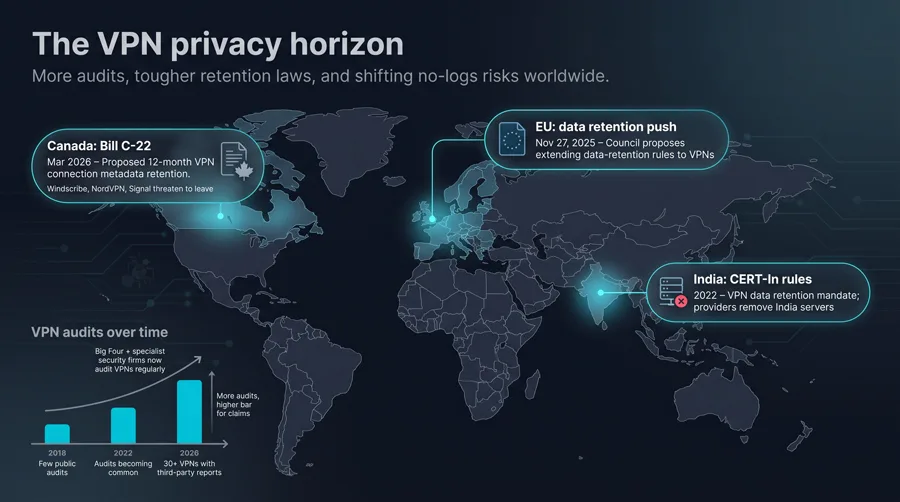
Regulators are watching. A leaked EU Council document dated November 27, 2025 proposed extending data-retention rules to VPN providers, arguing that metadata is vital for serious-crime probes. Privacy groups counter that forced logging would neuter a primary defense against mass surveillance, and the debate continues in Brussels.
North America is heating up, too. Canada’s Bill C-22, introduced in March 2026, would require providers to store connection data for twelve months. Windscribe, NordVPN, and Signal have threatened to leave the country rather than comply. The move echoes ProtonVPN’s 2022 decision to remove its India servers after CERT-In demanded data retention.
Every policy scare pushes reputable VPNs toward deeper transparency. More fleets boot solely from RAM, audit frequency is rising, and open-source releases move faster.
What can you do?
- Favor habit over headline. Pick a provider that treats audits as routine; check the PDF date before you subscribe.
- Read transparency pages. If a warrant canary goes dark or subpoena numbers spike, reconsider.
- Review jurisdiction drift. Laws change, and a once-friendly country can adopt retention rules overnight.
Privacy is a moving target. Audit dates expire, and today’s gold standard may feel rusty in two years, so schedule a quick provider health check each spring.
Frequently asked questions
Does a RAM-only server guarantee zero logs?
No. A disk-less server wipes data at reboot, but a provider could still stream logs elsewhere. Look for all three layers—RAM-only hardware, a published no-logs policy, and recent third-party audits—before you trust the claim.
How can I check a VPN’s audit?
Search the provider’s site for a PDF or blog post that names the auditor (for example, Deloitte or Cure53), states the scope (no logs versus app security), and shows the date. Anything older than two years needs a refresh.
Example VPN No-Logs Audit Page Screenshot (ProtonVPN Securitum Audit)
What if my VPN gets a secret data request?
Watch the warrant canary. If the statement disappears or the update date stalls, assume a sealed order arrived. Cross-reference the transparency report; reputable VPNs publish the number of legal requests (for example, multiple police requests in 2025 for CyberGhost, 0 data disclosed).
Will a no-logs VPN make me anonymous?
It hides your IP address and thwarts ISP tracking, but cookies, browser fingerprints, and logins can still identify you. Pair your VPN with a hardened browser, tracker blockers, and disciplined habits.
Can a government force a VPN to start logging?
Yes. Jurisdiction matters. Providers in privacy-friendly countries can fight or relocate. Many also design systems so enabling logs would require a public rebuild users would notice.
How often should I review my VPN choice?
If your provider has not released a new audit or transparency report in 24 months, shop around. Privacy standards evolve; your VPN should, too.
Wrapping up: choose proof, not promises
We compared a dozen VPNs by one yardstick: verifiable evidence. Marketing blurbs are easy; audited code, court records, and empty server racks carry real weight.
Before you subscribe, ask three quick questions:
- Has the provider published a no-logs audit in the last 24 months?
- Does its transparency page show recent legal requests, and zero user data disclosed?
- Is the warrant canary up to date?
If the answer to any of those is “no,” keep looking. “No logs” is a process, not a plaque on the homepage. The services at the top of our list prove it year after year; yours should, too.
Stay private out there, and demand the receipts.