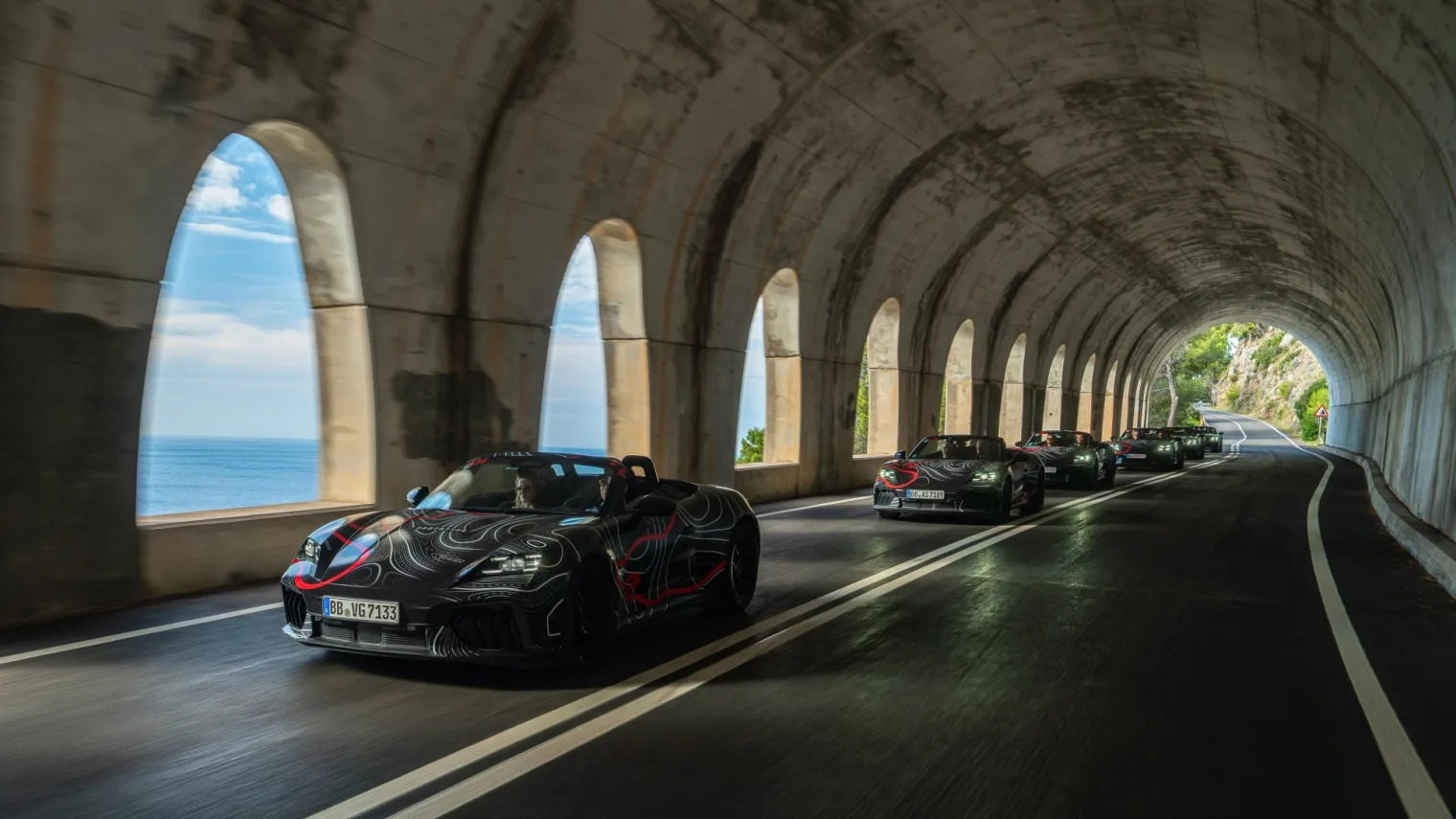
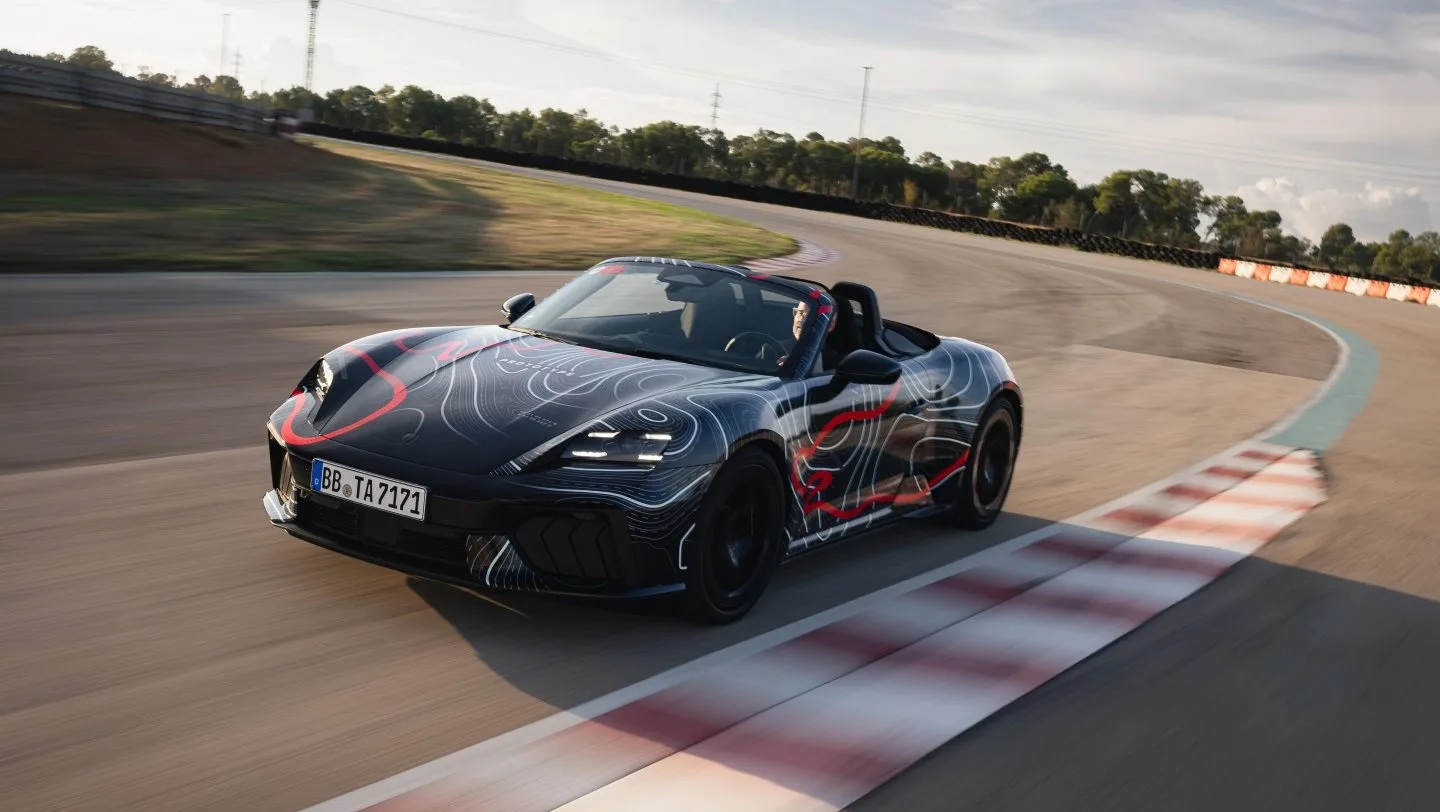
Porsche has spent years insisting the electric Boxster would still drive like a Boxster. On November 24, the company showed its work. The first electric Porsche 718 Boxster has entered the final stage of development, after prototypes covered about four million kilometres across more than 20 countries, and the production car gets its world premiere in the first quarter of 2027. The headline figures are blunt: the top version will be the most powerful 718 ever, with more than 500 horsepower, a sprint to 100 km/h in under three seconds, and a top speed above 250 km/h. For a car whose whole identity is balance over brute force, that is a loud way to go electric.
I have not driven it, and nobody outside Porsche has either, so this is a story about engineering choices, not seat time. The choices are the interesting part. Porsche could have built another fast electric roadster on a flat skateboard platform and called it a day. Instead, the company spent the development program solving the one problem that kills electric sports cars: weight in the wrong place.
The electric Porsche 718 Boxster puts its battery where the engine used to
The 800-volt battery sits directly behind the seats, in the spot the engine would occupy in a combustion Boxster. Porsche calls the layout E-Core, and it was designed specifically for the 718. The payoff is a 40:60 front-to-rear weight distribution, the same split as a traditional mid-engined car, plus the low seating position a roadster needs. Intelligent lightweight construction keeps overall weight similar to the current 911 Cabriolet models with the T-Hybrid powertrain. That is the spec that matters most here, because a heavy electric roadster with perfect power and the wrong balance would still be the wrong car.
The performance math lands with a thud, too. The current 718 Cayman GT4 RS, a 500 PS car, reaches 100 km/h in 3.4 seconds. The electric Boxster’s top version does it in under three. Same idea, quicker sprint, no combustion engine. That is the trade, stated plainly, and it is the argument the whole car will be judged on.
A gearbox that is not there
Every 718 Boxster will come standard with E-Shift, a virtual seven-speed PDK transmission operated by the steering wheel paddles. Tap the button and the car simulates gear changes, complete with a brief torque interruption and a recreated flat-six soundtrack sampled from the 981-generation Boxster GTS. Performance is identical whether E-Shift is on or off. With it switched off, the paddles change jobs and select between three stages of regenerative braking.
Two-time World Rally Champion Walter Roehrl has driven the prototype, and his verdict was that the car gives more feedback than any other electric car he has driven, with the E-Shift function lifting the driving enjoyment further. Take the quote for what it is, a factory driver praising a factory car, but Roehrl does not hand out that kind of praise lightly, and the fact Porsche put him in the car at all says something about how confident the company is in the chassis.
Four million kilometres of homework
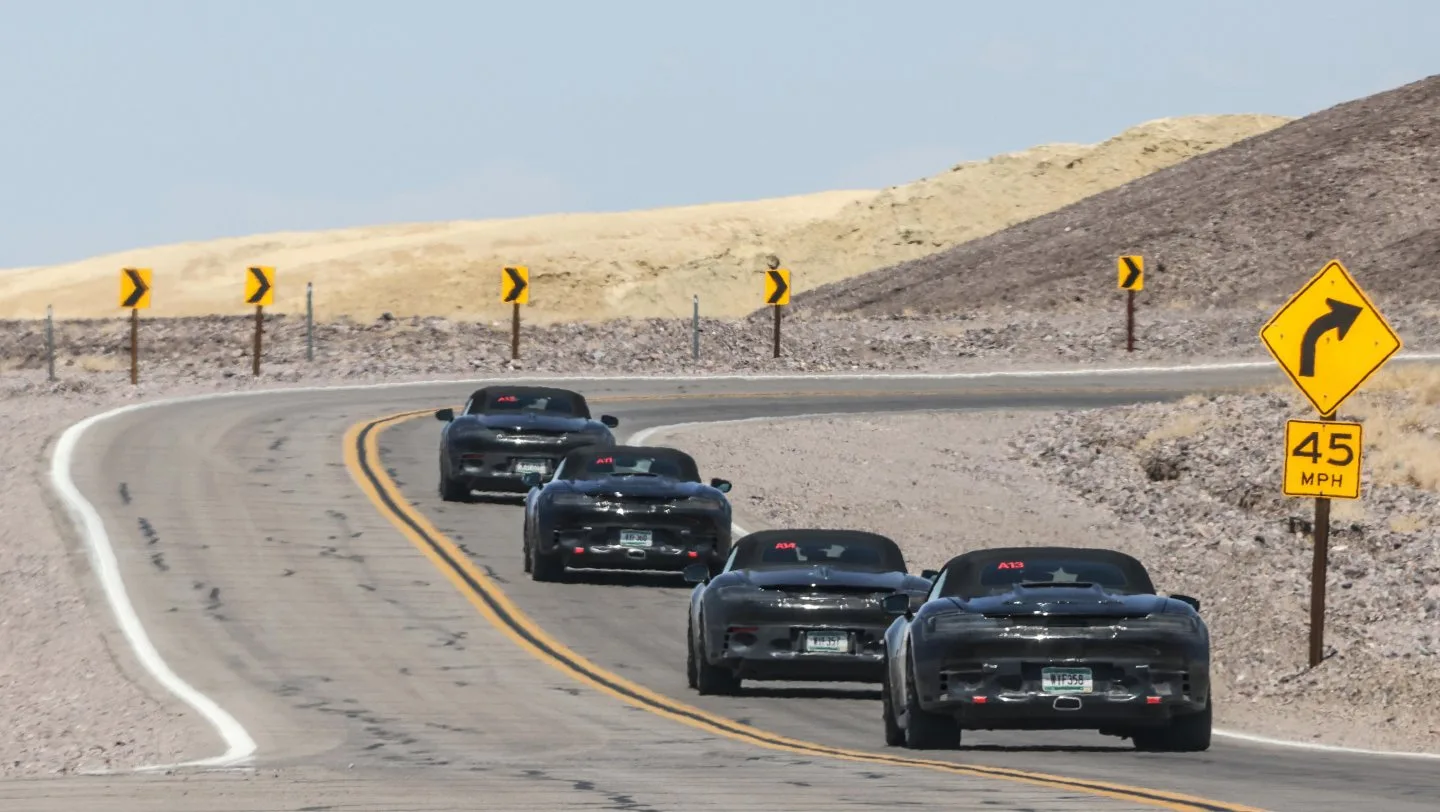
The test program ran from minus 30 degrees in Sweden to 51 degrees in Death Valley, from 86 metres below sea level to 2,750 metres up, across more than 20 countries and five different charging standards. City testing in Las Vegas, Los Angeles, and Shanghai covered everyday usability and driver assistance systems. The chassis borrows heavily from the 911: steering based on the 911 Carrera GTS, rear-axle steering available in a 718 for the first time, and the electronically controlled PTV+ limited-slip differential. The production car will be built at Porsche’s main plant in Stuttgart-Zuffenhausen, and a four-part documentary on the development program is rolling out daily on Porsche’s YouTube channel from November 24.
Who this is for
The electric Porsche 718 Boxster is for the driver who wants a roadster first and an electric car second, someone who cares more about where the weight sits than how many screens the cabin has. It is also for the Boxster loyalist who has been dreading this moment, because Porsche clearly built the car to answer that dread rather than dismiss it. Who should wait: anyone who needs a real combustion soundtrack rather than a recreated one, and anyone shopping on price, which Porsche has not announced yet.
Elsewhere this week, the Mercedes-Benz C111-II is heading to auction for the first time, Ferrari has revealed the Ferrari 296 Challenge Stradale, and Bentley has unveiled the Bentley Torcal.
The reveal lands in the first quarter of 2027, and that is when the real argument starts, whether a Boxster without a combustion engine is still a Boxster. On paper, Porsche has done the homework. I want to see the car.