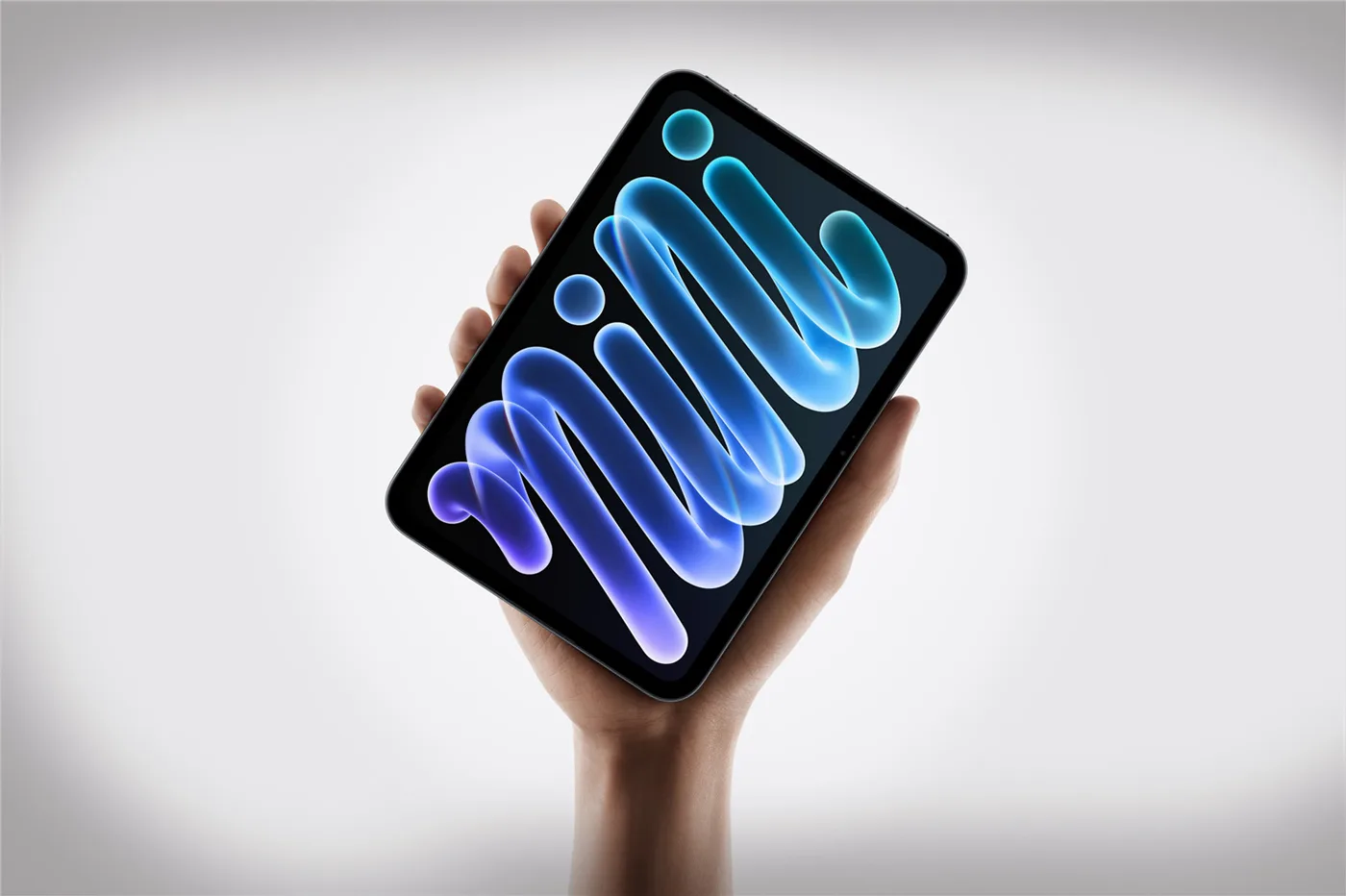
Apple just gave the iPad mini the update its fans have been asking for since the redesign, and it raised the price by $200 to do it. The new mini, announced October 26, pairs an 8.5-inch OLED display with the A20 Pro chip and an IP67 water and dust rating, in a body 5.4 mm thin. Pre-orders open Wednesday, October 28, with availability November 6, starting at $699 for Wi-Fi and $849 for Wi-Fi plus cellular.
I have not held one yet, so this is not a review. It is a read of the spec sheet against the way I actually travel: one bag, one hand free, and a tablet that has to survive flights, rain, and poolside reading. On that test, this is the first mini that does not ask you to accept a dim screen or an old chip in exchange for the small size. The question is whether the small size is worth $100 more than the larger 11-inch iPad Air.
The screen is the story
Every previous mini made the same trade: small body, middling screen. The old 8.3-inch LCD topped out at 500 nits, which meant squinting on a sunny deck. The new 8.5-inch OLED pushes peak brightness to 1200 nits, holds 600 nits across the full screen for SDR and HDR, and claims a 2,000,000:1 contrast ratio with P3 wide color. Bezels are 24 percent thinner, so the larger screen fits the same footprint. At the other end of the range, brightness drops to 1 nit, which matters for reading in bed or checking charts in a dark cockpit.

There is also a nano-texture option, borrowed from the iPad Pro, that cuts glare outdoors. For a tablet that lives in sunlight, that option might matter more than any chip number. The announcement does not price the nano-texture upgrade, so treat that as a configure-at-checkout detail.
A20 Pro and the AI question
The A20 Pro is built on a 2-nanometer process with a 7-core GPU that carries Neural Accelerators in every core. Apple claims up to 4.5 times faster AI performance than the previous mini, 2.7 times faster graphics, and 60 percent faster multithreaded CPU work. The 512GB model adds a Dual 16-core Neural Engine, 32 cores working together, for heavier on-device AI jobs.
What that means in practice depends on how you use a tablet. For reading, notes, and video, the old A17 Pro was already enough, and no chip makes a book load meaningfully faster. Where the A20 Pro earns its keep is on-device AI: local models, image editing with Clean Up and Spatial Reframing, and the new Siri AI in iPadOS 27, which draws on personal context and what is on screen. If you plan to keep this mini for five years, that headroom is the argument. If you upgrade every two, it is less urgent.
Built for outside the house
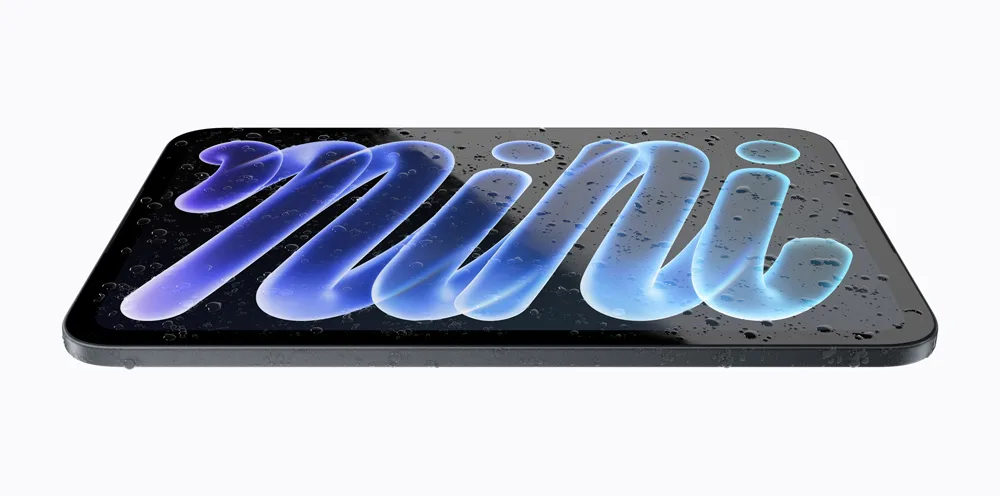
Thin usually means fragile. Apple went the other way: 5.4 mm thin and lighter than before, with an IP67 rating that covers a meter of water for 30 minutes. That is the first water resistance rating the mini has ever carried, and it changes where the tablet can go: rainy-day field work, poolside reading, a boat deck. The rating is tested in a lab and resistance fades with wear, so it is protection against accidents, not an invitation to swim with it.
The audio got a real redesign too. Apple built speakers into the display itself, with woofers paired through the screen for bass and tweeters hidden between the glass and the enclosure. The 12MP Center Stage camera moved to the landscape edge for video calls, and the rear 12MP camera gains an Adaptive True Tone flash for better document scans. Connectivity jumps to Wi-Fi 7, Bluetooth 6, and Thread through Apple’s N1 chip, while cellular models get the C2 modem with up to 50 percent faster cellular data and eSIM.
The price conversation
Here is the part that complicates the story. The previous mini started at $499. This one starts at $699, a $200 increase. The 11-inch iPad Air starts at $599. So the smallest iPad now costs $100 more than a larger, keyboard-friendly Air. Apple is betting that portability, OLED, and IP67 are worth that higher price, and for the people who buy minis specifically because nothing else fits in a jacket pocket or a flight bag, that bet probably holds.
Storage runs 128GB, 256GB, and 512GB. Education pricing starts at $649. The new TechWoven Smart Folio costs $79, Apple Pencil Pro is $129, and the USB-C Pencil is $79. Pair it with a travel keyboard if you plan to write on it, and it earns a spot in my packing list for the next trip. For everyone else, the honest advice is to wait for a hands-on look before paying the higher price, because the screen and the size are the whole pitch, and both are things you should see in person first. Full details are on Apple’s iPad mini page.
Questions People Ask About the New iPad Mini
Should I upgrade from the iPad mini 7?
If your mini 7 still handles reading, notes, and video without complaint, the upgrade case rests on three things: outdoor visibility, AI headroom, and water resistance. The OLED screen at 1200 nits is the visible difference. The A20 Pro matters if you keep tablets for years. IP67 matters if your tablet goes near water. If none of those three applies to you, the $200 price increase is a reason to wait for a sale or a hands-on demo first.
Mini or Air for travel?
Pick the mini if one-handed use, a jacket pocket, and water resistance matter more than screen size. Pick the Air if you type for hours, because the Air supports the Magic Keyboard and the mini does not; it gets the Smart Folio cover instead. The mini wins the bag test. The Air wins the desk test.
Is the cellular model worth $150 more?
The cellular model costs $849 against $699 for Wi-Fi, a $150 gap. It earns that gap if you work outside Wi-Fi range, travel internationally with eSIM plans, or want the faster C2 modem speeds. If the tablet mostly lives on home Wi-Fi and your phone’s hotspot, save the $150 and put it toward the Pencil or the Folio.


