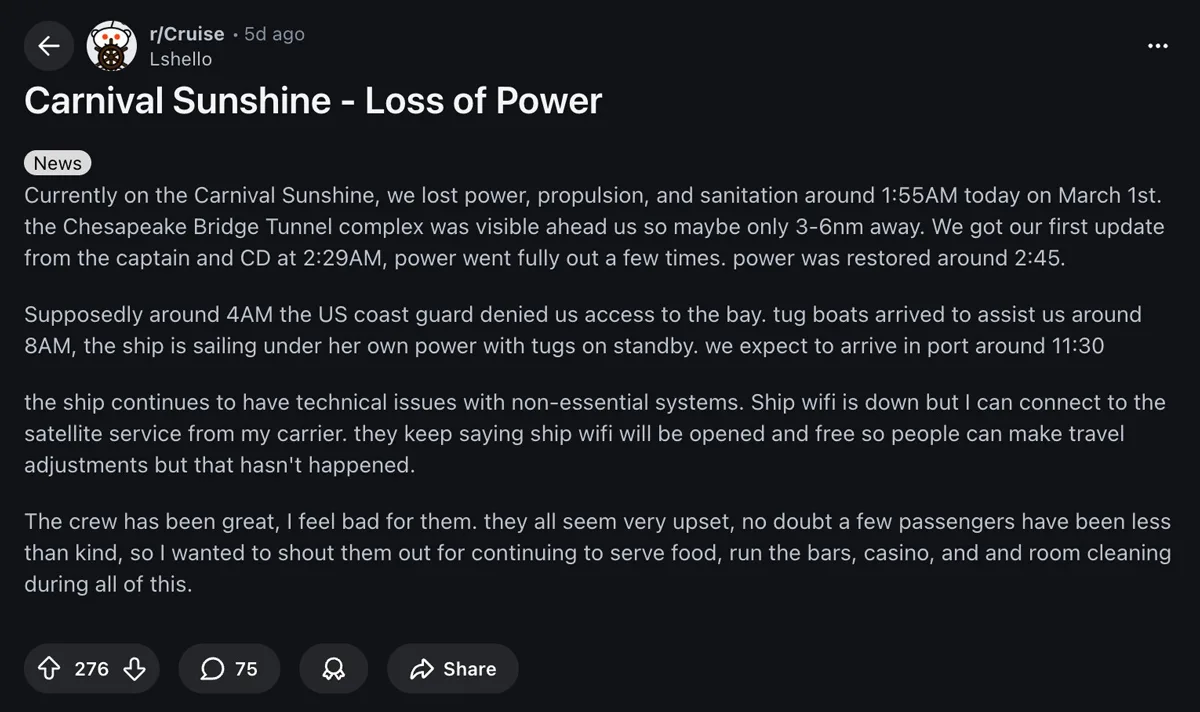
In the early hours of March 1, 2026, the Carnival Sunshine lost power, propulsion, and sanitation while returning to Norfolk, Virginia — just a few nautical miles from the Chesapeake Bay Bridge-Tunnel. For about an hour, 3,000 passengers sat in the dark while the ship drifted, with power cutting out multiple times before engineers restored it around 2:45 AM.
Nobody got hurt. Power came back. Tugboats were called as a precaution. The next group of cruisers waited an extra five hours in the terminal, everyone was offered $25 to cover lunch, and by Sunday evening Carnival Sunshine had departed for the Bahamas like nothing happened.
And yet.
There’s a reason “Carnival Sunshine power outage” spread across cruise forums and Reddit threads before most passengers had finished their morning coffee. There’s a reason comment sections filled up with jokes about biohazard bags and red-bagged “deposits.” That reason has a name: Carnival Triumph. Or, as the internet has permanently branded it, the Poop Cruise.
For those who need the refresher — the disaster began on February 10, 2013, when an engine fire fried the ship’s electrical cables, leaving Triumph adrift in the Gulf of Mexico with no propulsion, no working toilets, and limited power for four days before the vessel was finally towed into Mobile, Alabama.
Carnival Triumph eventually got a $200 million renovation and a new name: Carnival Sunrise. Cruise And the Carnival Sunshine — originally launched as Carnival Destiny before its own extensive refurbishment — is Triumph’s class sibling. Both are part of what Carnival now markets as the Sunshine Class. So when Sunshine loses power near a port entrance in the middle of the night, people notice. The connection may be circumstantial and the circumstances entirely different, but the optics land hard.
To be fair, Carnival’s response this time was measured. Engineers restored power within roughly an hour, and the captain made a ship-wide announcement before 2:30 AM, with U.S. Coast Guard protocols then requiring tugboat assistance before the vessel could dock. Cruise Hive Carnival communicated clearly with incoming guests and offered onboard credit. Passengers who were on the ship praised the crew throughout. One Redditor noted that while some passengers had been “less than kind,” the crew kept food service, bars, and housekeeping running through the entire ordeal.
That’s meaningful. It’s not 2013.
But the cruise industry has a long memory problem, not among executives, but among the traveling public. Every time a Carnival ship loses power near a port, the Triumph comparison surfaces immediately. It doesn’t matter that modern ships are dramatically better equipped, or that a one-hour outage bears no resemblance to a four-day disaster. The narrative has been set for over a decade, and Netflix made sure it would stick with its 2025 documentary Trainwreck: Poop Cruise, which recounted the incident through passenger footage and exclusive crew interviews.
The Carnival Sunshine has had a complicated recent stretch. A CDC inspection in March 2025 initially scored the ship an 89 out of 100 before being bumped to a 91 after engineers addressed the flagged issues. Cruise None of that indicates systemic failure, but it’s context that accumulates.
Carnival’s Norfolk operation is also worth watching in its own right. The port has grown significantly as a Mid-Atlantic cruise hub, and a delayed embarkation affecting thousands of guests ripples well beyond the terminal, into hotel bookings, travel connections, and itinerary adjustments that a $25 credit doesn’t fully cover.
The ship has not disclosed the cause of the outage, and according to tracking data, Carnival Sunshine is currently heading south toward the Bahamas at full speed. Cruise Fever No ports have been dropped as of this writing, and the line has said little publicly about the root cause — standard practice until a formal investigation concludes, but frustrating for passengers who deserve transparency.
What remains is a reminder that cruise lines, for all their marketing polish, are operating floating cities on open water. Complex systems fail. Engineers fix them. Most experienced cruisers understand this. The question Carnival continues to navigate — more than a decade after Triumph — is whether the industry has done enough to help the broader public distinguish between a manageable incident and a genuine disaster.
Right now, the answer appears to be: not quite.