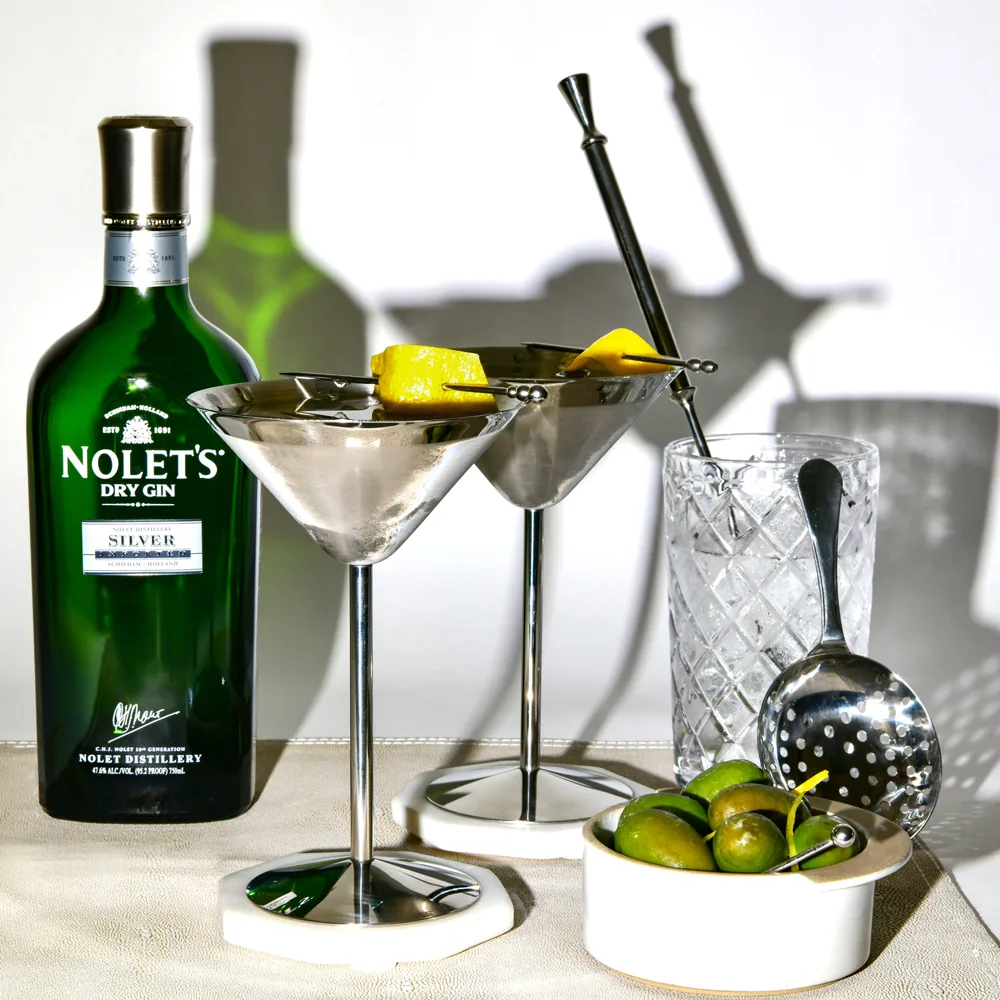
Most cocktail writers will tell you not to make a martini with NOLET’S Silver Gin. The Dutch distillery’s fruit-and-floral profile is supposed to wrestle with vermouth, soften the drink’s spine, and miss the point of what a dry martini is. I made one anyway. It worked.
That’s the short version of how I feel about this bottle. The longer one starts in Schiedam, the Dutch town that has been making gin since before the United States existed, with a family that has been distilling for eleven generations.
Eleven Generations of Dutch Distilling
The Nolet family has been running their Schiedam distillery since 1691. That’s the oldest operating distillery in the Netherlands, and in a country whose entire identity is wrapped up in jenever, that means something. If the name sounds familiar but you can’t place it, that’s because the same family also created Ketel One Vodka. The wheat-based smoothness Ketel One built its reputation on is the same baseline that defines NOLET’S Silver Gin, which the family launched around 2010 as a deliberate move away from London Dry tradition.
Carolus Nolet Sr., the 10th generation master distiller, developed the recipe with his sons Carl Jr. and Bob, who represent the 11th generation. Every batch still gets personally tasted and signed off by a member of the family before it leaves the building. That’s not marketing copy. It’s how the place actually runs.
Three Botanicals That Pull Juniper Off the Throne
NOLET’S Silver is built around Turkish Damask rose, white peach, and raspberry. Juniper is in there too, but it’s been pushed into a structural role rather than the leading one. That’s the entire reason this gin is controversial.
The rose gives it a perfume-forward top note that hits you the second you crack the bottle. White peach carries the mid-palate with a fleshy, almost orchard-fruit roundness, no actual sugar involved. Raspberry closes things out with a bright, slightly tart finish that doesn’t go cloying. The whole thing reads like a fruit and floral bouquet first, gin second.
What makes it work technically is how it’s made. Instead of charging every botanical into the still at once the way traditional London Dry production handles it, NOLET’S distills each of its signature botanicals separately in copper pot stills. Each one gets its own maceration at its own temperature, so the delicate volatile oils don’t get scorched into bitterness. Those concentrated essences are then blended into premium wheat spirit and given several days to marry before bottling.
It bottles at 47.6% ABV. On paper, that’s a serious proof, well above the 80-proof gins most American shelves carry. In the glass, you’d never guess. The heat is masked behind the fruit so thoroughly that it drinks like something at a much lower strength, which is part of why it holds up so well to dilution.
The Martini Question
Here’s where the cocktail community starts arguing. The traditional dry martini is a structural drink built on juniper and herbal vermouth. NOLET’S Silver doesn’t really cooperate with that framework. Its rose and peach can push against the botanical backbone of a classic vermouth, and the purists aren’t wrong to flag it. The phrase you’ll hear is “too pretty,” sometimes “more flavored vodka than gin.”
I made one anyway. And I liked it. Calling it a textbook dry martini is a stretch. Calling it a great cocktail isn’t. If you go in expecting a bone-dry London Dry martini, you’ll be disappointed. If you go in expecting a martini-shaped cocktail with personality, you’ll find it. The purist critique is fair on its own terms. I just don’t share it.
The other applications are where this gin really doesn’t need defending. A French 75 is one of the better arguments for it, because the citrus, sugar, and champagne lift the floral notes instead of fighting them. The same goes for an Aviation, where the maraschino and crème de violette pull the rose and peach into focus rather than competing with them. A Gin Fizz takes on a different shape entirely. The pattern is clear: pair this gin with acidity, fruit, or carbonation, and it sings. Drop it into a bone-dry, herbal context and the seams show.
How to Drink It
If you’re not in a mixing mood, the distillery’s own recommended serve is a good one. Pour it over a large ice format, top with a clean tonic that isn’t loaded with sugar, and finish with a wide slice of ruby grapefruit or a bruised sprig of rosemary. Skip the lime wheel. The peach and rose do their best work when nothing else is competing for the top of the nose.
It’s not a cheap pour. NOLET’S Silver sits firmly in the premium tier, which puts it in the same neighborhood as bottles like Monkey 47 and well above any London Dry workhorse you’d grab for a Tuesday gin and tonic. That price tag makes it a deliberate bottle, the kind you reach for on a Friday rather than every night.
But it earned a spot on my bar. The martini purists will probably still grumble. I’m fine with that.