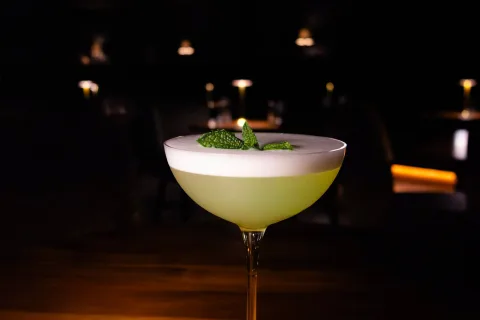
I order a Paper Plane almost every time I sit down at 1818 Chophouse in Edwardsville. It comes out in a coupe the color of dried apricot and does the one thing I want from a pre-steak cocktail, which is wake my palate up instead of coating it. If you order this drink out and keep meaning to build one at home, the good news is that it’s four ingredients in equal parts and takes ninety seconds. The catch is that three of the four are bottles you have to go buy, and one of them runs about $50.
September is Bourbon Heritage Month, which is as good a reason as any to decide which bourbon lives in that rotation. Blade and Bow sent its Paper Plane recipe over, and once the bottles are on your shelf you’re making a $15 cocktail for roughly $4.40 a glass. That’s the whole pitch.
What goes in a Paper Plane
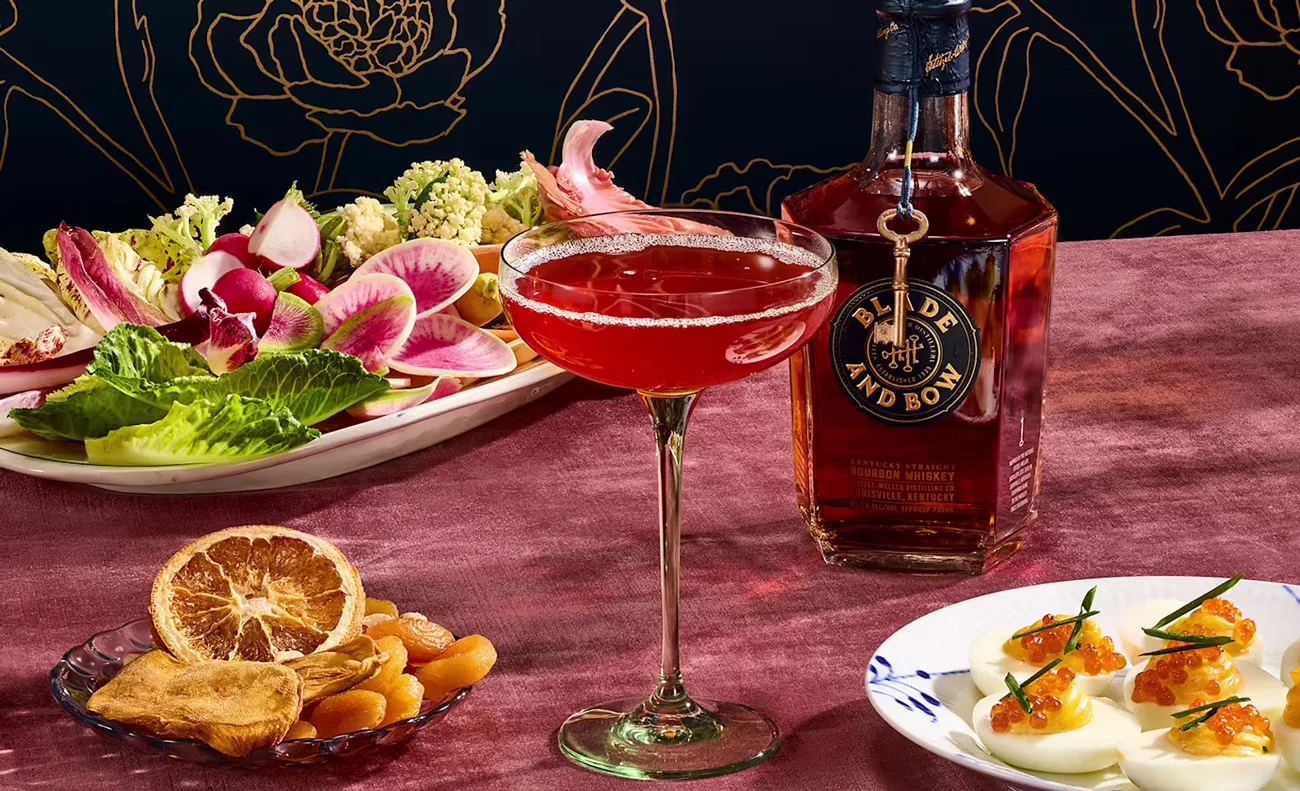
A Paper Plane is equal parts bourbon, Amaro Nonino, Aperol, and fresh lemon juice, shaken with ice and strained into a chilled coupe. That’s it. No syrups, no bitters, no muddling. The standard home build is 0.75 oz of each, which lands you a drink just under three ounces before dilution.
Blade and Bow’s version keeps that structure and specifies its own 91-proof Kentucky straight bourbon in the whiskey slot:
- 0.75 oz Blade and Bow Kentucky Straight Bourbon
- 0.75 oz Amaro Nonino Quintessentia
- 0.75 oz Aperol
- 0.75 oz fresh lemon juice
- Lemon twist
Directions:
Cut a long strip of lemon peel first and set it aside, keeping as little white pith on it as you can. Combine everything in a shaker with ice, shake hard until the tin frosts, and strain into a coupe. Express the peel over the surface so the oils land on the drink, then drop it in. The International Bartenders Association actually calls for no garnish at all, but every bar I’ve had one in serves it with the twist, and the citrus oil is worth the extra ten seconds.
Why the bourbon slot is a real decision
The bourbon is only a quarter of a Paper Plane, and it’s sharing the glass with a 35% ABV grappa-based amaro, an 11% ABV aperitif, and an ounce of lemon juice. That’s a lot of competition for one pour. An 80-proof bourbon that reads sweet and soft on its own tends to vanish under the Nonino, and what you’re left with is a bitter citrus drink with a vague whiskey note behind it.
Blade and Bow bottles at 91 proof, or 45.5% ABV, which is eleven proof points above the standard shelf pour and enough to still register once the shaker adds its water. I haven’t put this bottle in a shaker myself yet, so I can’t tell you how the apricot and pear notes it’s known for behave against Aperol’s grapefruit edge. What I can tell you is that proof is the first spec I check when I’m picking a bourbon for a drink that’s built to fight it, and 91 clears the bar.
What Blade and Bow actually is
Blade and Bow is a Diageo bourbon produced at the original Stitzel-Weller site in Louisville, the distillery that closed in 1992 and reopened as a working facility in 2014. It uses a solera aging system, which is rare in American whiskey and common in Spanish brandy: older stock, including some of the last bourbon distilled at Stitzel-Weller, gets mingled with younger whiskey in a tiered setup where no barrel is ever fully emptied. The name refers to the two parts of a skeleton key, and each bottle ships with one of five collectible keys representing grain, yeast, fermentation, distillation, and aging. Collect all five and you can join the Five Keys Club at the distillery.
The real twist happened in 2008
The Paper Plane came from Sam Ross in 2008, built for Toby Maloney’s opening menu at The Violet Hour in Chicago. Ross took the equal-parts skeleton of the Last Word, the pre-Prohibition drink of gin, green Chartreuse, maraschino, and lime, and replaced all four ingredients: bourbon for gin, lemon for lime, Amaro Nonino for the Chartreuse, and Campari for the maraschino. He named it after the M.I.A. song that was everywhere that year.
Then he tasted it and decided it was too bitter, and swapped Campari for Aperol within days. That single substitution is what gave the drink its orange color and its grapefruit softness, and it’s the version that got added to the IBA’s official cocktail list in 2020. If you want a genuine variation to try, make the original with Campari once. It’s a sharper, drier drink, and it explains why Ross changed his mind.
What it costs to build at home
A 750ml bottle holds just over 25 ounces, so at 0.75 oz per drink you get about 33 pours out of each bottle. Run the numbers on the three you need:
Blade and Bow at $54.99 works out to $1.67 a drink. Amaro Nonino, which runs $48 to $57 depending on where you shop, adds about $1.52. Aperol at roughly $27 contributes $0.82. Call the lemon 40 cents. Total: about $4.40 in the glass, against the $14 to $16 most bars charge for the same drink.
The buy-in is the part nobody mentions. You’re spending around $132 to walk out of the store with all three bottles, and the Nonino is the gate, not the bourbon. If you’re on the fence, that’s the bottle to think hard about, and the good news is that Nonino also makes a Nonino Manhattan worth the shelf space and drinks fine on its own over one big cube.
If you can’t find Amaro Nonino
Nonino is lighter and less aggressively bitter than most amari, which is precisely why it works here. Amaro Meletti is the closest easy substitute and pushes the drink sweeter, toward baking spice. Montenegro brings more orange and a lighter body. Ramazzotti is darker and more medicinal and will bulldoze the Aperol. All three make a drink. None of them make a Paper Plane, and I’d rather order the real one out than approximate it at home.
I’m going to build this with the Blade and Bow and see whether the solera fruit notes survive the lemon, and I’ll report back. If you’ve got a house bourbon you’ve settled on for Paper Planes, tell me what it is in the comments. I’m always looking for a reason to buy another bottle.
Questions people ask about the Paper Plane
Do you shake or stir a Paper Plane?
Shake it. Any cocktail containing citrus juice gets shaken, because shaking aerates and emulsifies the juice in a way stirring can’t. Stirring is for spirit-only drinks like a Manhattan or a Negroni. Shake this one hard for about twelve seconds, until the outside of the tin is too cold to hold comfortably, then double-strain if you want it perfectly clear.
How strong is a Paper Plane?
Stronger than it tastes, which is the trap. Before dilution the mix sits near 23% ABV, and after a proper shake it lands somewhere around 17%, roughly triple the strength of a beer in a three-ounce glass. The lemon and the Aperol make it go down like something lighter. Two is a fine evening. Three is a decision.
What does a Paper Plane taste like?
Bittersweet and citrus-forward, with the bourbon underneath rather than on top. The Aperol brings grapefruit and orange peel, the Nonino brings caramel, licorice, and mountain herbs, and the lemon keeps the whole thing from going syrupy. If you like a Last Word or an Aperol spritz but want something with more backbone, this is your drink.
Is Amaro Nonino worth buying just for this?
If the Paper Plane is the only drink you’d make with it, $50 is a lot of money for one cocktail. The bottle earns its place if you also drink Nonino Manhattans, which swap it in for sweet vermouth alongside rye and bitters, or if you’ll pour it over ice after dinner the way it’s meant to be drunk in Friuli. Otherwise, keep ordering the drink out.