My Osmo Pocket 3 has been the camera in my jacket pocket on every sailing for two years, not because it’s rugged, but because a 1-inch sensor makes footage look like it came from something bigger than it is. GoPro just built its first camera with that same sensor size, and it took the company until 2026 to get there. If you shoot travel or cruise content and you’ve been choosing between a GoPro for durability and something like the Pocket 3 for image quality, that gap just got a lot smaller, and it’s worth understanding exactly what changed before you spend $600 finding out.
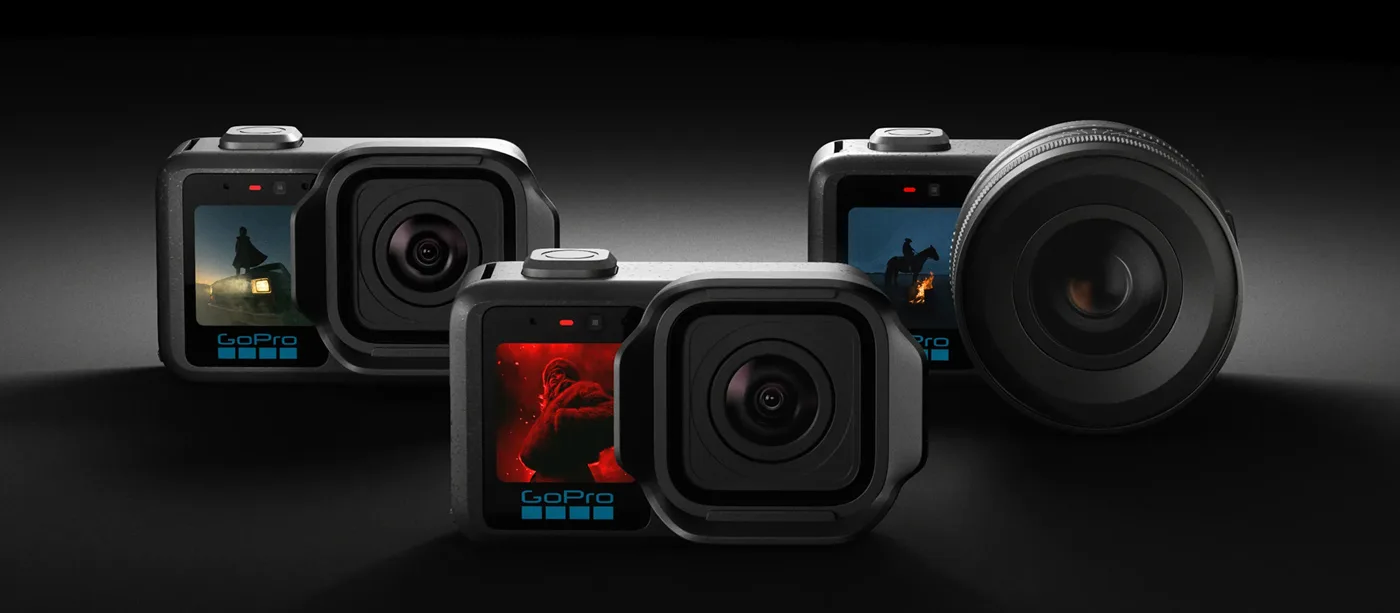
The MISSION 1 line launched May 28 in three versions. The base MISSION 1 runs $599.99 ($499.99 if you’re a GoPro subscriber), the MISSION 1 PRO adds higher frame rates for $699.99 ($599.99 subscriber), and the MISSION 1 PRO ILS, GoPro’s first interchangeable-lens camera on a Micro Four Thirds mount, arrives later this year at the same $699.99 price point. All three share a 50-megapixel, 1-inch sensor, which GoPro says is roughly four times the sensor area of the HERO13 Black’s 1/2.3-inch chip.

What actually changed from the HERO line
The sensor is the headline, but a few other numbers tell the real story. The MISSION 1 PRO weighs about 208 grams versus 159 for the HERO13 Black, and it’s noticeably bigger in hand. The rear screen grew to 2.59 inches from 2.27. Native waterproofing jumped to 20 meters from 10, no housing required. Top video specs climbed to 8K60 and 4K240 on the PRO, up from the HERO13’s ceiling of 4K120. Audio got a real upgrade too: four microphones with 32-bit float recording and support for generic USB-C mics, instead of relying entirely on GoPro’s own accessory ecosystem.
None of that is small. But it’s also worth saying plainly what GoPro didn’t fix. There’s no autofocus in the traditional sense. The MISSION 1 and PRO have a fixed-focus lens, and the ILS only works with fully manual lenses since there’s no electronic communication between body and glass. There’s no built-in ND filter, no cloud or NAS backup, and if you own older GoPro gear, the news is mixed: your HERO13 mounts, magnetic charging door, and batteries still work, but the ND filters, macro lens, anamorphic lens, and dive cases in your accessory drawer do not.
How it stacks up against the camera I actually carry
Here’s where owning a Pocket 3 is useful instead of just anecdotal. DJI put a 1-inch sensor in a compact gimbal camera back in October 2023, so GoPro closing that gap in 2026 isn’t a leap ahead of the category, it’s a catch-up move into where DJI already was. My Pocket 3 also weighs 179 grams with a full 3-axis mechanical gimbal built in. The MISSION 1 PRO weighs 208 grams with no gimbal at all, leaning entirely on GoPro’s digital HyperSmooth processing instead. That’s a real tradeoff: GoPro’s version survives a wave breaking over it and the Pocket 3’s doesn’t, but you’re carrying more weight for stabilization software instead of moving parts.
Reviewers who’ve had production units in hand for a few weeks now are largely landing in the same place on image quality: 8K daylight footage is a clear step up from the HERO13, low light is improved, and the battery life is close to what GoPro claims, in the neighborhood of three hours at 4K30 and closer to ninety minutes at 8K30. The pushback is consistent too. RAW photos are locked to the ultra-wide fisheye lens with no zoom option, RAW processing runs about a second per photo, and more than one reviewer running the math found the PRO costs roughly $300 more than DJI’s cheaper Osmo Action 6 for gains that mostly show up above 4K, which is a lot of resolution most people will never export.
Who this is actually for
If you’re already shooting 4K and mainly need something that survives a pool, a slope, or a tender ride to a snorkeling stop, the price jump over a standard action cam is hard to justify on spec alone. The MISSION 1 line makes more sense if you’re producing long-form video where 8K crops for reframing in the edit, higher bitrate, and real microphone flexibility actually matter, which is closer to how I use a camera for sit-down segments than how most people use an action cam on a zipline. The ILS is its own conversation entirely. Manual focus only and no autofocus support means it’s a tool for someone who already knows how to pull focus by hand, not a beginner’s first interchangeable-lens camera, and not a stills camera at all given the fisheye-only, fixed-lens limitation on the other two models.
I’m not buying one on spec sheets alone, and neither should you. But the sensor jump tells you something GoPro hasn’t said outright: the company that built its identity on being small and disposable is now competing on image quality with cameras that were never built to survive a fall off a paddleboard. Whether that’s a smart pivot or a distraction from what actually made GoPro useful is the question I’d want answered with a camera in my hands, not a spec sheet.
Questions People Ask About the GoPro MISSION 1
Does the GoPro MISSION 1 have autofocus?
No. The MISSION 1 and MISSION 1 PRO use a fixed-focus lens with no autofocus system. The MISSION 1 PRO ILS accepts interchangeable Micro Four Thirds lenses, but only fully manual ones, since there’s no electronic communication between the lens and body.
How does the MISSION 1 compare to the HERO13 Black?
The biggest change is sensor size: a 1-inch, 50MP sensor versus the HERO13’s 1/2.3-inch chip, about four times the surface area. It’s also heavier (208g versus 159g), has a larger 2.59-inch screen, native waterproofing to 20 meters instead of 10, and tops out at 8K60 versus the HERO13’s 4K120.
Is the MISSION 1 PRO ILS worth it?
Only if you already shoot manual focus and want a rugged, compact interchangeable-lens body. Lenses need to be fully manual since there’s no autofocus communication, and it isn’t natively waterproof like the fixed-lens models. It’s a niche tool for experienced shooters, not a first camera.
What’s the price difference between MISSION 1 and MISSION 1 PRO?
The MISSION 1 starts at $599.99 ($499.99 for GoPro subscribers) and the MISSION 1 PRO is $699.99 ($599.99 for subscribers). The PRO adds higher frame rates, up to 8K60 and 4K240, along with a higher max bitrate and 10-bit color options.
Will my old GoPro accessories work with the MISSION 1?
Some will. HERO13 mounting adapters, the magnetic charging door, and existing batteries are compatible, though fast charging only works with the new charger. Older ND filters, the macro lens, anamorphic lens, Max Lens Mod 2.0, the previous Media Mod, and dive cases are not compatible.


