I’ve been on more than 50 cruises. I’ve sailed the Caribbean in hurricane season, transited the Panama Canal, taken expedition ships to Alaska, and got off ships in ports where the tap water was off-limits. In all those years, the list of things I’ve worried about looks pretty mundane: norovirus, a missed flight to the embarkation port, the occasional rogue wave, and whether the buffet shrimp has been sitting out too long.
Hantavirus has never been on the list. After spending the last few days digging through CDC, WHO, and ECDC data, I can tell you it shouldn’t be on yours either.
Then the MV Hondius story broke, and suddenly my inbox filled up with friends and family asking if cruising was now dangerous. So let’s get into the data, because the answer is more reassuring than the headlines make it sound.
What Actually Happened on the Hondius
The MV Hondius is a 196-passenger Dutch-flagged expedition vessel, the kind of small ice-strengthened ship that runs multi-week polar voyages with shore landings. In April 2026, it left Ushuaia, Argentina with 147 people aboard for an itinerary covering Antarctica, South Georgia, Tristan da Cunha, Saint Helena, and Ascension Island. By early May, eight passengers had been sickened with hantavirus and three had died. Spanish authorities prepared for the ship’s arrival in the Canary Islands. The CDC issued a Level 3 emergency response, which is its lowest activation tier.
The strain involved is Andes virus, the only hantavirus on Earth that can spread person-to-person. The leading theory from WHO and Argentine health officials: the index passenger and his wife were already infected on land, during a four-month road trip across Chile, Uruguay, and Argentina before they ever stepped foot on the ship. WHO’s Maria Van Kerkhove was direct about it. This is not a virus that spreads like flu or COVID. Most people will never be exposed to this.
The Hondius outbreak is the first hantavirus cluster ever documented on a cruise ship. Ever. We are talking about a sample size of one in the entire surveillance history of the disease.
The Numbers That Actually Matter
Hantavirus is one of the rarest serious infectious diseases an American can plausibly encounter. The CDC has logged roughly 890 lab-confirmed cases in the United States across 30 years of surveillance, from 1993 through 2023. That works out to somewhere between 15 and 40 cases a year, in a country of 335 million people. The 2023 total was 26.
To put that in perspective, your annual odds of getting hantavirus in the U.S. are roughly one in 13 million. Lightning, car accidents, and choking on a Cheez-It are all more likely.
It’s also geographically concentrated. Ninety-four percent of U.S. cases occur west of the Mississippi, with the Four Corners states doing most of the heavy lifting. Plenty of states have reported zero or single-digit cases in three decades.
Here’s the part that does deserve respect: when hantavirus does hit, it hits hard. Hantavirus Pulmonary Syndrome carries a case-fatality rate of about 35 to 38 percent in North America, and Andes virus can run as high as 50 percent in South America. There is no approved antiviral and no licensed vaccine in the U.S. or Europe. Treatment is supportive, which is medical-speak for ICU care and crossed fingers.
So the honest framing is this: hantavirus is incredibly serious if you get it, and almost impossible to get unless you’re doing something specific in a very specific place.
Why Cruise Ships Are Not Hantavirus Environments
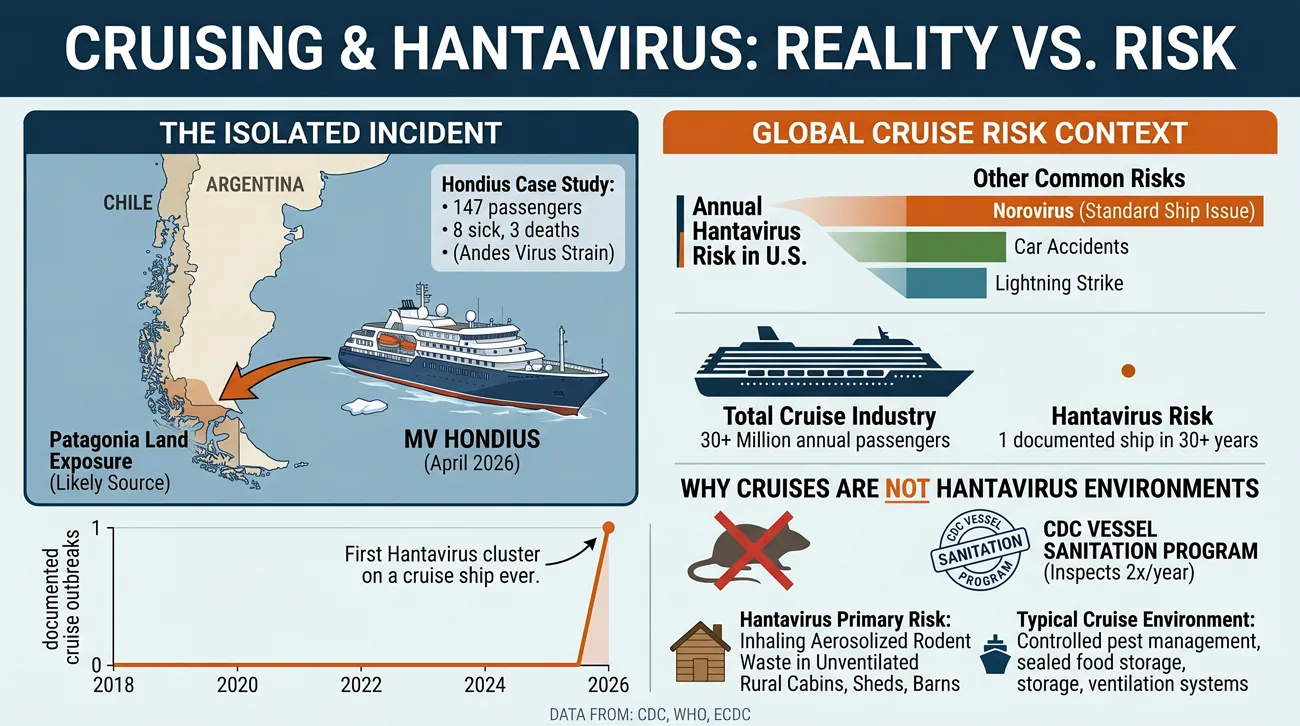
The way you actually catch hantavirus is by inhaling aerosolized urine, droppings, or saliva from infected wild rodents, usually after disturbing dust in an enclosed, poorly ventilated space. Think a hunting cabin that was closed up for the winter, a barn nobody has cleaned in months, or a remote outbuilding with mouse nests in the insulation. The 2012 Yosemite outbreak happened because deer mice had built nests inside foam wall insulation in specific Curry Village tent cabins.
A modern cruise ship is nothing like that. The CDC’s Vessel Sanitation Program inspects ships at U.S. ports twice a year unannounced. Pest control is a graded category. Rat guards are standard on mooring lines. Food storage is sealed. Industry pest consultants describe ships as having traps everywhere, with no rodents typically caught. The wild rodent reservoirs that carry the dangerous hantavirus strains, like deer mice and South American rice rats, do not live on cruise ships. They live in piñon-juniper woodlands and Patagonian grasslands.
Even on the Hondius, the cruise operator told WHO there were no rats on board.
The One Realistic Caveat
If you are booking a small-ship expedition cruise that visits remote South American ports or includes shore excursions in rural Patagonia, take rodent exposure seriously on land. Avoid sleeping in cabins or sheds with visible droppings. If you do encounter rodent waste, wet it down with disinfectant before cleaning and wear an N95 and gloves. This is not cruise-specific advice. It’s the same guidance you’d follow for any rural ecotourism in an endemic region.
For everyone else booking a Caribbean week, a Mediterranean run, an Alaska sailing, a Norwegian fjords trip, or a transatlantic crossing, the CDC’s exact words on the situation are worth reading. Routine travel can continue as normal. The agency assesses the risk to the American public as extremely low. WHO has explicitly advised against any travel restrictions. ECDC put it at very low.
My Honest Take After Reading All of It
The Hondius story is awful. Three people died on a vacation, and that deserves real coverage. It is also being absorbed by a public that has spent the last six years wired to read every novel-virus headline as the early innings of the next pandemic. That instinct is understandable. In this case, it’s also wrong.
Hantavirus has been killing 10 to 20 Americans a year, quietly, for three decades. The vast majority of those deaths happened in rural homes, sheds, and cabins. None happened on a cruise ship until April 2026, on a single 147-person expedition vessel running an itinerary that 99.9% of cruise passengers will never book. The CDC, WHO, and ECDC are not telling people to cancel their trips. They are telling clinicians to know what to look for if a Hondius passenger walks into an emergency room.
If you were planning a cruise, plan the cruise. The realistic risks on board are still the same ones they’ve always been. Wash your hands. Skip the buffet salad bar if it looks like it’s been picked over. Get the flu shot before you sail in the winter.
Hantavirus on a cruise ship is, statistically speaking, the worst kind of lottery ticket. Real, serious, and so vanishingly unlikely that worrying about it is its own kind of cost.
All that being said, I’m still booking!
If you want to keep up-to-date on all things cruising, go check out my byline on Cruise News. We will be continually sharing important updates about Hantavirus there, so make sure you bookmark us!